
Donnacha Dennehy’s “Moire”
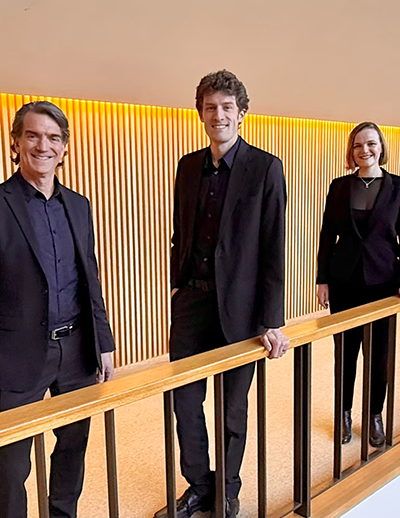
My practice as a musician has focused in a variety of ways, but one of the main avenues of performance and commissioning for me has been my violin/clarinet/percussion trio F-PLUS. Since our inception in 2017, we have premiered over 50 works for our instrumentation and performed around the country. I feel deeply that the music written for our group is meaningful and will find a place in the canon of mixed music for percussion. To exhibit one of the best works written for our group at PASIC would be an honor.
Donnacha Dennehy is an Irish composer whom I have long admired. As a recent Grammy nominee and Princeton University professor, Dennehy is an in-demand voice in the music world and often combines elements of his Irish heritage with his post-minimalist and spectrally influenced writing. Both of my dad’s parents were from Belfast, Northern Ireland, and I have, for years, dreamed of asking Dennehy to write a piece for F-PLUS connected to the Troubles, a period of political unrest and violence in Ireland in the second half of the 20th century. This affected my family, and I thought a piece connected to an important historical period could be meaningful.
After our residency at Princeton in 2023, I approached Dennehy about writing for us with this idea in mind. We received a grant from the Koussevitzky Foundation at the Library of Congress to commission the work titled Moire, which looks at patterns that cross and divide and, as Dennehy writes in the program notes, “Together, more is possible, as it were.” A reflection on division and unity is uniquely embodied in Moire, a major work from one of today’s great composers.
Why is this work part of an “individualized practice”? Written for my unique group that I love, by a composer I have admired for many years, and tied to a period of upheaval that affected my family, this piece feels very personal and represents the things I love most about music: collaboration and unity in divided times.