
← Back to Artists
Dream Balm
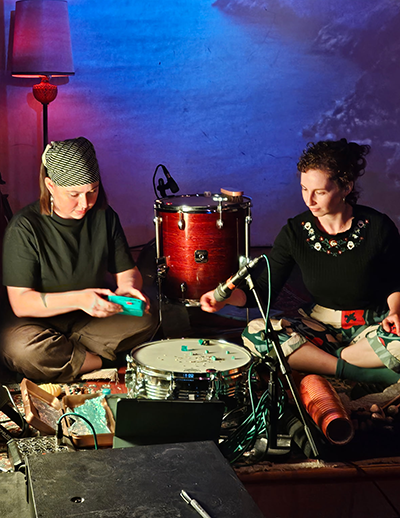
Dream Balm is the sonic expression of the friendship between Sophie Chin and Rose Martin. Their shared musical practices focus on embodiment, curiosity, intention, and play. They draw from experiences with percussion, piano, voice, teaching, caretaking, mythology, politics and social engagement, and improvisation. The container they play in converses with the following authors, whose work greatly informs this developing practice: Stóō author Jo-ann Archibald’s book Indigenous Storywork (2008), Lawrence English’s article “Relational Listening: A Politics of Perception” (2017), Michael Jones’ paper “Among Objects: Percussion Ontology, Mediation, and Violence” (2024), Potawatomi botanist Robin Wall Kimmerer’s book Braiding Sweetgrass (2013), and George Lipsitz and Barbara Tomlinson’s book Insubordinate Spaces (2019). As Dream Balm, they explore the intimacy of performance and engage audience connection through a lens of consent and care. Sharing sound and space is an act of love.

game: sound balm

New Music/Research
New Music/Research PresentsLive

“game: sound balm,” is a playful and intimate sound art performance that follows (and breaks) the rules of a dice-based game. We developed the game through a process of play, crafting the rules as we found processes and sounds within a collection of sonic objects to which we hold meaningful or sentimental connection. As we engage our convergent practices of chance operations, structured improvisation, instructional-based scores and/or prompts, prepared instruments, contact mic’ing, and speaking percussion, we integrate our shared personal practice of somatic embodiment. This practice encompasses the intimacy of touch between performer and sound object and gives attention to the reciprocity between object, sound, and human relationships. We ask: “What does this sound give me? What do I give my collaborator?”
On stage with “game: sound balm” our bare hands are often the implements. An intimacy of touch is expressed in each game action: we hold an object, move, watch, and hear. We listen in relation and respond to the vibration, resonance, or surprises gifted by the sounded object. Our practice of somatic embodiment also acknowledges the interrelatedness of our stories, and the many knowledges we bring into “game: sound balm.” We each are educators, care workers (hospitality, caregiving), and percussionists. We bring our experiences with loss and grief, chronic illness, religion and spirit, and our interconnection with more-than-human beings into “game: sound balm.” A personal practice of somatic embodiment as performing artists begins with the ways we listen to and treat our bodies before, during, and after a musical performance, asking: “what do I need to stay connected to my body on stage and off?” This includes a practice of self-compassion. We feel that, in the context of PASIC, it is critical to present a personalized practice that models somatic embodiment, one that reflects care, reciprocity, a deeper listening to the body, sonic object, and one another.