
The Capixaba Congo: Rhythm, Instrumentation, and Tradition
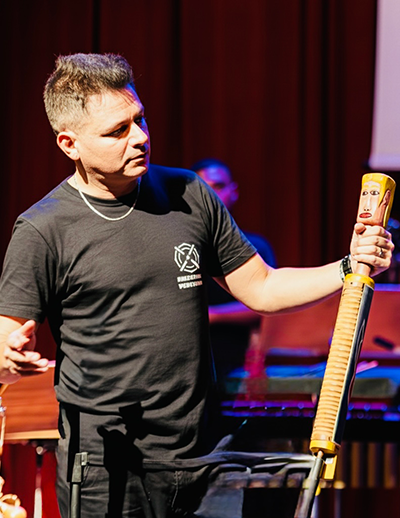
This study investigates the Congo bands of Espírito Santo through a qualitative approach, with an emphasis on instrumental formations, especially the use of drums and the casaca, articulated with historical contextualization, rhythmic cells, and the development of musical notation. Congo bands constitute a hybrid cultural expression that integrates music, dance, and religiosity, resulting from historical processes of cultural interaction. The research is developed using an action-research methodology, seeking to understand how these musical traditions are articulated and transformed over time.
The study provides a historical contextualization of the presence of these manifestations in the territory of Espírito Santo, where there are currently more than sixty Congo bands, identified through documentary records, public and private archives, and iconographic, sound, and audiovisual sources. The research analyzes the instruments used, characteristic rhythmic patterns and their regional variations, as well as the relationships between music, religiosity, and cultural identity.
In view of the scarcity of systematic studies on Capixaba Congo and its limited visibility in traditional music education, this work seeks to promote the appreciation of this cultural tradition through performance practice, emphasizing rhythmic patterns, instrumental performance, and the collective transmission of musical knowledge. The expected outcome is to contribute to the preservation of Afro-Capixaba intangible cultural heritage, strengthen dialogue between practitioners and researchers, and create a collection of sound and visual records to support future research on Congo bands in Espírito Santo.