
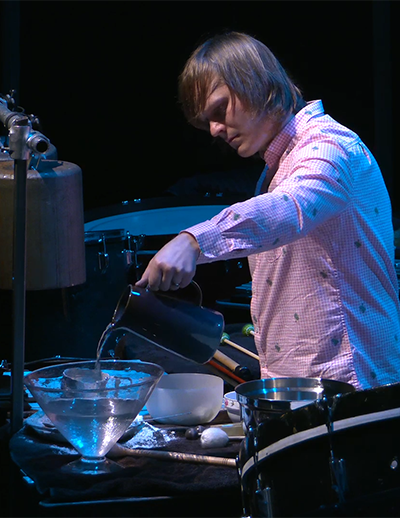
Exercise 32 – Christian Wolff
My progression as a musician developed through my roots in classical piano training, orchestral and marching percussion experience, 20th-century compositional training, and an inability to unhear the sounds of nature and objects in my day-to-day life. Recently, I have begun building my own instruments whenever possible to achieve the sounds I can hear within material objects. This practice has been incredibly educational in shaping my methods of sound generation and my general approach to instrument usage.
As a performing artist, I am highly dependent on the freedom to engage with written musical material on a compositional level and to find a collaborative path through the piece that satisfies both the intent of the composer and my own artistic desires. I strive to understand why and how material is placed together on a score in order to determine what is of vital importance to the artistic intent of the work. Using this knowledge, I often take liberties in the details when I believe it will better serve the overarching intent of the work.
Christian Wolff’s Exercise 32 satisfies nearly every element of my personal practice, as it leaves decisions such as instrumentation, choice of material, and sequence of those choices to be decided by the performer. These broad freedoms allow me to provide my own commentary on instrument and sonic combinations through the piece. While I fully believe the composition is entirely Wolff’s, I see my interpretation of this music as a collaboration between the written ideas and the living impulses of sound through time. I believe that it falls to me, as the actualizer of notated material, to generate that dialogue as earnestly and openly as possible, with the hope of creating an engaging performance.
Exercise 32 can be between 30 seconds and 20 minutes, depending on the version performed.