

A Guide to Balanced Buzz Rolls
A Guide to Balanced Buzz Rolls
by Drew Talley
Educators' Companion
Volume 9
No. 1
Fall
2026
General Philosophy
Buzz rolls are an essential rudiment that every percussionist will encounter in their music career. To be clear, the term “buzz roll” has several variants: multiple bounce, closed roll, triple bounce, pressure strokes, pressed roll, and crushed roll. In the grand scheme, these are all describing the same thing with slight differences in approach.
Each describes a sustaining tone, like any string or woodwind instrument. Snare drum is one of the most articulate instruments. Therefore, one must create the illusion of sustain by overlapping multiple strokes for each individual hand motion. In creating this illusion, the stick will have a different feel within the hand. This feel change is due to the stick staying in contact with the drumhead longer than typical single strokes.
To develop a consistent buzz sound, the player must have an equal number of bounces occurring in each hand motion. Developing an equal number of bounces requires the player to understand the balance of pressure between the thumb and first finger, downward stroke speed, and the touch needed from the middle finger making contact on the stick.
Roll density, or how many bounces per hand motion, is a highly debated subject within the percussion community. The minimum is three bounces per hand (triple bounce roll), as two bounces would be a double-stroke roll, and one bounce would be a single-stroke roll. However, depending on the dynamic level and the intensity of the desired roll, players could have five or more bounces per hand motion.
Buzz Notation
Notation for buzz rolls can be tricky. Frequently, composers use the same notation for both double-stroke rolls and buzz rolls. Therefore, the player must consider the background or context of the music. Generally, if it is not in a marching style or alluding to militaristic undertones, rolls in a band/orchestra/percussion ensemble are performed as buzz rolls. However, there are exceptions to this rule, one must always use their ears and best judgement. In more modern literature, composers will use a Z symbol on a note stem to indicate a buzz versus slashes on the stem (tremolo notation).
Another aspect of buzz rolls that is unclear is how to “fill up” the printed note duration of a roll to create the sustain illusion. There are two schools of thought on this subject: metered rolls, and unmetered rolls. Most percussionists agree that for shorter roll lengths, the player should have a prescribed rhythmic base with added buzz strokes. This is known as a roll-base or skeleton-rhythm, as it is the framework. For example, quarter-note length buzz rolls at 120 BPM will work well played as four 16th notes in each quarter-space duration. This is a metered roll. However, a fermata-roll, or other types of long extended note values, should be felt and filled up by ear to make it sound full and smooth, hence the unmetered roll. Of course one could mathematically determine a rhythm to maintain throughout, but most professionals are not as concerned in those contexts.
As mentioned previously, the roll-base is the underlying pulse of any roll. However, rarely is the roll-base written in the music. Percussionists must determine what rhythm is appropriate to fill up the printed note length. First consider the tempo, then be mindful of the dynamic needed. For example, when playing a whole note buzz roll at 160 BPM at a pianissimo dynamic, one should not use a 16th-note roll-base. A better solution would be to experiment with eighth notes as the underlying rhythm. This allows the hands to stay relaxed and is a smoother motion to control at that volume.
Generally, quiet dynamics will necessitate a slower roll-base versus louder dynamics. When altering dynamics, such as drying a crescendo or diminuendo, try modulating the roll-base to help achieve a silky sound void of tension. For novice percussionists, limit roll-bases to eighth notes, triplets, sixteenth notes, then expand to more advanced, odd-numbered, note groupings.
Physical Technique
It is helpful to think of the fulcrum to be in-between thumb and middle finger. This reduces unnecessary tension between the thumb and index finger. The index finger acts as a wall resisting the thumb pressure. The middle finger has a slight inward pull while making contact on the stick. This point of contact should be close to the finger-pad of the middle finger, as it helps counterbalance the thumb’s inward squeeze. The back fingers, ring and pinky, have minor supporting roles in comparison to the other three. Think of them as a cave, in which the stick can freely move.
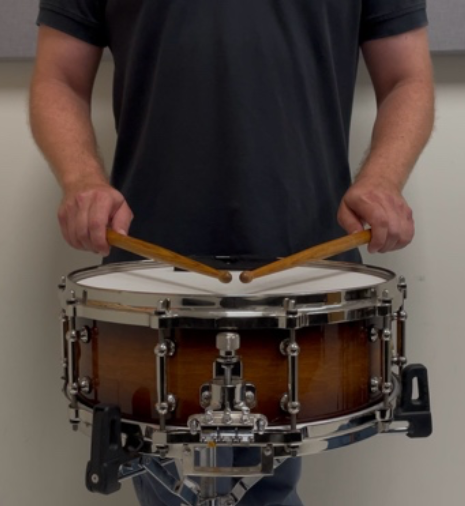
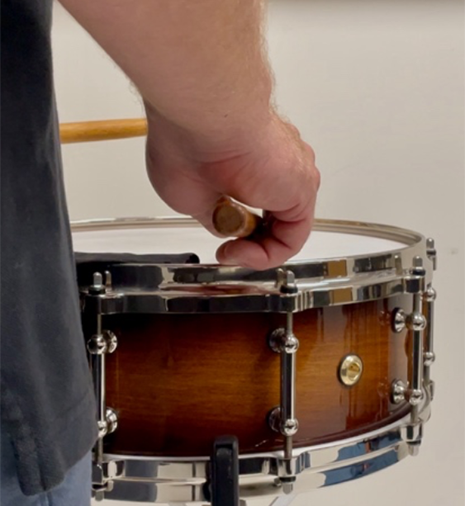
One common ailment of rolls is the lack of finger support on the stick. While finger support is essential, avoid white knuckles or fingernails from over-squeezing in the grip. Think of how much pressure one would use while holding a toothbrush brushing their teeth. Being more relaxed than tight is an ideal starting point regardless of the dynamic.
While players can develop a smooth roll using a combination of different muscle mechanics, this author recommends an arm-motion approach. The forearms smooth out and blend the sound from each hand motion. Generate the initial stick motion from the elbows, while the wrists remain in a fixed position. Ensure that the drum stand is at a proper height to allow the arms to have a slight downward angle.
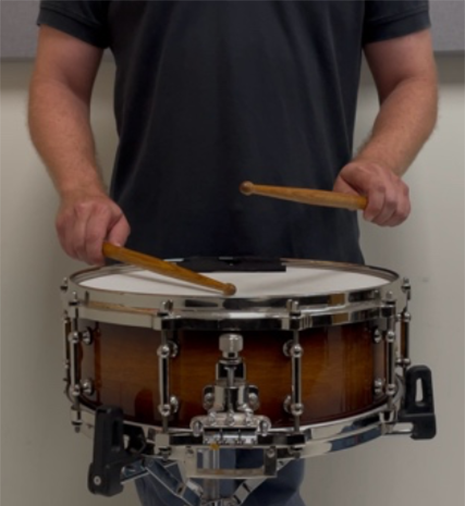
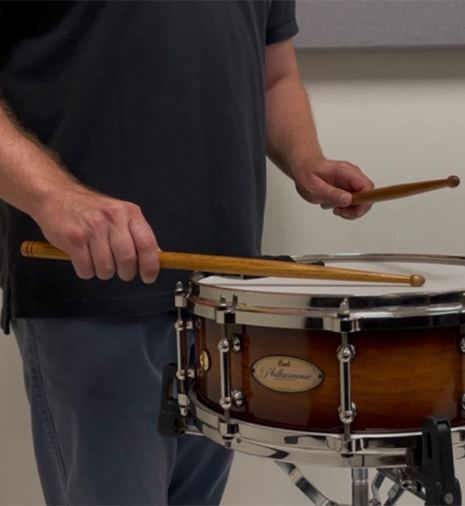
The downward stroke velocity has a direct correlation to the desired dynamic. An aggressive buzz roll will have a faster stroke speed than one at a quieter dynamic. Experiment with different rates of downward stroke momentum to see how it changes the stick interacting with the drumhead.
Getting Started
At first, strive for as many bounces as possible by allowing the stick to dribble out until it rests stagnant on the drumhead. The moment right before the stick stops moving on the head, you will notice a flurry of fast rapid bounces. This is the ideal buzz sound and should occur with a very relaxed grip on the stick. Lift off quicker from the drum to lessen the number of overall bounces. Then increase the downward stroke speed, as this feeling of forearm weight behind the stroke condenses the bounces tighter to one another thus recreating the buzz sound. As a reminder, the middle finger and thumb can add or reduce the number of bounces by adjusting the amount of squeeze. This process takes time, experimentation, patience, and muscle internalization as it is a balancing act.
Go slowly to clearly hear how many bounces each hand is achieving. If a player can match the number of bounces and get them to sound identical, the roll will sound balanced as the hand motion continues to get faster. To understand what is happening as the speed increases, recording a video in slow mo is a great tool. As the player progresses, they should aim for an identical feeling and motion from each hand.
Exercises
Students usually lack the awareness to know how to approach their roll development woes. Frequently one or two exercises are looped ad nauseam in hopes that it improves. The following exercises give students a variety of options, with clear intent, to help perfect their buzz roll. Exploring the recommended variations will add an extra challenge, even for an experienced player.
“Lift-Off” works the physical motion of the buzz stroke. Generate the motion from the elbow and allow the stick to bounce to the full note length. As the note length reduces, the player will have a faster downward stroke velocity as well as a faster lift, thus eliminating some bounces and compacting the others. Keep the fulcrum free from unnecessary tension to allow stick motion. As you gain awareness on how to control the bounces, strive to keep an equal number of bounces throughout the entire exercise. Listen for consistency within one hand then across the hands. For an added challenge, reduce rests between strokes.
“Three’s Builder” isolates the feeling of a triple bounce roll by working three note groupings. The player should feel more finger engagement in the slower sextuplet rhythm, while the forearm and elbow drive the nine-lets. The hand modulation helps blur the bounces into a realistic roll sustain. Remember, memorize the feeling of a triple bounce more than trying to count strokes. Often this exercise helps a roll open up from being too dense.
“Pressure Gauge” helps develop a deeper understanding of the touch sensitivity needed within the fulcrum, alongside with the weight of the downward stroke. Start from a tight dead stroke and gradually allow the buzz to breathe and transform into an open diddle-like buzz. In knowing the extremes of the buzz-roll spectrum, the player can find the middle ground easier.
“Buzz 8’s” works on the core elements of a roll. Look for consistent hand motion, consistent sound quality, and connected buzzes when the hands begin to alternate. This works well for novice percussionists or to quickly teach by rote. Experiment with different dynamic levels or by extending measures.
“Buzz Time Table” progresses a roll slow to fast by modulating through different rhythmic groupings. While the exercise can be overwhelming, it is important for students to become aware of the more elastic rhythms that are not as easily divisible against the beat or measure. Often these are the best roll-bases for a smooth sustain. At first, allow the stick to get as many bounces as possible until it rests on the drumhead. Wait to lift the resting hand until playing the next stroke. As the rhythm advances, each stroke needs fewer bounces, so the rate of lift will increase. Listen for consistency in the number of bounces and how fast or slow they occur. Experiment with this exercise in reverse or play without a metronome.
“16th & Triplet Roll Builders” expand upon constant buzz stroke groupings. One of the biggest benefits of this exercise is eliminating accented starts or ends of a roll. Since these groupings end with a buzz stroke, they are considered untied-buzz rolls. Avoid interrupting the stick motion as more strokes are added. Try the same exercise with five-lets and seven-lets as rhythmic bases.
“Isolated Buzz 16th & Triplets” merges the ability to morph single strokes into buzz stroke combinations with different roll-bases. Practice wrist strokes into forearm strokes without buzzes to isolate the mechanical motion needed. This exercise benefits from repetition as opposed to reading straight through. Use a subdivision on a metronome for timing accountability throughout the transitions.
“Dynamic Chicken & a Roll” is a revamp of a classic double-stroke roll exercise. The player must be able to transition between the single strokes and different roll lengths, in addition to the dynamic shading. Avoid accented starts or releases and resist physical grip changes as the dynamic shifts. Even for louder dynamics, keep the overall height of the roll low, use weight and downward velocity to increase the volume. Try with more moderate dynamics to work on consistency of dynamic control.
“Doug’s Challenge” is a conceptual exercise in which the player must develop the ability to control unmetered rolls, along with pushing their dynamic control to the limit. Create new levels of expression from experimenting with roll density, hand speed, and beating spot placement. Doug Howard, retired Principal Percussionist of the Dallas Symphony Orchestra, inspired this exercise.
Beyond the Technique
Here are a few additional tips to promote buzz development. Mirrors help ensure that the player lifts straight up and down, as well as having identical motions across the body. The author recommends dense, large-bead concert sticks over drumset-style, lighter small-bead sticks. Double check that the playing zone is directly over the snare wires to maximize snare response. While practicing, turn off the snare wires and dampen the drum for a better understanding of tone quality. For inexperienced players, playing near the rim can be easier to facilitate buzzes because the drum head is slightly more tense compared with the center.
Final Thoughts
Perfecting a buzz roll is a lifetime pursuit. Consistent practice, from a variety of exercises, will help achieve a balanced roll. Have a clear vision of the buzz sound before playing so that the hands can match the aural image. Go slow and internalize the feeling with regulated breathing. Playing metered and unmetered rolls and developing control over roll density at a variety of dynamics are essential elements. While there is no universal way to play buzz rolls, these techniques will guide the transformation of a buzz roll into a silky smooth sustain.
RELATED ARTICLES
Interpreting 6/8 Rolls
by Jeff Hoke
Percussive Notes
Volume 45, No. 1, February 2007
The Buzz Roll: Two Points of Pressure and Overlap
by James Vilseck
Percussive Notes
Volume 60, No. 6, December 2022
A New Approach to Teaching Snare Drum Rolls
by Andrew Spencer
Percussive Notes
Volume 31, No. 2, December 1992
Fine Tuning the Snare Drum Roll
by Pat Pfiffner
Percussive Notes
Volume 36, No. 4, August 1998
Drew Talley is an active music educator across the Dallas Fort Worth Metroplex. He’s been the Assistant Director of Percussion at Wylie HS, Flower Mound HS, and currently teaches within Allen ISD. As a Percussion Director, he led his students to Bronze and Gold medals at the UIL 6A State Marching Championship, in addition to being named Grand Champions at the BOA San Antonio Super-Regional. His lesson students have placed in the All-Region/Area Bands, including the TMEA All-State Band, as well as into competitive collegiate music programs. Mr. Talley has presented at East Texas A&M University’s Percussion Director Symposium, Southern California School Band and Orchestra Conference, and the National Conference on Percussion Pedagogy.
As a professional musician, Mr. Talley has experience performing orchestral, chamber, operatic, musical theater, and commercial music across the United States. He’s shared the stage with major artists on radio and national television. Former percussionist for entertainment companies; such as Disney, Six Flags Over Texas, and Busch Gardens-Williamsburg. Mr. Talley holds a M.M. in Performance from Carnegie Mellon University and a B.A. in Music Performance from UT-Arlington. Connect with him directly through his website, www.Talley-percussion.com.