

PAS Hall of Fame:
Steve Smith
by Robyn Flans
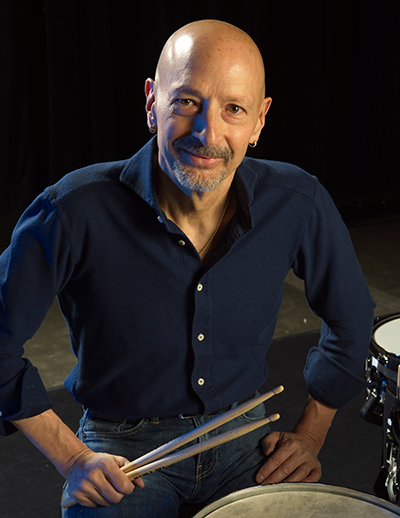
Celebrated, studied, revered, and respected, Steve Smith is a drummer one listens to for pleasure and inspiration, a visual performer who inspires awe and motivation, and an instructor whose wisdom comes from a teacher who is an eternal student. The Massachusetts born-and-bred musician has a visceral recall of the moment his life changed at age six when he felt the bass drum in the pit of his stomach during a Fourth of July parade in Whitman, Mass. So, when he had his first musical opportunity in elementary school, he gravitated to the drums. He is grateful to his parents for seeing the value of a private teacher as soon as they recognized the spark, and he credits Bill Flanagan, a big band swing drummer, for lighting it and building the foundation.
With two years on a practice pad, followed by a year just on snare drum, Smith developed his hand technique. Flanagan had Steve work on reading and emphasized sight-reading as well. He taught him vibes and suggested piano lessons, and by the time Smith graduated high school in 1972, he felt prepared to enter Berklee College of Music, where he encountered such important mentors as Gary Chaffee and Alan Dawson. During his first summer off, he attended a Stan Kenton jazz camp, where he studied with Peter Erskine, who, Smith says, helped him conceptually with his jazz and big band playing.
Steve found the Berklee community to be inspirational as well, including one student Smith met while he was on a summer tour with trumpeter Lin Biviano. Vinnie Colaiuta had recently graduated from high school when he saw Smith in Brownsville, Penn., and they spoke briefly after the gig. Colaiuta told Smith he would be attending Berklee in the Fall, and they promised to connect. They became fast friends when the semester began.
“We’d go to each other’s gigs,” Colaiuta recalls, “and we even took lessons together with Gary Chaffee during one of the semesters. And we practiced together.” Vinnie laughs as he recalls one practice session in the basement of Smith’s parents’ house with a jar of peanut butter, a turntable, a ride cymbal, and a bunch of “really fast up-tempo jazz records. We would take turns playing the ride cymbal to see whose arm would fall off first until invariably one of us would pass out.”
The two drummers went together to see everyone who came through Boston, like Miles Davis, McCoy Tyner, Billy Cobham, and Tony Williams. Colaiuta remembers the two of them taking a bus to New York thinking they were going to see Miles Davis, but it ended up being Herbie Hancock with Tony Williams and the V.S.O.P. Quintet.
The two drew creativity and insight from one another at a pivotal time and developed a comparable work ethic. “We had similar objectives,” Colaiuta says. “When you hang out together, you reinforce each other’s systems and drive towards becoming the kind of musician you admire. We listened to a lot of the same people, so we’d feed off each other.” Colaiuta says that period with Smith was important towards his growth and approach, and he ventures to say they influenced one another: “We hit the drums the same. We used to tilt our cymbals and play them the same way to try to draw a certain sound out of them.” Vinnie describing them as two teenagers with a lot of energy, hope, and drive, sponging up music, lessons, and life and inspiring one another: “Just kids wanting to go out and get a gig.”
Smith concurs. He did not yet have the grand vision of what he would become one day. He was just looking to be the best musician possible, to play with musicians he respected, and to find work. Initially, he aspired to work with big bands such as those of Stan Kenton, Woody Herman, or Maynard Ferguson, but jazz-rock fusion violinist Jean-Luc Ponty had other ideas for Smith when he hired Steve to play with him in October, 1976. Smith left Berklee in his seventh semester to tour with Ponty and recorded his landmark album Enigmatic Ocean in the summer of ’77.
Then, a year and a half later, when Smith was offered the choice between touring with Freddie Hubbard or Ronnie Montrose, he elected to go with Montrose, as he wanted to experience something different. It was fortuitous as, for half the tour, the band opened for Journey, during which time Steve established friendships with the band members. “Steve Perry and Neal Schon felt my drumming would be right for the group, which led to me joining the band later that year. Because I had mainly played straight-ahead jazz and jazz-rock-fusion before Journey, my drumming focus changed and I developed a compositional approach that was creative and satisfying for me and enhanced the soul-rock sound of the group.”
During the next seven years (1978–85), Smith learned new drumming concepts and, for the first time, experienced being a full band member. He was free to express himself and be an integral contributing force behind Journey’s six definitive recordings: Evolution, Departure, Captured, Dream After Dream, Escape,and Frontiers. In addition, their manager, Herbie Herbert, provided great mentorship and taught Smith a lot about the music business. “The fact that I was a royalty participant, and kept a modest lifestyle, gave me financial security that helped me be adventurous in my career choices,” Steve says.
In 1985, at the peak of Journey’s success, Smith was let go from the band. It was a crucial time for him; though he says the rewards of the Journey experience outweighed the challenges, he had to overcome the hurdle of being stereotyped as a rock drummer. At the same time, Smith was beginning to form the vision of the complete musician he wanted to be and the career he pictured. In 1983, while still with Journey, he had already laid the foundation when he put together a fusion jazz ensemble called Vital Information, returning to his roots. When Journey let him go a couple of years later, his intention was to make the new band a priority, but a series of events intervened.
While doing a clinic with Peter Erskine and Lenny White, Erskine mentioned he had just left the popular jazz fusion group Steps Ahead, and White chimed in, “They called me to play with them, but I’m too busy.” Smith seized the opportunity and said, “Lenny, I need a gig.” White, whose own band had opened for Jean-Luc Ponty when Smith had held the drum seat and knew Steve could play that music, said he would give Steps Ahead a call. Smith is very grateful to Mike Mainieri and Michael Brecker for taking a chance on him immediately post-Journey.
In addition to Steps Ahead helping to break down the preconceptions about Smith’s playing, he says the revolutionary drum videos that Rob Wallis and Paul Siegel made for DCI — Steve Smith Part 1 and Part 2 — played a huge role in helping to establish his new identity as a different kind of player and a clinician. “In that video, there are performances with Vital Information, plus Steps Ahead gave DCI permission to include a live version of their song ‘Oops’ with me on drums. That was a game changer,” said Smith. All of it led to clinics for Zildjian, Sonor, Vic Firth, and Remo and garnered press, earning Smith his first of five consecutive #1 honors in Modern Drummer magazine’s Readers Poll for Best All Around Drummer in 1987. He went on to earn additional accolades through the years, including #1 Jazz Drummer in Drum! magazine (2008, 2009, and 2010), being named one of the “Top 25 Drummers of All Time” by Modern Drummer in 2001, and the following year, being voted into the Modern Drummer Hall of Fame. His 2003 Hudson Music DVD Steve Smith Drumset Technique / History of the U.S. Beat was voted #1 Educational DVD by MD readers. Hudson Music released Smith’s DVD Standing on the Shoulders of Giants in 2008, and it was voted Best DVD of 2009 by the readers of Drum! magazine. The Modern Drummer Readers Poll voted Smith #1 Fusion Drummer in 2012, and in 2017 Smith topped an unprecedented three categories in the MD Readers Poll: #1 Rock Drummer, #1 MVP, and #1 Educational Product (for his Hudson Music Book/DVD Pathways of Motion). In 2018 MD readers voted Smith #1 Classic Rock Drummer. In 2017 Smith was inducted into the Rock and Roll Hall of Fame, in 2023 he was inducted into the Zildjian Hall of Fame, and now he is thrilled to be inducted into the PAS Hall of Fame.
For a while, after Journey, Steve added session work to his schedule, accepting all genres but only agreeing to play jazz in the live realm. In 2001 he decided to focus on bandleading and composing with Vital Information, but then something else happened. Musicians Howard Levy and Jerry Goodman called Smith to play some gigs with an Indian tabla player. “They hired me because they knew I could read music and play in odd-times,” Smith says. “The music Howard transcribed for the tour looked rhythmically complicated on paper because almost every measure was in a different time signature. After a couple of weeks of touring, I figured out that some of the songs that looked difficult on paper were actually in 4/4. The reason that Howard wrote measures of 9/8, 7/8, 5/8, and 3/8, for example, is because that is what the music rhythmically sounded like to him. But in fact, the time signature did not change; the rhythms were phrases that went over the barlines. I found that quite fascinating, and I started investigating Indian rhythms. Later that year, saxophonist George Brooks asked me to play in his new group called Summit, which featured Zakir Hussain. We recorded the album Summit in 2001, and my journey into Indian rhythms was beginning.”
In 2002 while teaching at the Marktoberdorf Drum Camp in Bavaria, Germany, Smith attended daily classes in South Indian rhythms using the rhythmic language of Konnakol. He used the rhythms he learned in Summit, and Zakir recognized Smith’s desire to learn more. During the gigs Summit played all over the world between 2002 and 2004, Zakir instructed Smith each day.
“It was an intense, on-the-job training that really brought my understanding and skill level to new heights,” Steve says.
Smith played often with Pete Lockett, a British musician knowledgeable in North and South Indian drums and rhythms. In 2009 Smith taught for a week In New York City with Zakir as part of the Carnegie Hall Workshops, and at the end of the week, they played an evening of percussion music at the venue with Vikku Vinayakram and Giovanni Hidalgo. In 2014 Smith toured North America and India with Zakir Hussain and Masters of Percussion. Over the years there were many other collaborations and performances with some of the giants of Indian music. “All of these experiences increased my knowledge and abilities with Indian rhythms,” Smith says. “At PASIC 2005 I presented an Indian-rhythm clinic with kanjira player Ganesh Kumar that was well received and is on YouTube.”
The discovery and love of Indian rhythms led the way to Steve injecting it into some of his work with Vital Information. To date, Vital Information has released 18 albums. He describes the current line-up featuring Manuel Valera (keyboards) and Janek Gwizdala (bass) as “the younger generation.” “I love what they’re bringing to the band and to the music, and they have fresh ideas,” Smith asserts. “They’re incredible virtuoso players, and every night we explore and expand our boundaries and push each other. It’s just what I need at this point in my life to keep me interested and excited about playing music live.”
And Smith still loves giving clinics and masterclasses. He recalls his very first big clinic at PASIC ’80, sharing the event with Louie Bellson and Alan Dawson. Zildjian’s Lenny DiMuzio talked him into it, and Smith was terrified because, during that period, PAS was extremely classically oriented and Smith was known as a rock drummer. “At one point before the clinic, Lenny held my hand and just told me that I’d be okay, and I’d be able to do it.”
Smith feels that he actually is good at it because he had excellent teachers who were great role models, starting with Bill Flanagan and then Alan Dawson, Gary Chaffee, Pete Magadini, Freddie Gruber, and all the way to Zakir Hussain and V. Selvaganesh. Besides his enjoyment of imparting information, Smith particularly enjoys clinics and festivals when there are multiple drummers on the bill because the exchanges that transpire are inspiring. “I always come home with new ideas,” he says.
Todd Sucherman, drummer for Styx and world-renown educator, says that Smith’s playing and ideas have been life changing for him, beginning in 1979 when he first heard Journey’s Evolution album at age nine. “It spoke to me on a very deep level,” Sucherman says. “The feel, beat construction, and how he shaped and built each track was stunning to me.”
It led Todd to seek out additional work that Smith did and drove him to Ponty’s Enigmatic Ocean. “This album was like the Rosetta Stone for me — my fusion bible — and all of a sudden, I could decipher stickings, articulations, and concepts. It was the key to understanding other fusion drummers who mystified me in my youth. Steve led me to studying other drummers intently, and even though I had been playing professionally since the age of six, Steve’s influence gave me a maturity beyond my years in my playing.”
Sucherman says seeing Smith in concert with Journey for the first time in Chicago in 1980 is still seared into every cell of his body. “In 1982 I wrote Steve a letter through Modern Drummer magazine, and he replied with a hand-written six-page letter. He answered every question, provided wise advice, and shared a few transcriptions. I now give the same advice to other drummers who write to me that Steve gave me, and it’s incredible that Steve’s kindness and wisdom ripples through time, over decades to a new generation. Seeing Steve perform in clinic in 1983, 1984, and 1986 was instrumental in my musical development and helped shape my fascination with drum education.
“Anyone who says ‘Don’t meet your heroes’ has never met Steve Smith, who continues to be a North Star in my life — on stage and off. Steve’s contributions to music have made my life, and countless other musician’s lives, better forever, and I’m eternally grateful for that.”