

Zero to Hero: Raising Players from Raw Material to Top Shelf
Zero to Hero: Raising Players from Raw Material to Top Shelf
by Bill Bachman
Percussive Notes
Volume 64
No. 5
October
2026
The article “Zero to Hero: Raising Players from Raw Material to Top Shelf” by Bill Bachman outlines his “Extreme Hands Makeover” teaching method, which has successfully trained many middle and high school drummers into world-class performers. The method emphasizes developing loose, flowing strokes through free strokes that rebound naturally, precise finger control for even diddles, and gradual introduction of downstrokes. It also incorporates Moeller whip strokes for faster tempos. Bachman’s approach involves strategic, diagnostic exercises that expose imperfections to accelerate progress and avoid wasted practice time, resulting in quicker and more effective skill development.
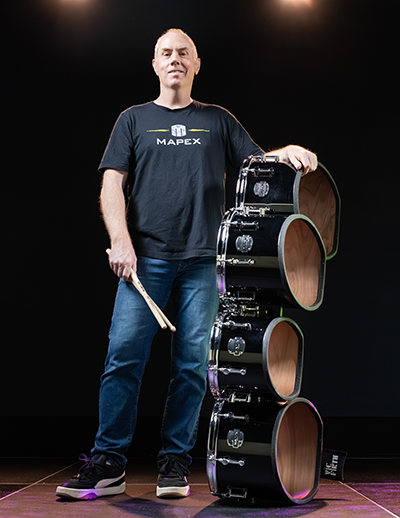
During PASIC 2025 I started to think about how many middle and high school students I’ve taught over the years who went on to march in world-class drum corps. I started counting chronologically through the years and came up with well over two dozen players. For decades I’ve been using a method that has led to these results, and about a dozen years ago I codified the pedagogy into the “Extreme Hands Makeover” and made it available on drumworkout.com.
First of all, I haven’t invented anything about how to play a drum, but many of my teaching methods are quite unique — and most of them were born out of desperation. When all of the usual methods and explanations are failing to reach a student, I’ll reverse engineer the technique and come up with a fresh way to explain it — and they suddenly get it! The moments as a teacher when something new comes out of my mouth that is both extremely concise and extremely effective are magical to me, much like the thrills of playing music where the whole exceeds the sum of the parts. I also create strategic exercises that are designed to call you out as brutally as possible if you’re playing something with even the slightest imperfections. Here are a few of the 26 steps in my Extreme Hands Makeover, with some brief insights into the methods.
Free strokes (a.k.a. full, legato, or rebound strokes) start and end all the way up past vertical. They are extremely helpful in developing loose, flowing strokes. When you play lower strokes and/or use a set position where the sticks pause down near the drumhead, it is very easy to hide extra tension in the hands. However, for the stick to rebound all the way up past vertical on its own, the stroke must be played with plenty of velocity on the way down, and have no restrictions on its way back up. Mastering free strokes with this approach results in loose hands that play with a very natural touch. Finger control also becomes well developed, since with this approach the fingers have to act as players, not holders.
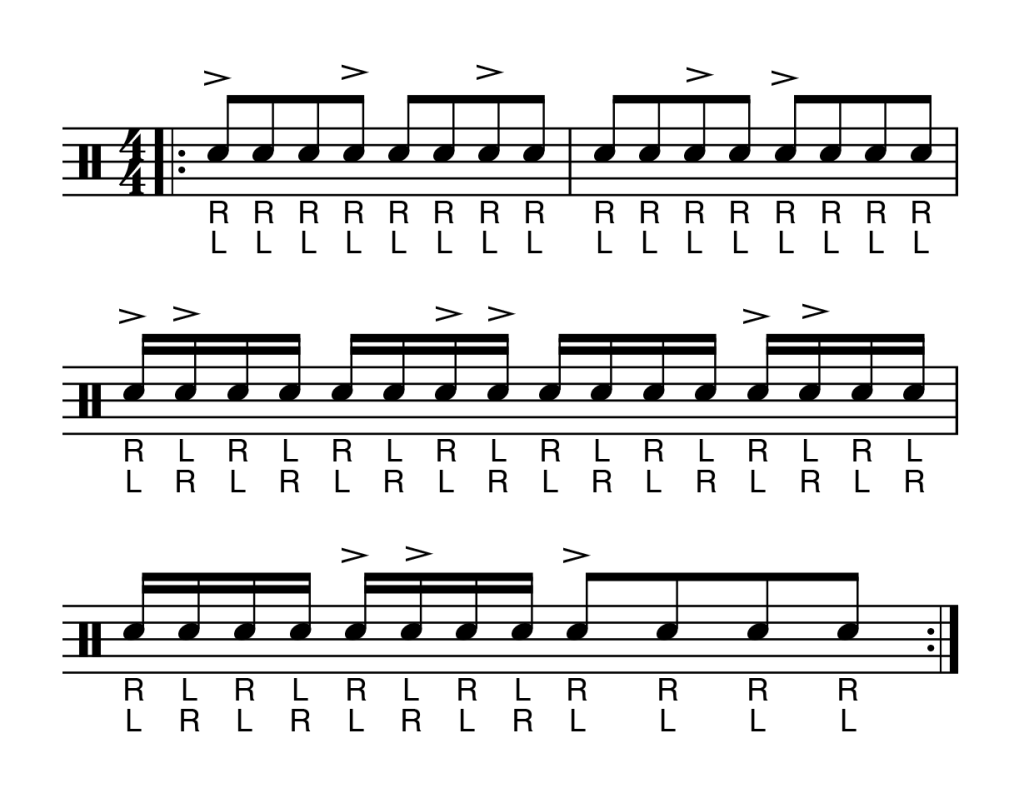
Downstrokes: I only introduce downstrokes once free strokes are rebounding smoothly and unrestricted. I will lead into the downstrokes with free stroke accents such that it would be awkward to suddenly hit the downstroke harder than the free strokes that preceded it (many players will attack isolated downstroke accents extra hard, which can compromise their musicality and touch). As a general rule, I believe that the downstroke should be played exactly like the free stroke until a split second after hitting the drum. To define the appropriate stick height and velocity of an isolated downstroke accent, you can always ask, “What would eight-on-a-hand do?”
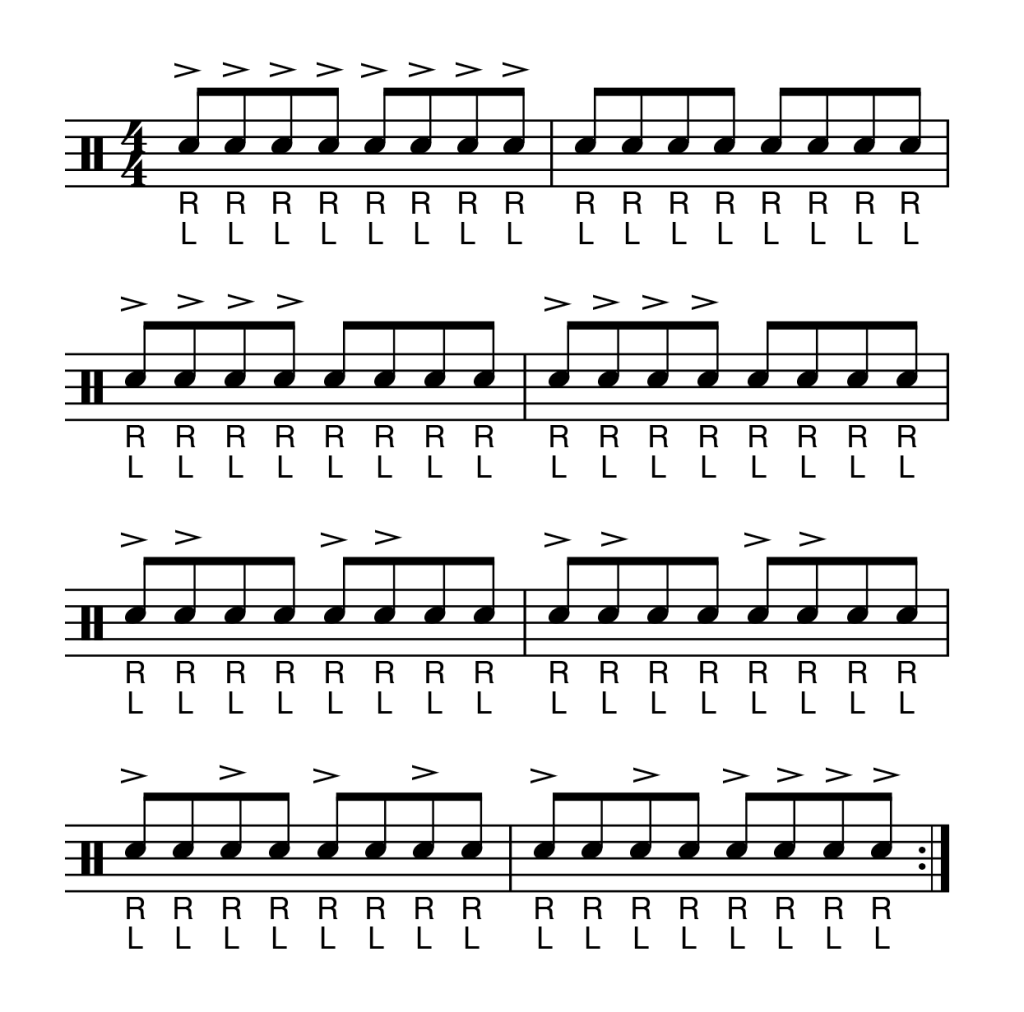
Here’s an exercise called, “8-4-2-1 accent/tap” where the downstrokes are set up by free strokes:
Diddle quality: Playing quality diddles, where the second beat of the diddle has the same volume and power as the first, is a challenge; it’s all a matter of finger control. I explain it like an “alley-oop” combo play in basketball. The first stroke is a light free stroke mainly from the wrist that rebounds back up (the “alley”), and the second stroke is more of a reactive slam dunk from the fingers (the “oop”). As a general rule, the first beat of a double stroke should be played as lightly as possible so that the sick rebounds up as high as possible to set up the fingers for the second stroke.
In the Extreme Hands Makeover I have many workouts where we slow down the faster tempo’s technique (a double consisting of a free stroke and downstroke) and invert the diddles so that the second stroke is on the strong downbeat. In this manner, the fingers will develop the quick reaction and power necessary for quality diddles in less time.
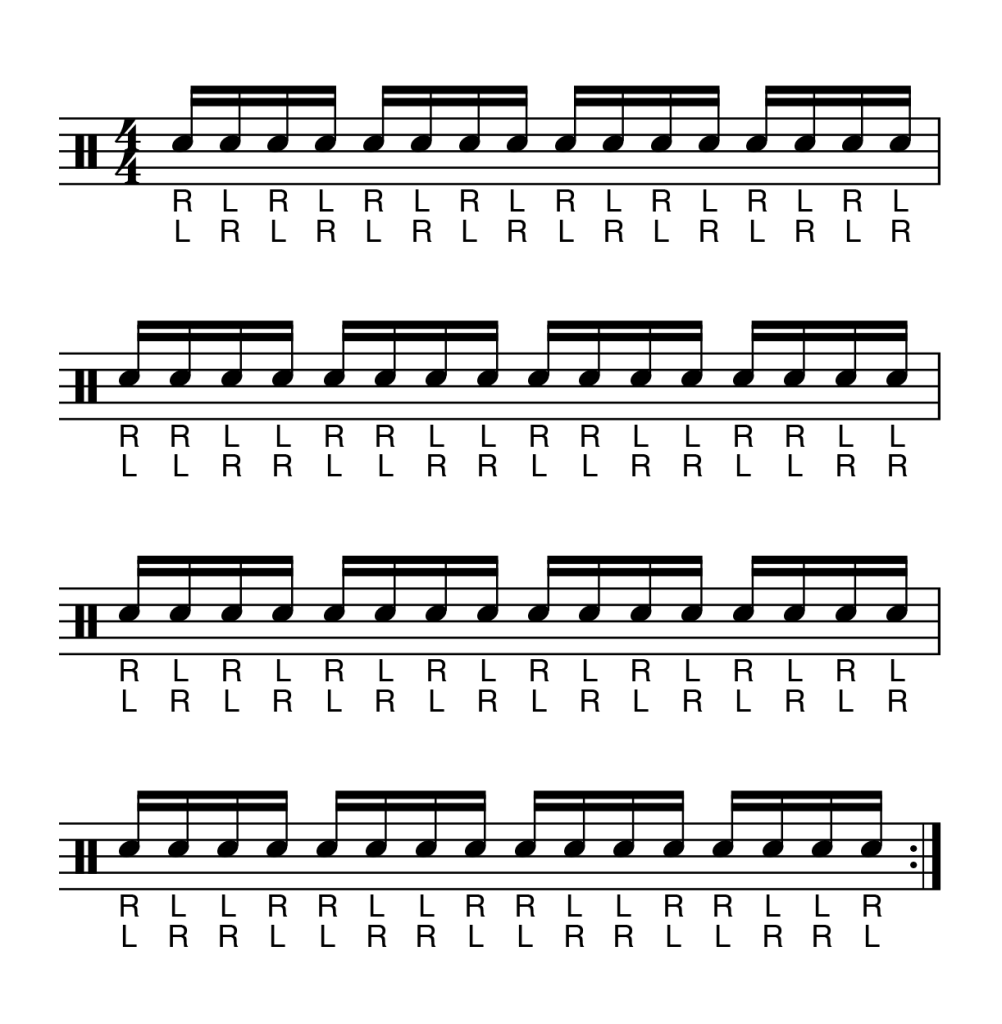
Here is a simple exercise called “Inverting Diddles” where the diddles get compared to singles and turn around so that the second beats of the diddles are on the downbeat:
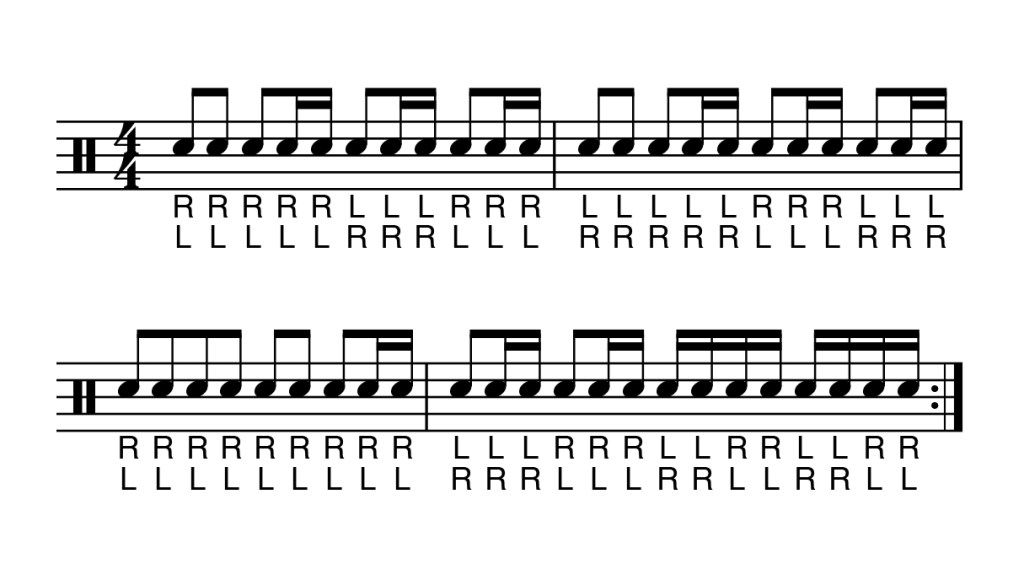
The next exercise, “Dragon Diddles,” sets up the diddles with rebounding free strokes, which helps train students not to play harder or stiffen up on the initial beat of the diddles:
Moeller whip strokes: Many flam rudiments are nearly impossible to play at medium speeds and up without whip strokes, a technique often associated with the famous teacher Sanford Moeller. The whipping motion is where the forearm’s up-and-down motion replaces the more typical wrist motion. There are two ways to attain stick height: (1) lifting the front end up with the wrist, and (2) pushing the butt end of the stick down with the palm, which in turn raises the front (this is what ultimately happens with a whip stroke). At faster speeds, when there is not enough time to upstroke with the wrist, we’ll need to replace the wrist motion with a whipping motion. In the Extreme Hands Makeover we slow down the faster tempo’s technique and play oversized whipping motions in four different contexts: whip & flop, whip & stop, whip to diddle, and whip to free stroke.
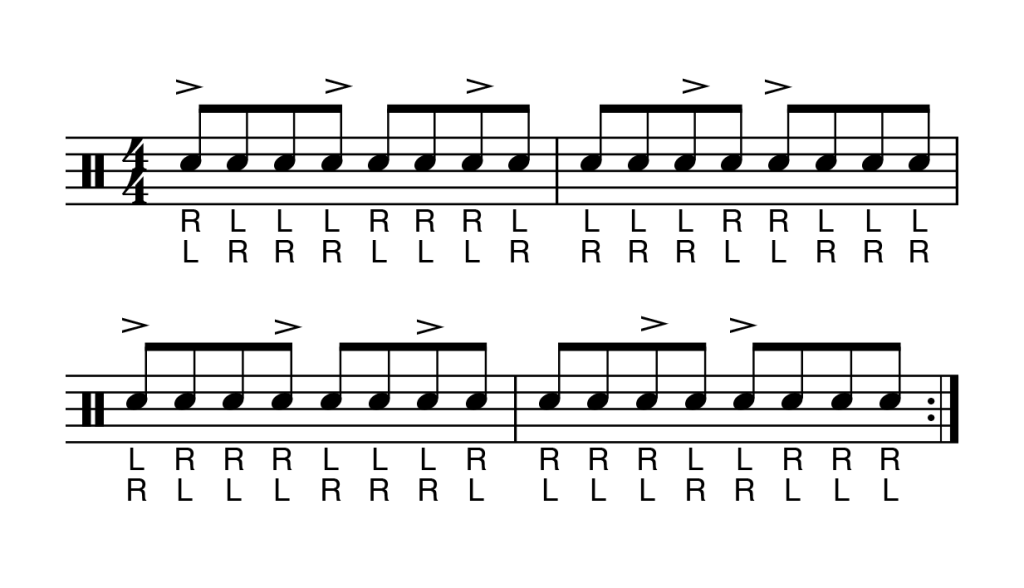
Here are two brief exercises using the son clave accent pattern to be played with the Moeller whip & flop and Moeller whip & stop techniques:
The Extreme Hands Makeover is packed with many fresh angles of attack on timeless fundamentals that are easily digestible. The pedagogical approach in this plan will help percussionists get a much greater return on their practice time. No more misdirected hard work in the practice room where you’re just pushing up against a brick wall. With the Extreme Hands Makeover, you will see greater results and will see them much sooner!
Bill Bachman is the founder of the hand technique site drumworkout.com, author of the books Stick Technique, Rhythm & Chops Builders, and Top Shelf Hands, and the “Logic” book series from RowLoff.com. He’s performed at clinics and drum festivals on five continents and teaches at Marcus and Flower Mound High Schools along with offering online lessons globally.