

The Spirit of Samulnori
The Spirit of Samulnori
Teaching Korean percussion in a Western-style classroom
by Karissa O. Van Liew
Percussive Notes
Volume 64
No. 5
October
2026
Samulnori is a Korean folk percussion genre developed in 1978 that features four main instruments: kkwaenggwari (small gong), janggu (hourglass drum), jing (large gong), and buk (bass drum). It evolved from traditional Korean farmers’ music and traveling entertainers, adapting for concert performance to preserve cultural heritage in modern Korea. Central to Samulnori is the concept of hoheup, a circular body movement that connects players’ breath, soul, and rhythm, uniting the ensemble. The genre has been successfully adapted for Western music education through a combination of aural learning, rhythmic singing, movement, and cultural education, allowing diverse learners to authentically experience and perform the music while fostering cultural understanding.
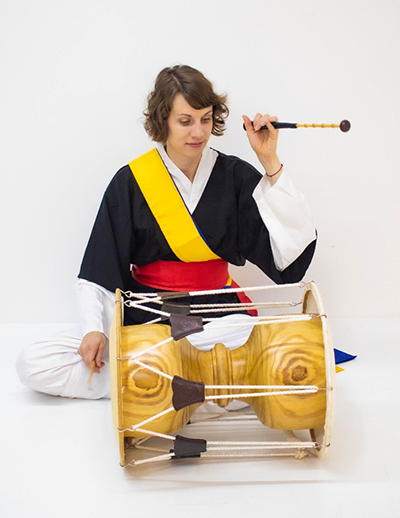
Samulnori (餌僭啾檜) is a genre of folk percussion music that originated in South Korea in 1978. It is a participatory genre that promotes community arts, enabling a wide range of abilities and multigenerational players within the ensemble. “Samulnori” is made up of two words, “Samul” and “nori,” which means “to play four objects.” The four instruments that make up the percussion ensemble are:
Kkwaenggwari (small, clanging gong): The kkwaenggwari serves as the ensemble leader, articulating the primary rhythmic patterns and guiding transitions between sections through aural and visual cues.
Janggu (double-headed, hourglass drum): The janggu is the featured drum of the ensemble, performing virtuosic rhythmic patterns. Its distinctive playing technique includes rapid alternation of the left hand crossing to strike the right side of the drum.
Jing (large, reverberating gong): The jing resonates and fills the empty space of the otherwise percussive instruments by emphasizing the foundational beats and important accents of the rhythmic patterns.
Buk (bass, barrel drum): The buk functions as the rhythmic foundation of the ensemble, reinforcing the primary beats within the rhythmic cycles. Its deep, resonant tone supports the steady pulse and connects the ensemble’s interlocking rhythmic patterns.
Samulnori rhythms typically fit within compound meters, such as 12/8, which allows the music and performers to flow within a circular, coiling motion. Performers move their torso in a circular motion, to connect their body, soul, breath, and the rhythm to the flow of energy, which is known as hoheup. The hoheupis a core concept of playing Samulnori because it connects the body with the rhythms, and unites the ensemble into one unit, synchronizing the pulse and rhythms.
HISTORY OF SAMULNORI
Samulnori developed from two longstanding Korean performance traditions: pungmulnori, or nongak (farmers’ music), and the namsadang, itinerant professional entertainers. Because Korea was historically an agrarian society, village percussion ensembles were woven into community life, performing at seasonal celebrations and agricultural rituals intended to encourage a plentiful harvest. Playing percussion also provided farmers with an outlet from the demands of physical labor, bringing people together through music, dance, singing, and shouts of blessings that reinforced a sense of communal encouragement. Conversely, the namsadang earned their livelihood by traveling to villages, presenting performances that combined percussion (pungmulnori), dance, plate spinning, acrobatics, tightrope walking, mask drama, and puppet theater.
South Korea’s rapid modernization following the Korean War dramatically reshaped the nation’s cultural identity. As Western classical music and popular genres gained prominence, many traditional musical practices experienced a decline in public interest. Recognizing the need to preserve Korea’s traditional percussion heritage while appealing to contemporary, urban audiences, Kim Duk-Soo and three fellow musicians reimagined village percussion as a concert art form. Rather than presenting the music as an outdoor procession, they adapted it for the stage, emphasizing seated performance, refined ensemble coordination, expanded rhythmic variation, and improvisation, while retaining the vitality of the folk tradition. Their debut performance in the basement of a Seoul theater in 1978 marked the birth of SamulNori Hanullim and established Samulnori as a distinct genre that continues to serve as one of South Korea’s most recognizable expressions of traditional percussion.
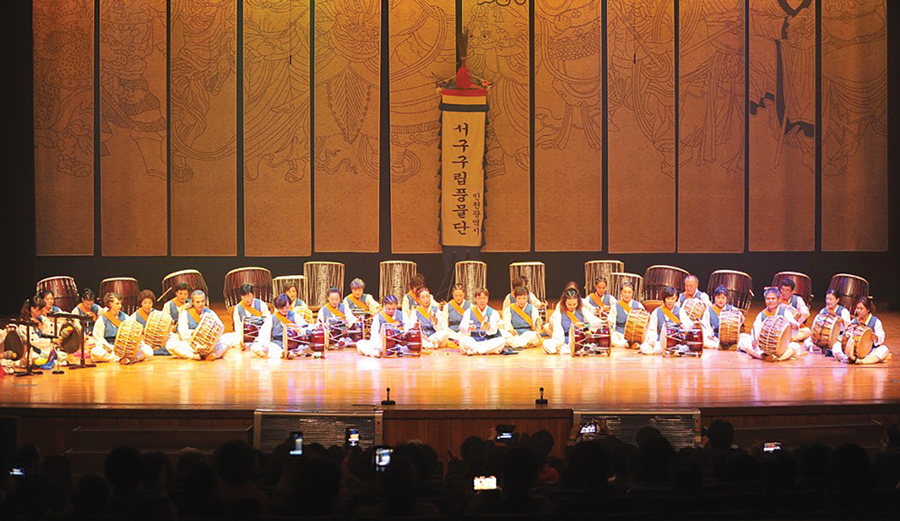
SAMULNORI FOR WESTERN MUSIC EDUCATION
Because Samulnori itself emerged by adapting earlier rural performance traditions for an urban concert setting, the genre provides a compelling model for thoughtful adaptation in educational contexts. As the Samulnori repertoire is performed outside of Korea, the genre has been adapted to mediate the tradition, becoming accessible for all learners and their available resources. Although adaptations may involve different instruments or performance settings, the rhythmic language, vibrant spirit, and stylistic characteristics of Samulnori remain essential to preserving the integrity of the tradition.
Musically, Samulnori can be adapted for musicians ranging from upper elementary students to collegiate percussionists. Successful performance depends less on exact instrumentation than on preserving the rhythmic feel, aesthetic spirit, and stylistic conventions of the Samulnori canon. The PASIC 2026 workshop introduces percussionists and music educators to the performance practices of Samulnori while demonstrating strategies for adapting the tradition to Western educational settings. Participants will explore components of World Music Pedagogy (WMP), developed by Patricia Shehan Campbell, and the Five Samulnori Building Blocks developed by Dong-Won Kim (former Educational Director of SamulNori Hanullim). The workshop incorporates both Western and Korean pedagogical strategies to effectively recreate the music. Some of the most pertinent pedagogical strategies include the following:
• Aural Understanding: Musicians first develop an aural model of the genre through repeated listening. Recordings should be revisited throughout the learning process.
• Rhythmic Singing: Each Samulnori instrument is associated with distinctive vocal syllables that allow musicians to internalize rhythmic patterns before transferring them to instruments.
• Movement: Because Samulnori evolved from the marching tradition of pungmulnori, movement develops hoheup and reinforces rhythmic flow. Musicians can stand and bounce with their knees, sit and move the torso, or step in time while making various formations.
• Instrumental Playing: Traditionally, Samulnori has been transmitted through oral and aural instruction rather than written notation. While notation and visual aids are occasionally used in Korea today, the heart of learning the music is aurally by rote. Call-and-response, rote learning, and repeated phrases enable musicians to internalize the rhythmic language before relying on notation.
• Cultural Education: Learning the rhythms alone is insufficient for an authentic performance of Samulnori. Musicians should also develop an understanding of the genre’s historical origins, cultural significance, performance practice, and aesthetic values to perform the music with greater musical and cultural awareness.
An effective resource to hear a variety of Samulnori performances and download cultural presentations is available at: https://www.theheartrhythmsofkorea.com.
When taught through a combination of aural learning, movement, cultural context, and carefully adapted performance practices, Samulnori can be authentically experienced beyond Korea. Rather than replicating every aspect of the tradition, educators can preserve its musical identity while making it accessible to diverse ensembles and learning environments. Therefore, Samulnori offers a meaningful way to expand percussion repertoire while fostering cultural understanding through performance.
REFERENCE
Kim, Dong-Won, and Karissa O. Van Liew. 2024. The Heart Rhythms, Songs, and Dances of Korea. GIA Publications.
Karissa O. Van Liew is an international music educator who began playing traditional Korean percussion in 2016 in South Korea, which led her to co-author the book The Heart Rhythms, Songs, and Dances of Korea, which is part of the World Music Initiative series with GIA Publications. Karissa teaches middle school band at the American International School of Chennai in India. She will continue exploring our beautiful world, engaging with others through music, and developing music education resources on unfamiliar music cultures.