

Starting Strong with Stand-Alone Percussion Classes
Starting Strong with Stand-Alone Percussion Classes
by Matthew Kilby and Nathan Woods
Educators' Companion
Volume 9
No. 1
Fall
2026
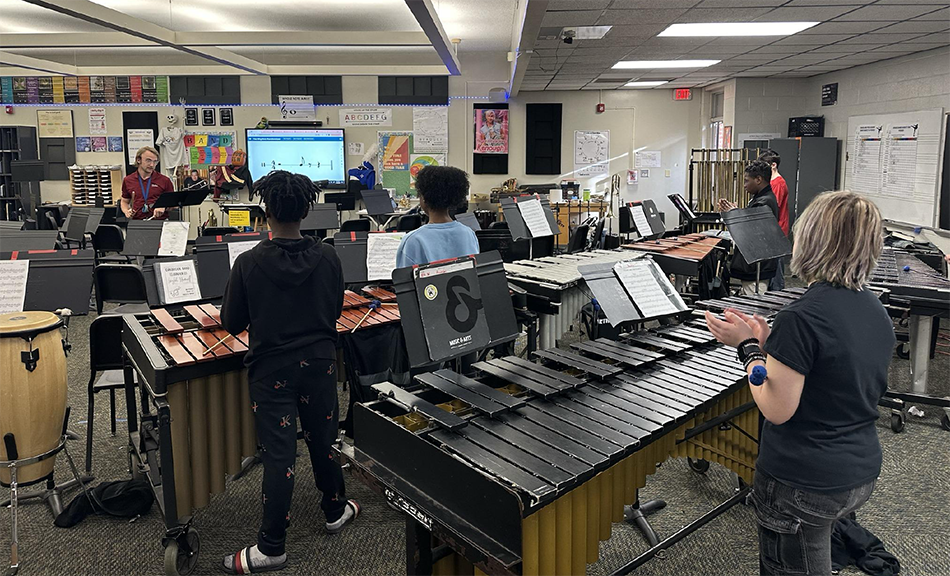
BENEFITS OF STAND-ALONE PERCUSSION CLASSES
This article is designed to help you (the band teacher, and specifically the non-percussionist band teacher) create your own percussion-only class. The benefits of doing so are immeasurable for the students, teacher, and even for the wind and brass students. Tailoring instruction more directly to percussionists and non-percussionists is much more efficient than splitting groups by number or grade level. It may feel overwhelming to begin implementing percussion-specific techniques into your curriculum, but we are here to help! The pedagogical strategies and needs of percussionists differ from those for wind and brass students. We hope that by creating a percussion-only class you will be able to focus more effectively on these two groups of students. Even administrators can benefit by learning more about the needs of their students as seen in the following quote.
As a Middle School Principal, supporting performing arts programs goes beyond attending events; it requires building schedules that align with program needs and involving teacher input. Administrators must balance class sizes to promote equity, maximize learning, minimize behavior issues, and justify teacher allocations. In band programs, this means creating opportunities for teachers to lead larger classes while providing small-group, instrument-specific instruction—in this case, in percussion. Working with band directors to build class rosters helps me understand program needs and support teachers in providing quality, individualized instruction. While percussion class sizes may initially seem too small, beginning with foundational techniques is crucial for advancing skills and fostering interest. As leaders, our role is to find creative ways to grow all facets of our programs, including percussion, to enhance learning for all students involved.
—Bentli Lewis, Principal at Oakbrook Middle School
RE-STARTING OAKBROOK MIDDLE SCHOOL’S PERCUSSION CLASS
The following article shares the initial steps of a school that re-started its percussion-only classes with the arrival of two new teachers. The ideal approach to working with percussionists in any context will depend on the teacher’s assessment of the community’s readiness, current investment and commitment to music education, and the program’s relationship with co-teachers, administrators, and community stakeholders. There may be no one-size-fits-all for music education in any context, and the authors chose to reflect on the experience at this middle school to give a realistic picture and to hopefully inspire others to consider the benefits of a stand-alone percussion class.
For their first year, one of two band directors ran the percussion class with the help of a percussion specialist who came weekly to check-in. Percussionists were started at an atypically advanced age (8th grade) to generate appropriate numbers at the high school level. One of the two directors, Nathan Woods, took charge of the percussion program. His background is playing clarinet, but he also has DCI experience playing mellophone. In the following article, he shares valuable insights and experiences from his position as a non-percussionist percussion educator. He offers tips for starting points, material selection, and strategies in the first year.
Defining Stroke Types and their Roles in Tone Production
Defining the four-stroke types is one of the most fundamental aspects of teaching a beginning percussion class. Defining each stroke type (full, down, tap, up) creates a foundation for moving efficiently and creating desired sounds. For younger percussionists, stroke-type exercises should be employed daily or on a very frequent basis. Nathan used the exercises from the Michael Huestis Percussion Solutions text. Here is another example of an exercise I frequently use:

Keyboard Sightreading Method
NW: Every time we sightread on keyboard instruments, we always follow the same procedure:
- Count and clap the rhythm
- Say the note names to yourself out of time
- Say the note names in rhythm
- Say the note names and touch the key with your finger
- Say the note names and air-play – focus on moving from one note to the next
- Play
Having a consistent routine and a step-by-step method for every sightreading example helps beginners and middle school students find success. I also repeatedly say to look at the music while only glancing at the keyboard. Students will begin to understand that the music will change while the keyboard will never change and that we use technique time to memorize how the keyboard is laid out.
The Benefits of Frequent Keyboard Sightreading
• Builds confidence
• Builds resilience and community support
• Builds technique in context (focusing on piston stroke and moving from one note to the next)
• Builds musical literacy
NW: I’ve found success with routines and a step-by-step method. Middle school students especially appreciate knowing what’s coming next in each class period and love participating in a lesson that logically goes from A to B. Every class starts with the same fundamental skills and may alternate between snare and mallet days. On snare days, we have a packet we work through and finish with a rhythm randomizer (free digital tool linked below) before moving on to music. On mallet days, we play scale patterns, then the seven South Carolina Band Directors’ Association junior scales, and sightread. Because sight-reading may be a common area of deficiency for middle school percussionists, we generally follow a six-step procedure when sight-reading on mallets. Generally, in each class, we’ll read an easier example with the six-step procedure and three additional examples. Two of appropriate difficulty (two-thirds of the class can successfully sight read) and then a challenging one that the class can read after working on it for a bit.
Percussion Ensemble:
NW: I appreciate percussion ensemble music as a way to differentiate instruction. The percussion ensemble pieces we play reinforce what we learn in fundamentals. We’re working through Festival of the New Sun[1] (Tapspace) in 7th grade to reinforce what we’re learning in Tap Pyramid and Bucks (Generic Exercises found in the Percussion Solutions Handbook) and reading 16th note combinations. We’re also working through Candlesticks[2] (Tapspace) in the 8th grade to reinforce sightreading procedures directly. Kids who are ready for a challenge can get put on a more independent part, and kids who need more support can double parts.
Repertoire
NW: Because we started 8th graders, the overall trajectory of the year was similar to a beginning band class. The Holiday concert was challenging to put together, the Concert Performance Assessment was a little less challenging, and the Spring Concert was the most successful. Little wins and assigning parts based on ability level for each student were key to building momentum. Right now, I’m getting a lot of benefits from doing a percussion ensemble and putting the weaker kids on the harder parts to build their skills.
Both classes were formatted as mallet day/snare day (once the 8th-grade students were strong enough to do more than 20 minutes on each instrument). We did about 20 minutes of fundamentals (tone production, scales, sight reading/working through a fundamentals packet), and then for the rest of the class, we worked on a percussion ensemble piece or something for the combined band. Once we got to a month before the concert, we did 10 minutes of fundamentals and 30 on music, then shifted to spending most of the time on concert music two weeks before the concert.
AN OVERVIEW OF THE YEAR
1st Quarter
NW: We began with a few weeks of just pads. We played various rhythm charts from Teaching Rhythm Logically[3] with all full strokes. Gradually, we expanded to more advanced rhythms and used Bucks (a simple accent-tap exercise) to teach the four stroke types. After a few weeks, we introduced keyboard instruments through the Mark Wessels Fresh Approach to Mallet Percussion book. We only played a few pages before moving on to the Huestis 30 Progressive Mallet Etudes. I treated the Fresh Approach books as a beginning band method book and always read three examples from the 30 progressive etudes using our sight-reading procedure. We continued this process until it was time to assemble the Winter concert in the 2nd 9 weeks.
2nd Quarter
We continued daily sightreading on both pads and keyboards. The percussionists combined with the winds class for the first time for the winter concert to mixed success. We played a grade 1.5 piece of music, which was beyond what the beginning percussion class could technically do. I did my best to work around this by giving stronger students more difficult or independent parts and doubling parts for students who needed more help. Learning this piece and the others of similar difficulty took much time because they weren’t technically ready to do what the music called for. Moving into the 3rd 9 weeks, I continued using the same protocol for class by sightreading as much as possible and spending a great deal of time to reinforce technique.
3rd Quarter
We began the semester with about a month of just technique and sightreading time daily until it was time to prepare music for assessment. I wanted the percussionists to play with the Honor band going to our assessment to experience polishing festival music and being in the sightreading room. We prepared the music quickly due to the percussionists’ strong foundation in technique and reading and previous experience with the winter concert. We began to prepare Begin Transmission, an easy percussion ensemble piece, but it became apparent that we would not have adequate time to get it concert-ready.
At this point, I noticed that it had become far easier to balance the percussionists with the band due to their strong technique. Having a percussion class has shown me that most middle school percussion balance issues are due to poor technique and that overcoming these issues can only be fixed by consistent, focused work.
4th Quarter
I stayed the course and sightread and reinforced technique as much as possible. For the Spring Concert, we prepared a Tapspace easy percussion ensemble piece, Candlesticks, because the students were much more musically literate and quickly learned their concert music. At the concert, we had a student with a critical part absent, which was an opportunity to stress to all the students that every person is valuable and needed.
Building a Community in the Classroom and the Expectation of Continuing Band in High School
NW: Creating a sense of community in the classroom starts with strong relationships with students and ensuring every student feels successful each day. Giving tools in technique time and showing students how to apply these tools to appropriate sightreading or repertoire is crucial for inspiring student self-efficacy. Having a good personal rapport with each student can be a stepping stone for letting go of strict management and allowing students to interact, chat, and get to know each other during each lesson.
To encourage student to continue with band after 8th Grade, I use “when” instead of “if” when I talk about the high school, and I make sure Matthew is as involved as possible when in the room. I will say, “When you’re doing marching band next year, you’ll need to be able to do XYZ,” or “When you audition for region band in high school, doing X will help you Y.”
Because the high school percussion director was in the room once a week helping teach the class, recruitment went very well, and 2/3rds of the class ended up continuing band in high school. Despite many students having only one year of experience, because of the time spent working on fundamentals, these students are now huge assets to the high school percussion program.
CREATING SUSTAINABLE COLLABORATION
If you are a band director who is not a percussionist, I hope you can use this information to feel confident about starting a percussion only class all on your own. You can do it! However, some school budgets will have the luxury of hiring a percussion specialist to teach the percussion class. Bringing up a strong percussion section requires all teachers to have clear and compassionate expectations for their students and each other. If you do not have a percussion specialist nearby, the information above will help you create a percussion only class that is successful and gives your percussionists a strong start. If possible, consider enlisting the help of a local university student or emailing a trusted colleague. Little can replicate the advantages of having instrument-specific teachers or one-on-one instruction. For percussion specialists and band directors, the most important priority is supporting the other. Tactfully navigating differences in vision, philosophy, and implementation will create sustainable and high-level student experiences. The relationship between the two teachers is more important to maintain than the tedium of the pedagogy or sequencing. Compromise will be necessary! To address any problem that may arise, percussionists and band directors alike may have to reframe their mindsets:
To Percussionist Teachers: Band directors are responsible for a wide variety of instrumentalists. Percussion has the most modern development in the band family of instruments (think of the changes in the last 10, 20, or 50 years compared to the other band instruments!) Because of the nature of common teacher training systems, percussion is less frequently taught and deeply understood by those outside the percussion niche. Be forgiving of whatever situation you walk into and be part of a sustainable solution. Advise without being condescending or judgmental to benefit overall programs and understand that giving percussionists solid fundamentals is extremely challenging in a heterogeneous classroom. Set up systems to help band directors. The cardinal rules of instrument care, mallet selection, and appropriate repertoire you learned may not be as universally understood as you assume. Being an ambassador for your craft without creating unreasonable expectations for your colleagues will bring sustainable results.
To Band Directors: Having a baseline knowledge of percussion instruments will create more buy-in from your students, who will be assured that you value their time and intellect as musicians with the same passion as other instrumentalists. Avoid perpetuated stereotypes that percussionists are more ill-behaved or less musically capable than other instrumentalists. Percussionists simply require different types of planning, procedure, and instruction to be successful. The procedures for students who consistently play one instrument seated will not work for students who play multiple instruments standing. Sight-reading procedures for students who maintain bodily contact with their instrument will not work for students whose instruments require more hand-eye coordination and are separated from the student’s body by an implement (stick or mallet). A percussion class or pullouts for percussionists will be hugely beneficial. Percussionists need the same caliber of detail and attention in making their first sounds in the 6th-grade band as their wind-playing counterparts. If creating a percussion class is impossible in your scenario, I’d highly recommend using the PAS archives to meaningfully include percussionists in group warm-ups, lessons, repertoire, and activities.
CLOSING THOUGHTS REGARDING ADMINISTRATION
While moving percussionists into their own class may create sections with lower numbers, if administrators are unhappy with a split that puts 8 students (percussionists) in one class and 45 wind players in another, another strategy could be to create a large class with two teachers and then have several sub-configurations for splitting those classes into two separate spaces.
Hopefully, your administrators encourage collaboration between middle school and high teachers for the betterment of all. It can be particularly useful to have the high school percussion specialist come and work with middle school percussionists. Our principal commented:
As a veteran principal with experience leading middle and high schools, I have come to understand that almost all of what we do in middle school, especially in the performing arts, is to prepare students for high school. In our world of instant gratification, the time and dedication required to become a proficient instrumentalist is a great challenge for many students. But with great challenges come great rewards! By explicitly encouraging and supporting collaboration between high school and middle school music educators, the opportunity to grow the strength of both programs comes to fruition. Building a relationship with the future directors and having those high school directors’ expertise to assist in the classroom pays dividends in the rich musical and social experiences our middle school musicians experience. These deeper relationships and heightened teaching and performing experiences are critical to elevating the experience for the musicians and our school community.
—Tripp Alderege, Principal at Fort Dorchester High School
MATERIALS
Start-Up Kit
NW: We didn’t use a startup kit this year, but next year, beginning percussionists will get nice Marimba and Xylophone mallets, a stick bag, Vic Firth SD1s, and a practice pad.
This last year, we used all school instruments, mallets, and sticks borrowed from the high school or left over from previous students. Fortunately, there was already a class set in decent condition. I appreciated the chance to show kids which mallets were appropriate for which instruments and why, though they saw way more wear and tear than you’d usually see. In the future, I’m setting a goal to have at least 2/3rds of the kids have their own mallets and sticks to encourage practice and inspire individual ownership.
Instructional Texts/Websites
Teaching Rhythm Logically – Darcy Williams
A Fresh Approach to Mallet Percussion – Mark Wessels
Percussion Solutions for Band Directors Textbook (Available through the Facebook Group linked below)
30 Progressive Mallet Etudes – Michael Huestis
Percussion Solution for Band Directors Warm-ups – Michael Huestis
https://www.facebook.com/groups/569570536997988
Randomized Note Name Worksheets (musictheory.net note naming exercises)
Rhythm Randomizer (On class display, often used to support what we worked on in Teaching Rhythm Logically)
https://www.rhythmrandomizer.com
Sight-Reading Factory (On class display)
https://www.sightreadingfactory.com
Percussion Ensemble Repertoire
Candlesticks by Brian Slawson (Tapspace)
Festival of the New Sun by Alan Keown (Tapspace)
Begin Transmission by John Herndon (Tapspace)
Endnotes
[1] https://www.tapspace.com/percussion-ensemble/festival-of-the-new-sun
[2] https://www.tapspace.com/percussion-ensemble/candlesticks
[3] https://teachingrhythmlogically.com/
RELATED ARTICLES
Teaching to the Calendar: An Approach to Planning High School Percussion Curriculum
by Matthew Kilby
Percussive Notes
Volume 60 No. 4 August 2022
Selecting the “Right” Percussion Ensemble Literature
by Chris Dandeles
Percussive Notes
Volume 61 No. 4 August 2023
Odds and Ends: A Guide to Uncommon Middle-School Auxiliary Instruments
by Emma Kieselhorst
Percussive Notes
Volume 61 No. 6 December 2023
Inclusive Strategies for the Music Classroom
by Amy Smith with the Education Subcommittee of the PAS Diversity Alliance
Percussive Notes
Volume 62 No. 1 February 2024
Matthew Kilby is a percussionist and educator based in Summerville, SC. Prior to joining Wando High School as Associate Band Director (Percussion/Jazz), he spent seven years at Fort Dorchester High School, where he was named Rookie Teacher of the Year and received a Citation of Excellence from the National Band Association. During his tenure, the percussion ensemble performed at the 2024 SCMEA Conference, and in 2024, the marching band became a 5A state finalist for the first time in school history.
Matthew holds degrees from the University of North Carolina at Chapel Hill (BM, with Honors) and Indiana University (MM), and is currently completing his DMA at Boston University. His primary teachers include Michael Spiro, Kevin Bobo, John Tafoya, and Juan Álamo.
An active member of the Percussive Arts Society Education Committee, Matthew has contributed to Percussive Notes and PAS Classroom. His compositions, published by C. Alan Publications and Tapspace, have been performed by university and high school percussion ensembles, marching bands, the TMEA All-State Percussion Ensemble, and by professional percussion ensembles. He remains an active performer, appearing regularly with various ensembles and Latin Jazz groups in the Charleston area.
Nathan Woods is one of the band directors at Oakbrook Middle School in Summerville, SC. This will be his third year at the school. In that short time, he and his co-director, Marlin Ketter, have doubled the band size, received the Outstanding Performance Award, the highest distinction offered to member bands of the South Carolina Band Directors Association, and begun the 7th and 8th grade percussion classes. Oakbrook Middle School primarily feeds into Fort Dorchester High School, where Nathan assisted the marching band in making the 6A state finals for the first time in school history.
Nathan holds a Bachelor’s degree in Music with an emphasis in Music Education from the University of South Carolina and is currently pursuing his Master’s degree in Music Education at the American Band College through Central Washington University. He is also a proud alumnus of The Cavaliers and Carolina Crown.