

She-e Wu: How to Make Music “Musically”
She-e Wu: How to Make Music “Musically”
by Dr. Laurel Black
Percussive Notes
Volume 64
No. 5
October
2026
She-e Wu emphasizes that authentic musical performance relies on three essentials: an emotional connection to the music, thorough intellectual analysis, and the physical ability to execute it. She advises spending quality time with music to move beyond overthinking and achieve true authenticity. Wu criticizes the impact of unfiltered social media, warning that listening to recordings before forming a personal connection can hinder authentic musicality. She encourages musicians to first develop their own interpretation before exploring others’. For her PASIC 2026 clinic, she plans to perform excerpts including challenging Bach pieces.
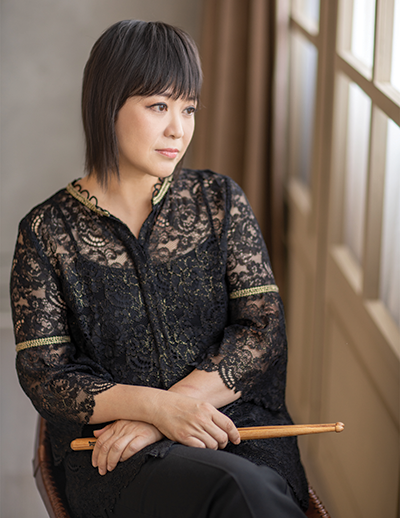
To say we look forward to hearing more from the inimitable She-e Wu is an understatement. I was fortunate to correspond with her to learn more about her plans for her upcoming clinic at PASIC 2026.
Laurel Black: Do you believe musical playing begins with analysis and interpretation?
She-e Wu: I believe every musical performance must include three essential components. First, is an emotional connection with the music. A performer must feel the music from the inside out; this should be their most important relationship with the piece. There is no app to teach how one should feel; it is a private and intimate connection upon which most other musical decisions are based.
Second, is an intellectual understanding of the music. This requires a thorough analysis of every element, including style, form, pitch material, counterpoint, harmonic progression, motivic or rhythmic development, articulation, gesture, and phrasing. It also involves studying expression, phrase, and breath markings, and range on the instrument. Physical performance requirements inevitably must be considered from the intellectual perspective, including specific strokes and techniques at various tempi, appropriate arm weight distribution, and advantageous body positioning, to name a few.
Third, is the physical execution of the music. If a performer has an emotional connection and intellectual understanding but lacks the physical capability to execute the piece, their musical expression will be blocked. Having the physical ability to execute one’s musical imagination and ideas is a strict requirement.
Black: How do you take yourself from an overthinking headspace to an authentic musical space?
Wu: I treasure my “quality time” with the music I am working on. If I can feel the connection from a gut level, truly understand it intellectually from every aspect, and train my body to execute what is required to express how I hear it, then there is no room for anything else. To me, that is true authenticity.
Black: What’s the most common mistake you see that thwarts authentic musicality?
Wu: I want to share some thoughts on a topic I feel strongly about regarding music education and the impact of social media. One of my biggest pet peeves is how the constant availability of unfiltered social media videos leads most people to “hear” a piece of music via online platforms before they even form an idea of how it could exist in their own authentic musical imagination. I completely disagree with this approach. Once we listen to a recording or watch a video, we are immediately influenced by it, which permanently alters and pollutes our purest musical connection to the piece. It becomes incredibly difficult to develop authentic musicality when being pulled in different directions by outside influences.
I cover this concept in my lecture, “How to Learn Music,” where I discuss our standard learning methods versus how we can improve upon them. My advice is to avoid listening to any recordings of a piece until you have formed a personal connection with the music, studied it thoroughly, and can execute your own musical ideas. Once that foundation is established, you should absolutely check out what is “out there.” With an authentic idea and an educated basis already formed, you will then have a real foundation to listen to other recordings and critically evaluate their interpretations.
Black: Have you chosen any compositions to use in your clinic?
Wu: I am still finalizing the details, but I plan to play excerpts from various pieces. I will definitely be performing some Bach — which might not be the easiest choice in front of thousands of percussionists, but I love the music and want to go for it!