

Let Them Play Like a Girl
Let Them Play Like a Girl
by Raychel Taylor
Percussive Notes
Volume 64
No. 5
October
2026
The article “Let Them Play Like a Girl” by Raychel Taylor discusses gender-specific challenges faced by girls in percussion and band programs, such as lack of representation and societal pressures. It emphasizes the importance of educators recognizing these issues and implementing strategies like creating respectful, inclusive classroom norms and building supportive cultures. By addressing these obstacles and fostering positive environments, educators can increase girls’ engagement, confidence, and sense of belonging, benefiting all students in the program.
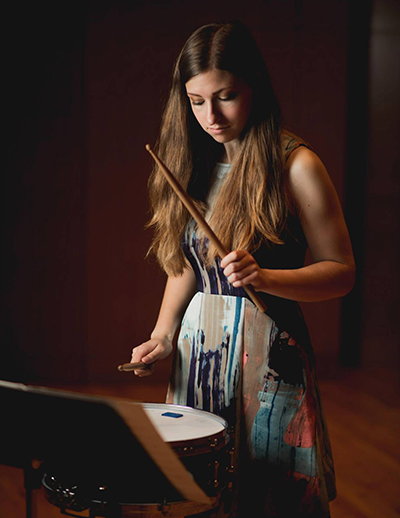
The first goal of my PASIC 2026 clinic is to help educators be more aware of gender-specific issues that may exist in classroom or ensemble dynamics, and then give educators the tools to work through those issues. Some of these strategies include: co-creating classroom norms that explicitly value respect and shared leadership across genders; building a culture that fosters inclusivity; eliminating gender assumptions around abilities, emotions, leadership, and opportunity; and establishing practices that increase student engagement, confidence, and sense of belonging in your program.
Girls face unique challenges in percussion and band programs due to a lack of representation among professionals in their field and insufficient education about gender-specific issues for their teachers. I have more than a decade of experience teaching in high school band and percussion programs, in addition to many years of running Girls March summer camps specifically for female percussionists; thus, I have had countless opportunities to observe students’ experiences, listen to their testimonies, and develop an approach to teaching that centers social-emotional awareness. Even though this presentation centers women and girls, it is also important to acknowledge that by improving our classrooms and ensembles for the girls in our programs, we automatically improve the environment for all students.
Many of our assumptions about women and girls are socially ingrained and should be wrestled with or questioned accordingly. In this session, I hope to encourage educators to reflect on their experiences, analyze whether a mindset adjustment is needed, and seek out tools to make a change.
The first time I realized I needed a perspective change was as a student at the University of North Texas. Being part of a highly competitive program as a gender minority made me ask one important question: why did I feel especially competitive with the other women in the program? The answer was in part because there were fewer of us, so we felt extra pressure to always represent ourselves as best as we could, but also because our existence in society is inherently competitive. Women are often pitted against each other socially, so I made a conscious choice to extend a hand in friendship to the other women in the percussion studio. That was when my mindset shifted and I began to recognize patterns of women being treated differently among their peers, teachers, coworkers, and employers. While I certainly had negative experiences, the catalyst for this change was brought on simply by me questioning the way I thought about myself and the other women around me.
You may be wondering why any of this matters, or why you should care. In the words of my mentor Sandi Rennick, “As educators, we need to understand the power of our words.” One interaction can completely change the trajectory of a student’s future. I have seen this ring true time and time again. Most of us can point to a time in our life where one pivotal experience — positive or negative — either affirmed our pursuit of a career path or caused us to almost quit entirely.
While some of these experiences may be universal to people of any gender identity, women and girls face additional hurdles that may seem invisible to others. If we want girls to continue playing past junior high and high school, then as educators we must acknowledge what those obstacles are and try to address as many of them as possible. Hurdles may take many forms, such as being discouraged from playing by teachers or being actively excluded by peers. Simply feeling like you don’t belong is enough for many students to want to quit. Feeling singled out by a teacher in a way that feels unbalanced or unfair can also be an undue hardship for students. Some may feel like they need to be pioneers on a given professional path. Not everyone wants to be the first person going into the jungle, and it takes a lot of work to hack away at the undergrowth to clear a path for others. Students are not always aware of the trailblazers; therefore, it is our job as educators to ensure that students see people who look like them being successful so they understand that paths do exist. This requires us as educators to have knowledge of the trails and the trailblazers, so that we can guide students to available paths.
Many of these hurdles are avoidable if we as educators think about how we speak to students and intentionally build spaces where all students thrive and feel that they belong. This means that we need to create an environment where students feel safe to express themselves and have room to work through challenges and struggles without fear or judgement. It means providing spaces for students to feel big emotions even within a competitive, high-achieving environment. It means fostering positive interactions between teacher and student and peer to peer. It means learning how to navigate social dynamics and overcoming stereotypes within the percussion section.
And yes, it means letting them “play like a girl.”
Raychel Taylor is an educator, performer, and arts entrepreneur in northern Illinois. Motivated by her passion to provide young female percussionists with direct access to female mentorship, Raychel created Girls March, an organization that advocates for women in the marching arts. Raychel serves as the Director of Percussion at Prospect High School and is a performing member of berimbau sextet Arcomusical.