

Juan Carlito Mendoza: Applying What We Practice to Music
Juan Carlito Mendoza: Applying What We Practice to Music
by Colleen Clark
Percussive Notes
Volume 64
No. 5
October
2026
Juan Carlito Mendoza is an internationally recognized drummer, educator, and author who balances his career as a middle school band director with subbing on Broadway shows like The Lion King and Hamilton. After earning a degree in music education and directing high school and middle school bands, he won the 2012 Guitar Center Drum Off, which boosted his performance opportunities. Mendoza emphasizes the importance of applying technical skills to musical contexts and focuses on practical, purposeful practice. His clinic at PASIC aims to simplify complex information, encouraging efficient, patient practice that connects technique to real musical situations. Subbing on Broadway requires adapting quickly to different setups and replicating the nuanced style of primary drummers, which Mendoza finds both challenging and rewarding.
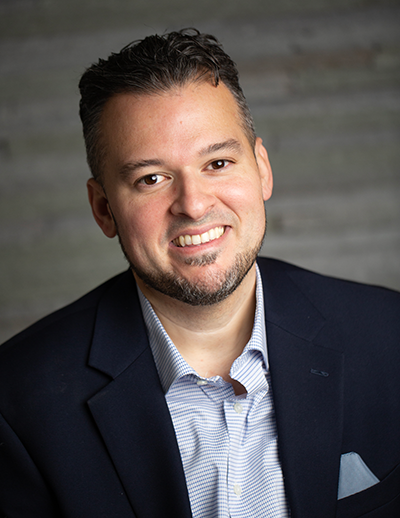
Juan Carlito Mendoza is an internationally recognized drummer, educator, and author who subs on Broadway’s The Lion King and Hamilton, won the 2012 Guitar Center Drum Off Grand Championship, has appeared on NPR Tiny Desk and Drumeo, and is a middle school band director. Mendoza’s story is inspiring as is his approach to practice. His clinic will cover ways in which to apply practice directly to musical scenarios.
Colleen Clark: Introduce yourself to Percussive Notes readers.
Juan Carlito Mendoza: I went to college for music education. I got my bachelor’s degree in that and immediately transitioned into being a high school band director. Six years later, the middle school band director job opened up in my district. I was like, “This is what I really want to do.” On top of that, I could get out at 2:45 and I had time to go get my masters. I’ve been teaching at the public school for 23 years. During that time I was playing, and then the Guitar Center Drum Off thing came up. I was fortunate to win that competition, and things have exploded since then. Now I am subbing for Carter McLean atLion King on Broadway, which has been awesome. About three months ago, I started subbing onHamilton. There’s a lot of things going on between teaching and subbing on Broadway, but I’m blessed to do it.
Clark: Was playing on Broadway something you had wanted to do as a youngster or was that something you worked towards later?
Mendoza: I did some musical stuff in high school, and I dug it a lot. One of my best friends hipped me to the Lion King soundtrack. I heard the drumming and I was like, “Wow, this is a really good show.” So when I started college, I started doing musical productions, too, for different high schools. Then, when I graduated college, I was recommended to do a regional theater thing called Plays in the Park. I did that for about five or six years. It was great because every couple of weeks was a new show. So, I got to learn a lot about how to manipulate different setups and how important the implements that you play with are. Learning those skills translated a lot into learning these books on Broadway.
I went to the first Drum Fantasy Camp, and Dave Weckl was all about making sure you adjust all your settings to your ergonomics before you start playing, and people wouldn’t do it. I did it, thank God. It’s important, but there are times where you don’t have that luxury. I don’t have that luxury subbing at Lion King or Hamilton. Every show has its own challenges, but the physical aspect is tricky, at least on Broadway. Studying the way these guys play is an art form in itself. Trying to replicate, say Carter McLean, is a feat in itself because his touch is immaculate and his musicality is great. It’s so cool that they trust me to come in there.
Clark: Talk about your plan for your PASIC clinic.
Mendoza: There’s so much information out there, but I think the problem now is there’s not enough focused information. Hopefully I can give information, but show you how to apply these concepts immediately into an actual real-world situation. For example, playing five-over-two is a cool skill to have, but how are you going to apply that musically? That’s my goal now, especially because I’m older. When you’re younger, you have time to explore all those possibilities. You’ll need it from time to time, but for me, what’s the musical purpose of what we’re doing in the practice room?
That’s the goal of the clinic. The first thing you need is the technical skill to apply whatever it is that you’re trying to apply musically. I’ll break down certain things technically. It could be, why do we play this rudiment? Here are some musical applications of how you can do this without forcing it. A lot of what we deal with in the practice room is how do we apply this to music? Sometimes you’re forcing a situation that doesn’t need to be forced. You apply rudiments because it goes with the phrasing of the music. That’s my approach. We have all these technical abilities and skills, but how do we apply them to music and, most importantly, how do we practice in the practice room?
A lot of the issues I’ve seen with my students is that they have all this information, but they don’t know how to tackle it in a simple way. I think we make things into rocket science sometimes when it’s not that hard. For example, let’s say somebody’s having an issue with a flam accent. Let’s break down what the motions are first, because it’s really about the motions and how those motions affect the sound of the instrument. That’s how I want to approach it.
I’m going to do some timing exercises, too, including how to practice with a metronome. A lot of these things have applied for me, especially with Hamilton. They have a click 99% of the time, but the way they play within that click is different. I learned that the click is on, but listen with your ears and adjust to the ensemble. Sometimes the click is not the most important thing. Most of the time it’s let’s make this feel good so it doesn’t sound like I’m out of place or forcing myself into something that is not going to work out.
Clark: What do you hope that your PASIC audience takes away from your clinic?
Mendoza: I want them to understand that it’s an endeavor, but it’s not impossible to put things together. It’s more of a way to get focused on whatever goal you’re trying to accomplish. That’s the biggest thing, because there’s so much information out there that sometimes we don’t know how to consume it. Let’s take this into bite-sized pieces and come up with a simple plan so that you can be efficient and effective. That way, you get motivated every day to keep practicing, and then you’ll get to that goal eventually. A big thing as well is knowing it’s going to take patience. It’s going to take time. Knowing that failure will lead to success eventually, so don’t be afraid of failing.