

Improvisation, Aesthetics and Assessment
Improvisation, Aesthetics and Assessment
Centering art and creativity within the collegiate percussion studio
by Dr. Quintin Mallette
Percussive Notes
Volume 64
No. 5
October
2026
Quintin Mallette’s article discusses integrating improvisation into collegiate percussion lessons to enhance technical skills and foster creativity. He found that students initially resist improvisation due to familiarity with strict notation but gradually engage through exercises based on chord progressions, especially from blues and pop music. This approach encourages deeper musical analysis and a composer’s mindset. To address the challenges of assessing improvisation, Mallette employs flexible rubrics and self-assessment tools like journaling and recording. His praxial philosophy embraces both traditional repertoire and creative exploration, enriching students’ musicianship in classical percussion education.
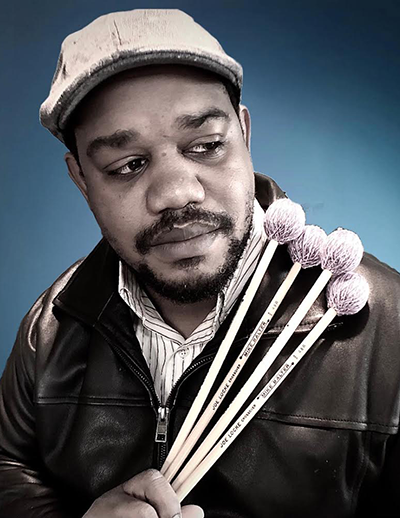
My virtual PASIC 2026 presentation explores how improvisation can be incorporated into weekly applied percussion lessons to support technical development and creativity. By approaching technical development using improvisational exercises, I have seen my students analyze pieces and etudes, often pulling out key themes and phrases, more deeply than before. I believe that the process of improvising helps them to think like a composer and in turn creates more appreciation when studying the compositions of others, whether in method books or stand-alone pieces. Since improvisations can be hard to assess I have come to rely on a variety of assessment strategies to provide clear feedback to my students.
Alright, it’s summer and it’s time to get my hands back in shape! Let me pull out Green, Delecluse, Pratt, Lefevre, Wilcoxin, and the list goes on. The method book is at the core of my professional preparation, as it allows me to focus on my sound, execution, and many other technical skills. At the same time, as an educator, I have noticed that several of my students lacked the same “all-in” approach to method books, with them often trending towards a box-checking mentality. I began to wonder if there was something I could do to impact what I perceived as a “lack of initiative.”
I recognized that I had been harboring a belief that my students would not be prepared for the “real world” unless I taught them “_____.” As an educator, I know this to be false. I do not believe that any specific repertoire or etude will determine my students’ potential. So, I began to imagine a curriculum where it was easier for me to meet my students where their interests were. The special challenge for me was trying to do this while still giving them the skills I felt they needed to succeed in our field’s shifting landscape. To do this, I revised my curriculum to one that was less reliant on method books. I began to incorporate more improvisation as a core piece of my weekly applied lessons, and I noticed that many of the technical skills I was encouraging my students to learn came up naturally. These included such foundational skills as rudiments, scales, and stroke types, as well as a variety of advanced techniques across the instrument family.
INCORPORATING IMPROVISATION AS TECHNICAL PRACTICE
One of the first things I noticed was that many of my students were hesitant to improvise. Many of them have spent a great deal of time reading music notation; the idea of “making something up” felt vulnerable. To overcome this, I began incorporating small improvisation exercises in place of two- and four-mallet technical exercises. This took many forms but was especially useful when incorporating chord progressions. Instead of checking off scales, I began to have them play in key areas to warm up. For four mallets I began to introduce a series of chord progressions informed by blues and pop music. The students and I would take turns improvising melodies and accompaniments over these progressions.
As they grew more comfortable with different progressions, they began working on them with each other outside of lessons. They intrinsically became interested in different ways to play these progressions as accompaniments. Together we were able to explore diverse topics such as sequences, motives, chord substitutions, and different techniques such as rolls, double and triple laterals, and mixed strokes in a musically centered way. Paradoxically, this often allowed me to lead them back to various method books to give them more materials to explore.
The resulting buy-in was something I hadn’t noticed before and led me to expand this model to other instruments and repertoire, with us often using improvisation to develop speed, phrasing, limb independence, and to create targeted technical exercises in real time. In this context the targeted technical exercise is an exercise that students can develop and transpose through major or minor key areas. Once they can play through these exercises in multiple key areas, the original problem from the repertoire usually goes away.
At its core, improvising in this way was not about using improvisation for performance; rather, it was about fostering creativity. As my students began to approach pieces in more creative ways, they began to apply this creativity to other aspects of their playing, leading them to bring fewer technical struggles into their lessons.1, 2 The problems we began to address in lessons became more nuanced. While students would still bring technical issues, they often had applied multiple strategies first, leading us to develop more together. As a result, I found myself improvising more in lessons as a way to create exercises and/or musical experiences to work on sound, phrasing, touch and interpretation in a way that felt organic and personalized to their repertoire or specific problems.
AESTHETICS AND MUSIC PEDAGOGY
This process felt like a success, yet I found myself wondering if this adventure was too far afield from what I should be focusing on in lessons. After all, a music education major should know the canonic repertoire well enough to mentor future students, performance majors should develop a facility advanced enough to be marketable for careers and or graduate school, composition students should know the percussion idiom well enough to build on it, and the list of “should knows” goes on. To quiet this inner critic, I found support in the music pedagogy literature, specifically that of foundational music philosophers Philip Alperson and David Elliot, both of whom promote a praxial theory of music education.3 This theory promotes the concept that value in music extends beyond a piece of music as we hear it, but includes music in a holistic sense, including its surrounding culture.4 In this way, when I take time to depart from teaching more standard books or pieces, I make room for my students to apply their classical techniques in less traditional ways.5 This comes at the cost of losing exposure to some of the pieces and experiences that those in our field have held as standard.
My students will probably never play through a method book cover-to-cover in their lessons, as I experienced. However armed with a praxial lens for music education, I am able to see them meet my learning objectives in a way that works for them and find ways to supplement any missing knowledge in other ways.6
DEVELOPING RUBRICS THAT SUPPORT CREATIVITY
Despite renewed confidence in centering improvisation in the applied curriculum, I was faced with the very real problem of assessment. While many of my fellow educators have been encouraging, in conversations they share the same concern with practical implementation. For this I turned to the emerging research on assessment, much of which focuses on the importance of rubrics.7 This research highlights the variety of ways in which rubrics can be vital for providing meaningful feedback to our students. Rubrics have become a key piece of my grading strategy and have allowed me to decenter participation and attendance from my students’ grades over the years. However, how do you create a rubric for an improvisation?
While the answer to these questions are individual, I have found that rubrics can be open and flexible. Through brainstorming the key components, or themes, from my learning objectives I am able to assign a quantitative value towards a qualitative theme. Using standard rubric templates, I can rank and arrange these themes to align with their importance towards my ultimate curricular goals. These rubrics are easy to implement and create a record for students to see how they are progressing despite the ambiguity that improvisation can bring.
Alongside rubrics, self-assessment strategies such as self-recording and journaling have allowed me and my students to quickly check in with what is working and what still needs work. Journaling and self-recording have become standard in music pedagogy over the past few decades. I will save an in-depth discussion of their implementation for the virtual PASIC session.
Through integrating improvisation into my applied percussion curriculum, I have experienced how creativity and technical development can co-exist. In this way improvisation can allow for student ownership over their technical growth while also making room for applying this technique in non-traditional ways.
I look forward to sharing my virtual PASIC session where I will discuss practical tips and strategies I use for implementing improvisation within my applied percussion curriculum. My session will include lesson demonstrations, sample rubrics, and self-assessment prompts. There will be time for questions, so I hope you will log on and share your teaching and learning experiences with me as well!
ENDNOTES
1. The literature on creativity often outlines a cyclical five step process of Preparation, Letting go, Germination, Assimilation, Completion, and Preparation for the next idea. This maps on to my experience and is something that should be researched in the future.
2. Kelly,The Psychology of Personal Constructs,374–375; Craft, Creativity Across the Primary Curriculum, 30–32. While many have written and referred to the topic, George Kelly is likely the first to coin the term the creativity cycle. While the author is familiar with the cycle from the work of educator Anne Craft, Kelly notes that the Creativity Cycle is one that involved loosening and tightening in thinking that then shifts to a new topic or context.
3. Alperson, 1991; Elliott 1995.
4. A praxial view of art sees the artistic work in a holistic sense to include both the aesthetic and non-aesthetic functions surrounding it. This philosophy of teaching situates the value of music as both the process of making music and the culture that surrounds this music-making. This perspective could include the different physical and emotional spaces where the music is received as well as the many different functions that the music can have.
5. The term “less traditional” is used here to refer to the inclusion of popular and other commercial music as source material for improvising. The intended goal is to highlight these art forms as an avenue for developing musicianship within the classical percussion curriculum.
6. I have included standard repertoire in studio class, through allowing students to select their pieces for juries or recitals beginning freshman year, and in my faculty recital programming.
7. Wesolowski, 2012; Moura et. al., 2024; Coban & Özgen, 2021.
REFERENCES
Alperson, Philip. “What should one expect from a philosophy of music education?.” Journal of aesthetic education 25, no. 3 (1991): 215–242.
Coban, Emre, and Özgen Korkmaz. “An alternative approach for measuring computational thinking: Performance-based platform.” Thinking Skills and Creativity 42 (2021): 100929.
Craft, Anna. Creativity across the primary curriculum: Framing and developing practice. Routledge, 2000: 30–32.
Elliott, David J. Music matters: A new philosophy of music education. Oxford University Press. (1995).
Kelly, George. The Psychology of Personal Constructs: Volume Two: Clinical Diagnosis and Psychotherapy. Oxford: Taylor & Francis Group, 1991. Accessed August 6, 2026. ProQuest Ebook Central.
Moura, Nádia, Pedro Dias, Lurdes Veríssimo, Patrícia Oliveira-Silva, and Sofia Serra. “Solo music performance assessment criteria: A systematic review.” Frontiers in Psychology 15 (2024): 1467434.
Wesolowski, Brian C. “Understanding and developing rubrics for music performance assessment.” Music Educators Journal 98, no. 3 (2012): 36–42.
Dr. Quintin Mallette is the Assistant Professor of Percussion at East Carolina University. He is a section percussionist with the Fayetteville Symphony and regularly performs on percussion and timpani throughout the southeast. His research interests focus on assessment and performance studies.