

Identity through Rhythm: A conversation with Matt Garstka
Identity through Rhythm: A conversation with Matt Garstka
by Colleen Clark
Percussive Notes
Volume 64
No. 5
October
2026
Matt Garstka, a drummer known for his work with Animals as Leaders, discusses his musical upbringing and passion for education. Growing up around a music store with educator influences fueled his curiosity and dedication to teaching. He approaches rhythm through three lenses: subdivision, grouping, and time signature, exploring complex concepts like metric modulation and clave. Garstka aims to inspire attendees at PASIC to find their own rhythmic identity within the vast world of rhythm. He emphasizes the importance of sharing knowledge and embracing diverse musical cultures, mentioning his current fascination with djembe and African music.
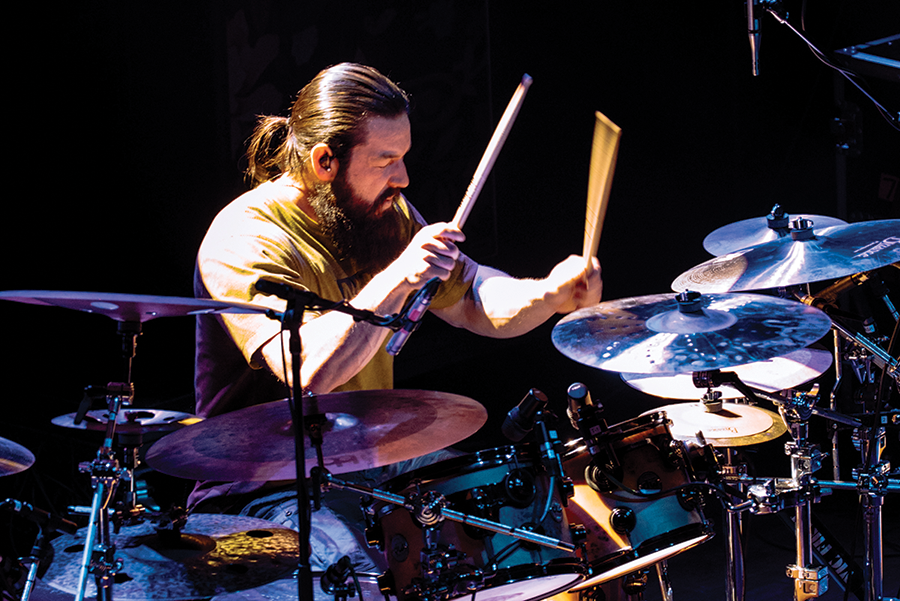
Matt Garstka grew up in a musical household in Massachusetts. Having spent his childhood years in and around a music store, he was surrounded by educators, which has greatly influenced his curiosity and dedication to education. Garstka toured multiple times with Gokh Bi System while still a student at Berklee. In 2012, Garstka joined the Animals as Leaders and has been with them since. He is dedicated to sharing knowledge and is committed to creating online lessons centered around time. His playing explores metric modulation, odd time and groove.
Colleen Clark: Introduce yourself to the Percussive Notes readers.
Matt Garstka: I grew up in a musical household. I’m influenced by pretty much all styles of music, and so I like to use those to dive into the abstract mathematical components of drumming as well. So to me it’s just all different colors and shapes.
Clark: How are you going to break that down in your clinic?
Garstka: There are essentially three kinds of ways I look at rhythm. One is by subdivision, one is by grouping, and one is by time signature. Once we outline all the numbers involved in each of those, you see that you can build worlds within worlds. We’ll do that kind of relating it to clave as well. I’m going into metric modulation via clave.
Clark: What do you hope PASIC attendees take away from your clinic?
Garstka: Inspiration and knowing that it’s a massive world of rhythm in which there’s enough room for everyone to carve out their own identity.
Clark: You seem to be so inspired by teaching. Do you think that teaching inspiration came from growing up around a music store and having that in your family?
Garstka: Absolutely. It came from the people I was around and inspired by, and I got used to learning. A lot of exciting things happen when you do that. I want to share that because it’s fascinating what we can do nowadays and how open we are to cultures all over the world. I’m in a djembe phase right now like crazy. I just can’t stop it. I was in an African band in my teenage years.
Clark: Would you like to send a particularly special message to Percussive Notes readers about your upcoming PASIC experience?
Garstka: A big thank you to all the readers for continuing to support events, magazines, education, and events like this.