

Effect to Expression
Effect to Expression
by Ross Karre
Percussive Notes
Volume 64
No. 5
October
2026
The article “Effect to Expression” by Ross Karre discusses the evolving role of percussion in 21st-century orchestral music. Modern composers increasingly collaborate with percussionists using unconventional techniques—such as bowed instruments and friction mallets—to create new sonic languages that move percussion sounds from mere effects to core expressive elements. The article identifies three main categories of these sounds: phenomenological (focused on the listener’s perception), morphological (requiring temporal control over sound characteristics), and denatured sounds (unrecognizable, transformed sounds). Karre argues for a shift in percussion pedagogy toward mastering the physics of sound production, advocating for percussionists to become experts in sound cultivation beyond traditional techniques. These innovations are becoming integral to major orchestral premieres worldwide.
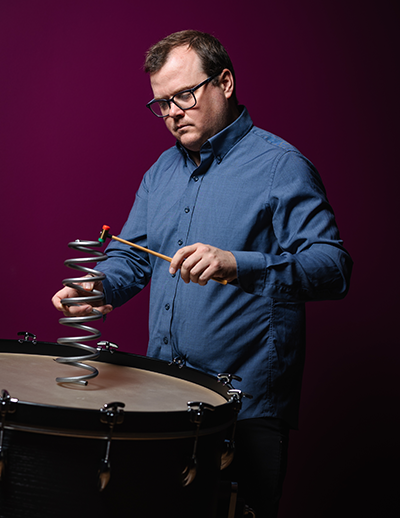
The quantity of sounding objects used in the percussion section, and the manner in which they are set into vibration, is staggering. Bowed instruments, friction mallets, and hybrid instrument constructions are common in world premieres in every major orchestra. Once relegated to the realm of incidental sound effects, these sounds are now core aspects of frequently performed, modern orchestral works. The refinement of approach for these more specific sonic outcomes warrants a broadening and reorientation of the pedagogical priorities of percussion in higher education.
For composers in the 21st century, collaboration with percussionists specializing in less conventional sound production will likely occur at a formative stage in their creative development. In the United States, dozens of composers have cultivated their creative voice with artists in Sō Percussion, Third Coast Percussion, Sandbox Percussion, International Contemporary Ensemble, WildUp, Alarm Will Sound, Talea, Yarn/Wire, and myriad groups outside of the United States. In these contexts, sounds are cultivated slowly, collaboratively, toward new sonic languages that shift the role of friction percussion from sound effect to sound expression. After working with these specialist chamber groups, the same composers have been given opportunities with major symphony orchestras around the world. The language of orchestral percussion is changing.
In the same way that triangle, tambourine, and cymbals expanded and deepened their expressive potential in the 19th century, activating sound objects in the 21st century is in service of three dominant categories: phenomenological, morphological, and denatured sounds.
Composer-percussionist collaborations prioritizing phenomenology take the whole sound, as perceived by the listener, as the site for exploration and refinement. It is no longer sufficient for the Superball mallet or double bass bow to simply make a generic sound effect but, rather, to achieve a specific sound outcome through variations in pressures, velocities, and coefficients of friction between the implement (for example: the bow), the object (for example: the cymbal), the modifier (for example: the muting hand), and resonator (for example: the timpano on which the cymbal is placed). In this modality, expressive virtue is a byproduct of the command and consistency of every feature of the sound. As Rimsky-Korsakov, Prokofiev, Stravinsky, and Ravel beckoned new dimensions of nuance on the snare drum, composers like Anna Thorvaldsdottir (in 2025–26 performances by Minnesota Orchestra, Detroit Symphony, Belgian National) require expressive command of the bow, the Superball mallet, and other friction methods. In her scores, and in the hands of her collaborators, these are not only incidental effects, but they are also core to the expressive language of her music.
Morphological sound languages, as a natural extension of phenomenological approaches, require temporal control over audible sonic characteristics. Like the slow progression from arco sul ponticello to sul tasto on cello (for example), morphological sound in percussion requires skilled manipulation of the implement, object, modifier, and resonator over specified durations. Several passages in the works of prominent and popular composer Jörg Widmann (in 2025, performances by the Cleveland Orchestra, Chicago Symphony, Royal Concertgebouw), require the percussionist to control the resonance characteristics of a tam tam with specificity rarely requested of the instrument (in the Western European symphonic music context). The control is exerted over the duration of the expression, morphing the sound from broad spectral noise to filtered partials.
In numerous cases, composers look to challenge the nurtured natural (the familiar, the expected, the conventional) sound of the object to that which cannot be identified. In this mode, the denaturing of sound is a priority. The object replaces its familiar historical context with a context unique to the imagination of the listener. Unplaceable, unidentifiable sounds coax the audience to suspend their familiar expectations and embrace new languages. A China cymbal on a timpano struck with a hard vibraphone mallet (such as that used in Liza Lim’s “How Forests Think”) concatenates and convolves the sound such that neither cymbal nor timpano is recognizable. The sound is vaguely animalistic and highly evocative of the post-industrial anthropocene. Liza Lim has made expressive use of denatured sounds in her works, which have been performed by the Bavarian Radio Orchestra and Melbourne Symphony (among others) in 2025, as well as dozens of others in years prior. When hearing denatured sounds, the images conjured in the listener’s mind’s eye are unique to each audience member.
The efficiency of the orchestral rehearsal convention creates a compromised circumstance for the cultivation of these sound languages. Complicating this, 19th- and 20th-century percussion fundamentals of technique (the result of countless hours in the practice room at music conservatories) are not transferable to the physical characteristics of these three modes. Does the professional and pedagogical percussion ecosystem need a re-evaluation of what constitutes a fundamental technique? George Lawrence Stone and George Hamilton Greene’s schools (not to mention the fundamentals of crash cymbals, tambourine, or triangle) may have less utility in modern orchestral premieres than ever before. However, it is premature to dispense with these fundamentals since they cultivate an attention to craft and detail that is itself transferable to new sonic languages and essential to the 19th- and early-20th-century repertoire that remains the majority of programming. This fact, coupled with the humble recognition that sounds modeled in the categories above aren’t difficult to achieve (but require a reorientation of priorities), fosters a relatively clear path forward. Our definition of “fundamental technique” must shift and expand from the physiological to the physical. Percussion instructors can shift the focus from the human body and its capabilities toward a comprehensive expertise of the physics of objects set into vibration — a shift from “stick control” to “sound control” (increasingly, without the sticks).
In practice, this involves positioning friction percussion alongside 19th- and 20th-century techniques involving tambourine, cymbals, bass drum, and triangle in lessons, clinics, and classes. The application of the same care that has inspired generations of cymbal and tambourine development is also required in modern percussion languages. Percussion instructors and performers must model the same curiosity and care for sound cultivation across every object and method. Following that, exercises, etudes, and excerpts involving these sound languages could be composed and included in lesson assignments. While the practical curricular impacts are important to consider, the real shift comes in a broadening of how we define our expertise. I believe we should inspire percussion students to become experts in sound cultivation, regardless of the implement or object in front of them.
As a percussionist of the International Contemporary Ensemble (15 years), I have worked with hundreds of composers in the creation of their percussion parts. These composers (Suzanne Farrin, Marcos Balter, Anna Thorvaldsdottir, Ash Fure, and Anahita Abbasi, to name a few) now work with major orchestras around the world. With these composers, I have worked carefully to elevate unconventional sounds to the consistent performance expectation of other high-stakes, ultra-sensitive techniques such as tambourine finger rolls, exposed soft drum rolls, and delicate triangle or cymbal work — to elevate sounds from “effect” to “expression.”
These sounds are now commonplace, not fringe rarities. They are a core language of a substantial number of world premieres with major orchestras. In this PASIC clinic, we will move these sounds from a place of consistent inconsistency toward the capability of setting any object into the desired vibrational expression. Every time. Without failure.
Ross Karre is a percussionist, filmmaker, and producer based in Oberlin, Ohio, and New York City. He is the Associate Professor of Percussion at Oberlin Conservatory. After completing his Doctorate in Music at UCSD with Steven Schick, Ross formalized his visual studies with a Master of Fine Arts. He is a percussionist for the International Contemporary Ensemble, where he was artistic director from 2016 to 2022. He has performed regularly with red fish blue fish, Third Coast Percussion, and Yarn/Wire.