
Castanet Technique
Castanet Technique
by David Valdés
Percussive Notes
Volume 64
No. 5
October
2026
The article by David Valdés addresses the neglect of proper castanet technique in orchestral percussion due to its technical difficulty. It contrasts the older, simpler “Jota” technique, involving holding castanets on the middle finger with shaking strokes, to the more refined “Escuela bolera” technique where castanets are held on the thumb allowing intricate patterns. Valdés advocates for the “Jota technique”—which produces natural double-strokes and richer phrasing—demonstrating its advantages in musicality, ease of playing rolls, dynamic control, and its applicability to orchestral repertoire such as Ravel’s “Alborada del Gracioso” and Wagner’s “Tannhauser.” He emphasizes that proper technique leads to better phrasing and musical expression, urging percussionists to avoid substitutes and embrace traditional methods that can be learned quickly.
Castanets are, probably, the most neglected instruments when it comes to orchestral percussion playing. Because of their inherent technical difficulty, percussionists have used all sorts of substitutes to play them while avoiding learning proper technique. That, sadly, produces very poor musical results. “Flamenco”1 technique is, indeed, a very developed and capable technique but, also, a very difficult one to master. It presents a steep learning curve, and the benefit versus time-spent-to-develop-it ratio is not very attractive. That may be the reason why percussionists, seeking for immediate benefit, avoid learning a difficult technique and resort to a plethora of mechanical devices and tricks. Those techniques developed in the 18th century when dances like the “seguidilla” and the “bolero” became very popular. It was then that the castanets started to be held on the thumb, freeing the other four fingers and, thus, allowing for very intricate patterns to be played. By the second half of the 18th century, a Spanish school of dancing (“Escuela bolera”) was already developed; a national affirmation versus the French and Italian influences that was also reflected in music, dancing, clothing, theatre, and literature, heralding the still-to-come Romanticism.
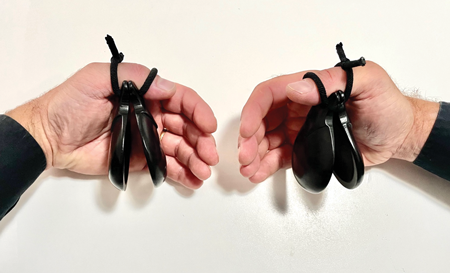
This is how the castanets are held in the “Escuela bolera”:
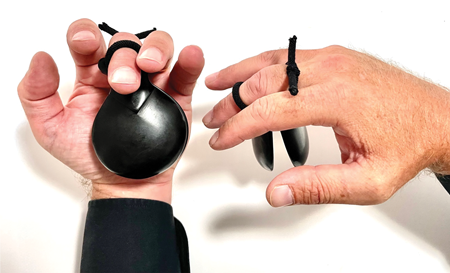
Before that, the “Jota” was in trend — a more vigorous dance, less stylized, that features many jumps. This older style did not allow for a “refined” castanet technique (nor it was needed), so the instruments were held on the middle finger, the technique consisting, basically, of shakes inside the palm of the hand. This is how the castanet is held in this older technique:
As it happens very often, one just has to look back to tradition, to folklore, to knowledge treasured generation after generation, to find a “modern” solution to a “modern” problem that was already solved centuries ago. That is why percussionists cannot ignore the old, trusty, traditional techniques that have proved their value for many centuries. This latter, older technique (with slight modifications) is the one that I will be demonstrating and teaching at my PASIC 2026 session. From now on, I will name it “Jota technique,” and its main and distinctive benefit is that, by default, it produces a double-stroke. We do not have to try hard; by simply moving our middle finger using a piston-stroke, the castanets will produce two sounds. One motion, two sounds. Simple, efficient, and elegant as a double-stroke on snare drum.
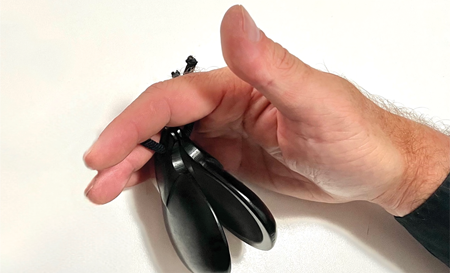
The single stroke is produced by not allowing the castanets to rebound (by pressing them against the palm of the hand). It is that simple!
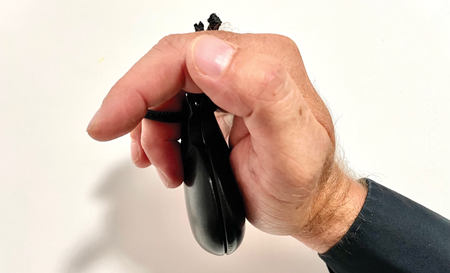
The “Jota technique” is not hard, and it can be understood and mastered in no time. It also offers the advantage that it can be linked and associated with the snare drum technique and studied in the same way, since the snare drum technique — I am simplifying, I know — is ultimately just a combination of single and double strokes. This technique greatly improves the musicality and phrasing that the castanets are capable of. With all those handles, machines, and devices, every passage becomes a repetition of single-strokes. That would be as if string players only used a continuous succession of down-bow strokes, which would result in very poor phrasing.
When playing on the usual devices, the phrasing is very poor due to using only single strokes (yes, you may repeat hands, but they are still single strokes). In the famous passage from Ravel´s “Alborada del Gracioso,” the alternation of single strokes does not produce interesting musical results. When using the “Jota technique,” any combination of singles or doubles can be used, producing a much richer phrasing (remember that the doubles are not a repetition of discreet single-strokes, but proper double-strokes produced by rebound. They are marked with a tie):
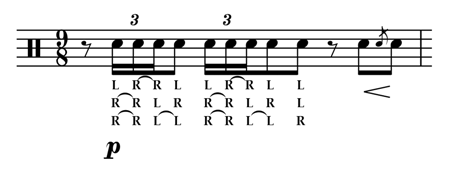
Of course, we can use also the reversed stickings, starting with the left hand. I can go with a single-stroke approach, too. This variety of stickings produces different phrasings, which result in a much richer musical expression. Notice that, on the example above, I have not indicated any stickings for the flam. That is because this “Jota technique” allows for a very interesting effect: the posticeo. It is produced by hitting the castanets against each other, which is done by simply moving our hands towards each other, the castanets colliding in front of our central body line.
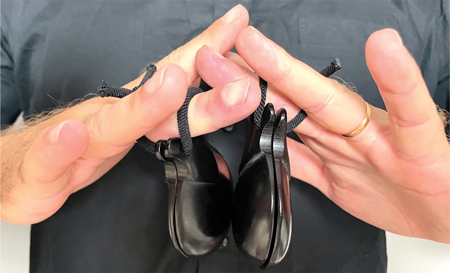
That produces a higher pitch, which perfectly mimics the melodic contour that we are accompanying/doubling in this passage, as all the instruments play an ascending motive. Also, it produces a flam, exactly what is written. Not only that; the “collision motion” to produce the posticeo produces a stronger sound, so there we have our crescendo. See how using the proper technique effortlessly produces the phrasing written by Ravel?
Want rolls? No problem. The “Jota technique” produces them very easily. The player just has to think an alternation of singles hand-to-hand, but allowing the castanets to rebound; this technique will produce its inherent double-strokes and, voilà!, we have our double-stroke roll, as on the snare drum.
Think, for instance, of Wagner´s Paris version of “Tannhauser,” which possibly features the longest castanet roll in the repertoire. It is very easily played using the “Jota technique.” Approach it as a double-stroke roll on snare drum and you will play this very long roll with no effort and very strongly.
We can also use the combination of singles and doubles that this technique allows for to play the following passage:
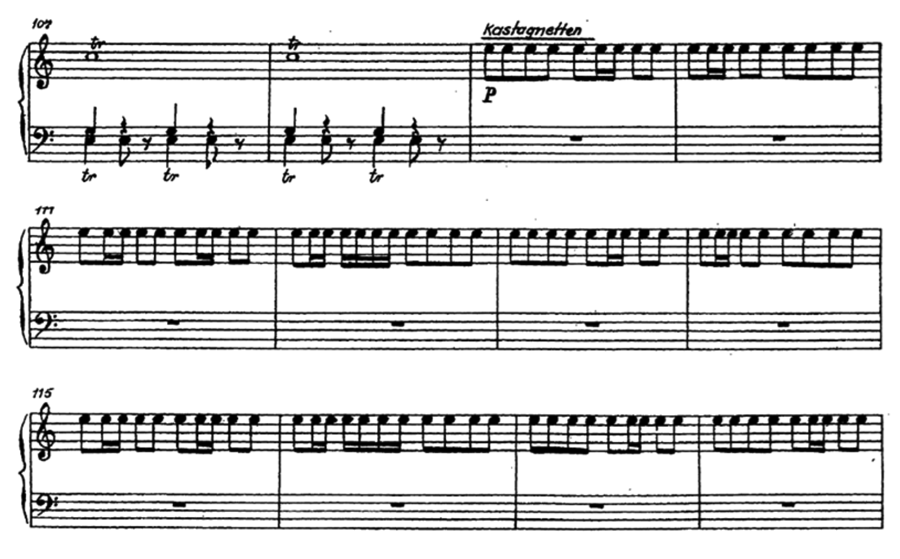
Use the singles/doubles capabilities of this technique and you will play this passage musically and using less energy, as you will be playing half the strokes.
But you may want to play shorter rolls. No problem! As with the snare drum, establish a “grid” as the basis for your roll and then let the technique double them for you. Check Korsakov´s “Capriccio Espagnol”:
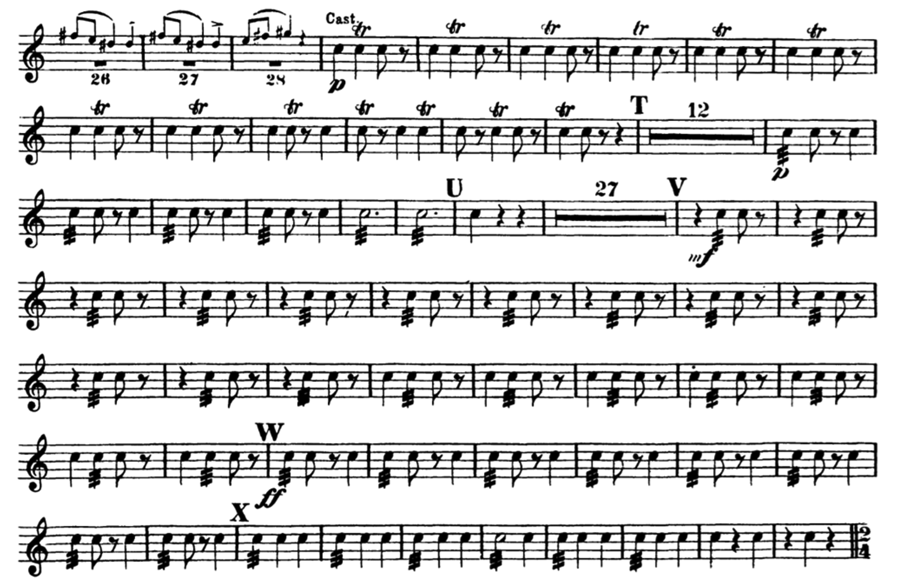
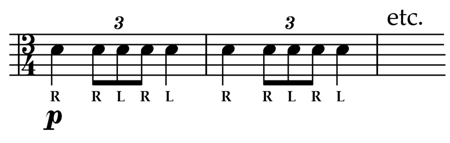
This is how I think of my grid (which, as on snare drum, will be very much tempo-dependant):
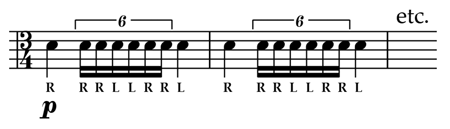
Then, it is very easily doubled, resulting in the following (which, at the indicated tempo, is a full roll):
The “Jota technique” also facilitates changes in dynamics. Playing castanets piano can be a serious challenge, but this technique allows easy “dynamic shaping” just by a slight change in how we hold the instruments. Let them hang by dropping the wrist and they will be hitting the thumb (a smaller surface) instead of the full palm of the hand (a much larger surface):
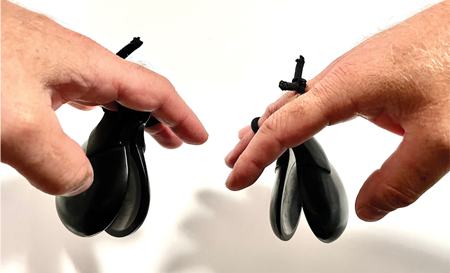
In my session you will learn how to hold and play the castanets using this technique. You will also see that it can be learned in less than five minutes and mastered in no time, so there is no excuse/need for resorting to substitutes. You will also realize that playing these instruments using proper technique is much more musical. Not to mention that, using this technique, the visual aspect of your playing will improve very significantly.
Please join me for a presentation that will combine applied technique, music-making, repertoire, fun, and a way of playing castanets that you may have never seen before!! I am sure that you will want to incorporate the “Jota technique” in your arsenal.
ENDNOTE
1. Although commonly used among non-Spanish percussionists, the term is incorrect, as flamenco did not exist until the very late 18th century (mid 19th century as we know it today). It is the same as naming the act of playing cymbals and bass drum simultaneously by just one percussionist “alla turca.” The term is incorrect, as Janissary percussionists never played that way (the davul player used both hands to play both heads, one with a thin rod, the other with a round stick. He would have needed three arms to play “alla turca”), but the expression, although incorrect, stuck. The same happens with “flamenco,” which is used indiscriminately with every Spanish music. The correct term would be “técnica bolera” or “escuela bolera.”
David Valdés studied at The Royal Academy of Music in London, where he gained his Postgraduate Diploma in Performance and his LRAM. David plays regularly with symphony orchestras and early music ensembles in Spain, Portugal, France, Poland, Russia, Germany, Norway, and the U.K. He has published a new critical edition of the percussion part of “Histoire du Soldat” using the original manuscript and sketches as the main sources. David has also published several early 19th-century works for tambourine and fortepiano, together with manuals on historical tambourine techniques. He is the founding member of Les Musiciens Domestiques.