

Beyond Performance: Teaching as Musicianship
Beyond Performance: Teaching as Musicianship
by Yun-Ju Pan
Percussive Notes
Volume 64
No. 5
October
2026
The article by Yun-Ju Pan explores the connection between percussion performance and teaching, emphasizing that teaching is an integral part of musicianship rather than a separate skill. Drawing from her own experiences, Pan advocates for incorporating pedagogy throughout percussion education, starting from undergraduate studies. She highlights the benefits of learning by teaching, such as deeper understanding, improved communication, and leadership skills. Through initiatives like the MSU Percussion Discovery Day, students gain authentic teaching experiences that boost confidence and musicianship. Overall, the article promotes teaching as a continuous, reflective, and creative process essential for developing well-rounded musicians and leaders.

“If you can play, you can teach… right?”
Growing up in Taiwan, my world revolved around solo percussion artistry. I believed the practice room was the source of all answers. If I could just master one-stroke efficiency on marimba, isolate polyrhythms, and polish advanced repertoire, everything else would fall into place.
Coming to the U.S. for graduate school introduced me to a dedicated Music Education degree — a concept that initially surprised me. But my first teaching job working with young percussionists shattered my assumptions. Demonstrating a fulcrum adjustment or explaining downstroke-to-upstroke motion that felt natural in my own hands left my students staring blankly. I realized performing is an internal art; teaching is an external bridge. I began asking questions I had never considered before: How could I explain a concept clearly? How could I help students truly understand instead of simply imitate? How could I create an environment where they felt confident enough to learn and make mistakes?
That experience transformed my perspective. I no longer focused only on becoming a better performer; I also wanted to become a better teacher. More importantly, I realized that teaching is a craft requiring intentional practice, reflection, communication, empathy, and continuous learning. I discovered that teaching is not separate from musicianship; it is musicianship. The same curiosity, discipline, creativity, and attention to detail that shape great performers also shape great teachers.
One idea that continues to influence my teaching philosophy comes from the Chinese saying 嫄鷃欞渮, often translated as “Never be ashamed to ask those who know.”It reminds us that true learning begins with humility and curiosity. Great educators never stop learning, and they are never limited by whom they learn from.
When I began teaching at the University of North Alabama, I quickly realized that some of my greatest lessons came from my own students. More than once, I spent several minutes explaining a concept, only to have another student explain it differently — and suddenly everything clicked. Those moments reminded me that effective teaching is not about finding the perfect explanation, but the one that connects with a particular learner.
Because students often communicate more naturally with their peers, I intentionally incorporate peer teaching into my studio. Teaching others requires students to organize ideas, anticipate questions, and deepen their own understanding.
As I began teaching at the university level, I noticed a recurring gap. Many percussion majors were accomplished performers but felt unprepared to teach. They could demonstrate a technique yet struggled to explain why it worked, adapt instruction to different learners, or lead a classroom with confidence. That realization led me to rethink how pedagogy is integrated into the undergraduate percussion studio. Rather than treating teaching as something students learn after graduation, I wanted it to become part of their musical development from the very beginning. If teaching is musicianship, learning to teach should not be the final step in a percussionist’s education: it should be woven throughout the entire journey.
LEARNING BY TEACHING
Most educators would agree that we learn the most when we begin teaching. Preparing to teach requires us to think deeply, organize knowledge, and ensure we truly understand a concept before explaining it to others. One of the most effective ways to deepen understanding is through teaching. When students prepare to teach, they must organize their thoughts, anticipate questions, solve problems, and communicate ideas clearly. In doing so, passive knowledge becomes active mastery. Rather than simply telling a younger student to “play with better tone,” teachers must explain how relaxed wrists create resonance on the marimba or why rebound matters on the snare drum.
Thinking like a teacher also changes the way we think as musicians. Instead of asking only, Can I play this? students begin asking, Why does this technique work? How would I explain it? What mistakes might another student make? Those questions encourage deeper reflection and a more complete understanding of their own musicianship. This is why I believe teaching deepens musicianship. The same analytical thinking, creativity, communication, and intentional practice that make someone a stronger teacher also make them a stronger performer and collaborator.
For this reason, teaching should not be viewed simply as preparation for future educators. Instead, it should be considered an essential part of every percussionist’s education. By integrating teaching experiences throughout a student’s undergraduate career, we are not only preparing future teachers, we are developing more thoughtful musicians, more confident leaders, and more complete artists.
BUILDING PEDAGOGY INTO THE STUDIO
In our percussion studio, pedagogy is woven throughout the semester rather than reserved for a single assignment or course. Students gradually develop teaching skills through authentic, hands-on experiences that help them grow both as educators and musicians. Pairing upperclassmen with younger students benefits both groups: younger students receive individualized guidance, while upperclassmen deepen their understanding through teaching. In percussion ensemble, student groups rehearse independently before weekly coaching, fostering collaboration, curiosity, and a supportive studio culture.
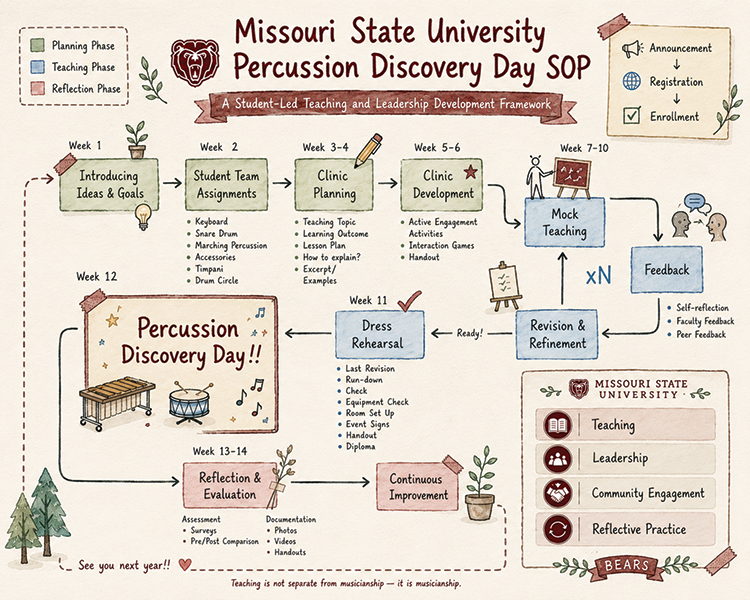
Throughout the semester, students prepare for MSU Percussion Discovery Day, our festival-style outreach event, by designing lessons, participating in mock teaching sessions, and receiving faculty and peer feedback. Through this cycle of planning, teaching, feedback, and reflection, they gain confidence as educators while strengthening their own musicianship. As they learn to explain concepts clearly and adapt to different learning styles, they deepen their understanding of the techniques and musical ideas they perform every day. Teaching becomes more than an educational exercise, it becomes another way of making music.
This philosophy comes to life through Discovery Day, during which university percussionists have authentic teaching experiences while serving middle and high school students in the surrounding community. Unlike traditional clinics centered on professional guest artists, Discovery Day places university students at the heart of the educational experience. Working in small teams, they design lesson plans, prepare instructional materials, and lead six interactive clinics covering keyboard percussion, snare drum, marching percussion, timpani, drum circle, and accessory percussion. Rather than simply demonstrating their skills, they learn to communicate clearly, adapt to different learning styles, and create engaging musical experiences for others.
Instead of emphasizing competition or performance evaluation, the event celebrates exploration, collaboration, curiosity, and active participation. Every clinic is designed not only to introduce younger students to percussion, but also to help the university students discover themselves as educators and leaders. The festival format creates a welcoming environment where younger students feel comfortable asking questions, trying new instruments, and learning through exploration. At the same time, university students experience the rewards and challenges of teaching. They learn to adjust their explanations when something is unclear, think creatively when unexpected questions arise, and recognize that effective teaching requires the same preparation, flexibility, and artistry as outstanding performance.
Discovery Day is more than the culmination of a semester-long pedagogy experience. It is the moment when students realize that teaching is not simply something they do; it is part of who they are becoming as musicians.
BECOMING TEACHERS, BECOMING MUSICIANS
One of the most rewarding aspects of this model has been the impact of near-peer mentorship. Middle and high school students connect naturally with college percussionists as mentors because they are approachable, relatable, and only a few steps ahead in their own musical journeys. Younger students see musicians whose goals seem attainable, while university students begin to recognize the responsibility — and privilege — of serving as positive role models.
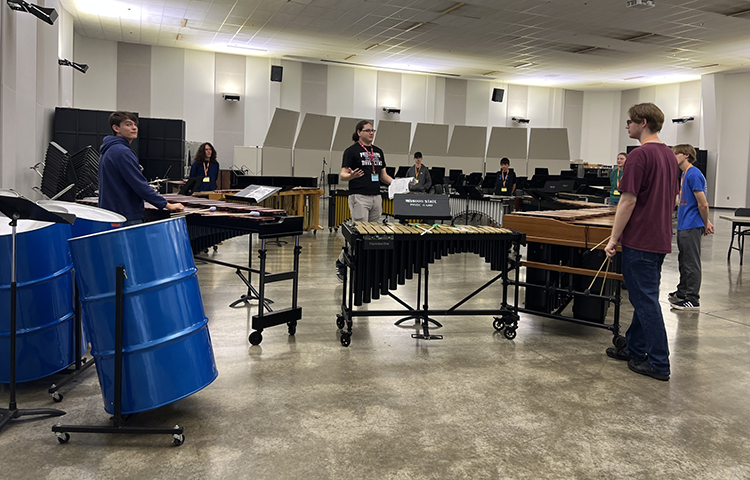
At the same time, the college students experience meaningful professional growth. They learn to adjust their explanations when something is unclear, respond to unexpected questions, encourage hesitant learners, and create welcoming, supportive learning environments. These lessons cannot be fully replicated through lectures or classroom discussions alone; they can only be learned through authentic teaching experiences.
Through these experiences, our students come to understand that teaching is far more than an educational responsibility. It is an essential part of their artistic development. In doing so, they discover that teaching is an essential part of becoming a musician.
BENEFITS BEYOND PEDAGOGY
Although Discovery Day was originally designed to strengthen teaching skills, its impact extends far beyond pedagogy. Students consistently reported greater confidence in communication, leadership, and musicianship after preparing to teach others. One of the most rewarding moments for me involved one of my first-year percussion majors. Before Discovery Day, he visited my office several times because he was anxious about teaching. He worried that he wasn’t experienced enough and feared making mistakes in front of younger students. At the end of the event, he walked up to me with the biggest smile and proudly said, “I taught today! And I can do it again next year!” In that moment, I realized the event had accomplished something far more important than simply helping him develop teaching skills; it had given him confidence both as a teacher and a musician.
The impact extended beyond our university students as well. A few days after Discovery Day, one of the participating band directors shared a story that stayed with me. On Monday morning, a high school student who had attended the event ran into the band room excitedly and immediately began showing his friends what he had learned over the weekend. That moment reminded me that meaningful teaching does not end when an event is over. When students are excited enough to share what they have learned with others, the learning continues long after the lesson itself.
I witnessed another unexpected benefit during the planning process. Students respectfully challenged one another’s ideas, defended their reasoning, and refined their lessons together. Watching them collaborate professionally reminded me that learning to teach is also learning to communicate, collaborate, and lead.
Discovery Day has also strengthened partnerships between Missouri State University and surrounding schools, creating meaningful outreach and recruitment opportunities while fostering a stronger regional percussion community. More importantly, it reinforces a culture in which teaching is viewed not as an obligation reserved for future educators, but as an integral part of every percussionist’s artistic and professional development. When students teach, they are not stepping away from musicianship, they are deepening it.
PRACTICAL IDEAS FOR ANY PROGRAM
One of the greatest strengths of this approach is its flexibility. Faculty do not need extensive funding, a large teaching staff, or a dedicated pedagogy course to begin incorporating learning-by-teaching experiences into their programs. Programs can begin with peer teaching, mock lessons, sectional coaching, or community outreach. The goal is not to create future teachers overnight, but to help students become more thoughtful and intentional musicians through the act of teaching.
Ultimately, our responsibility as percussion educators extends far beyond preparing students for the concert stage. We are cultivating musicians who can communicate, collaborate, inspire, and lead. Teaching is not separate from musicianship; it is musicianship. By intentionally creating opportunities for students to teach, reflect, ask questions, and mentor others, we prepare percussionists who are equally confident on stage, in the rehearsal hall, in the classroom, and within their communities.
I look forward to sharing practical strategies and examples during my PASIC session. I will discuss the process of guiding students as they design and lead their own clinics, as well as the faculty’s role in mentoring and supporting that process. My hope is that attendees will leave inspired to adapt these ideas to their own percussion programs and continue developing the next generation of percussion educators, one teaching experience at a time.
I am deeply grateful to my mentors, colleagues, and students, whose guidance and support continue to shape my teaching journey.
Yun-Ju “Alice” Pan is Assistant Professor of Percussion and Coordinator of the Percussion Area at Missouri State University. Originally from Taiwan, she maintains an active international career as a performer, educator, and clinician, presenting concerts, masterclasses, and educational workshops throughout the United States and Asia. Her work bridges performance, pedagogy, and cross-cultural collaboration, with a passion for preparing the next generation of musicians, educators, and leaders.