
Armature: Getting Creative with Live Looping
Armature: Getting Creative with Live Looping
by Andrew Toy
Percussive Notes
Volume 64
No. 5
October
2026
The article “Armature: Getting Creative with Live Looping” by Andrew Toy explores the artistic and compositional possibilities of live looping in percussion performance. Using his piece “Armature,” premiering at PASIC 2026, Toy demonstrates how loops can serve as a musical skeleton over which improvisation and dynamic arrangements are built. He discusses creating metric illusions by shifting the perception of looped rhythms without altering the loops themselves. Modern looping technology, such as Ableton Live, offers flexible control over multiple loop layers, enabling complex polyrhythms and arrangements beyond the sequential layering of traditional loop pedals. Automation tools like dummy clips help manage performance complexity. Additionally, manipulating playback speed and applying audio effects expand creative options and shape the sonic space. Overall, the article highlights how live looping enhances spatial awareness and musicianship in performance.
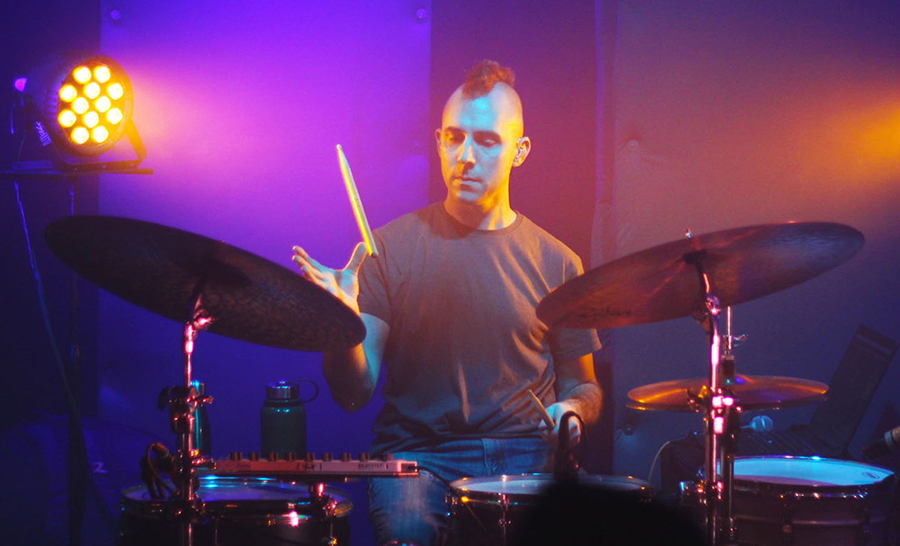
Live looping is not a new concept for the performing musician. On its surface, it provides a practical way to perform more than our brain and our four limbs can handle. The most obvious use of looping would be to build up an arrangement one part at a time until every part is present. But then what? With some creativity, and with the help of digital methods, we can create much more dynamic arrangements. Beyond its practical applications, and without simply piling on layer upon layer of sound, looping can serve as an inspiring composition and performance tool.
My piece, which will première at PASIC 2026, is titled “Armature,” and it takes its name from the wire structures that sculptors use as skeletons for their works. In a musical setting, this could be interpreted as the skeleton of a piece and the musical foundation that the performer improvises over or otherwise builds upon. In the same way that a sculptor could use a simple wire skeleton as the basis for a dog, a house, or a kitchen table, a loop could be interpreted in numerous ways, even within the same piece. Although no replacement for improvisation with other musicians, loops can be treated as a sort of invisible collaborator for the composer or performer.
As an example, the foundational loops that are established in Armature are in 12/8 and most likely felt as four groups of three eighth notes. By shifting the context throughout the piece via contrasting parts, the loops begin to feel like measures of 3/4, made up of three groups of four sixteenth notes (where the original eighth note becomes the new sixteenth note). In other words, metric modulation, but without changing part of the music. A sort of musical illusion is created by changing how the loop is treated, not by changing the loop itself. This is akin, in some ways, to the metric ambiguity sometimes found in Afro-Cuban music and specifically in the Abakwá rhythm.
Controlling the playback of loop layers is a simple but effective way to create an arrangement. More “old school” methods of live looping (looper pedals, for instance) let the player stack layers sequentially without any option to start or stop individual layers. Modern loop stations and DAWs such as Ableton Live offer this flexibility and more, which turn loop layers into building blocks that can be put together in endless ways. For example, if you’ve created four loop layers that work together (i.e., they are in time and in key), you now have 15 possible resulting loops at your disposal (1, 2, 3, 4, 1+2, 2+3, etc.). With eight loop layers, there are now 255 options. This number explodes if the loop layers are different lengths or speeds. Creating two simple loops of different lengths is a quick and easy way to make a (potentially very complex) polyrhythm.
All of these options can be a lot to manage in a performance setting. This is where automation can be a huge help: if we tell the DAW what to do ahead of time, we can focus on the actual performance instead of juggling so many time-sensitive actions. This can be done with precision via digital means, and there are many ways to accomplish this. My method of choice is to use “dummy clips,” which are clips that contain instructions (loop transport, effect envelopes, etc) but no actual audio, with Ableton Live.
Sometimes, though, actually changing a loop’s sound may be desired via changes in playback speed. As a simple example, if a loop is played at half- or double-speed, the rate of the rhythm and the pitch of the recorded sound will modulate by a factor of two. A fast and high-pitched musical phrase, such as a bell pattern, takes on an entirely new character, rhythmically and in terms of timbre, when slowed down. We can also create more subtle changes using playback speed. If two copies of an identical loop are played back at slightly different speeds, for instance, we can easily recreate the early “tape music” experiments of Steve Reich as the loops gradually move out of phase with each other.
Audio effects, applied to a live signal and/or recorded loops, add yet another dimension and bring us into sonic territory usually reserved for producers and sound designers. Altering a loop with effects (distortion, delay, reverb, EQ, etc.) creates contrast with the live acoustic sound of the drums. Filters can also be used to carve out sonic space for other sounds. One of the biggest challenges when live looping, especially with percussion instruments, is not making the overall sound too cluttered, either rhythmically or sonically. In that regard, this approach forces the composer to utilize space as well as possible. Since timing and space are so crucial, live looping has a hugely positive impact on the performer’s playing.
From a music technology perspective, we are just scratching the surface of what’s possible in the electroacoustic realm. Modern computers and audio interfaces let us process analog sound fast enough that we can hear processed sounds in near-real time (that is, with low enough latency to convince our ears that it’s instant). This was not possible in the not-so-distant past, to the frustration of those wanting to merge analog and digital worlds (myself included). Rather than synthesizing new sounds from scratch, the approaches described here can help unlock new ideas within the sounds and rhythms we already know and love.
Andrew Toy is percussionist, producer, and educator based in Washington D.C. He teaches music technology at American University and George Washington University.