

PAS Hall of Fame:
Michael Burritt
by Megan Arns
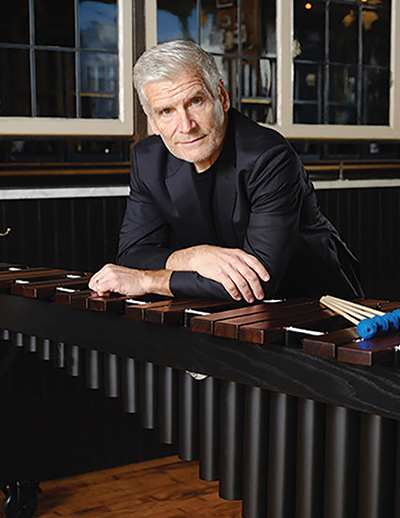
For more than four decades, Michael Burritt has shaped our modern percussion landscape in significant ways as a performer, educator, and composer. His immeasurable influence can be heard around the world through his performances and compositions and seen in the success of generations of his students in many areas of percussion. This influence can also be felt through the culture of excellence and enthusiasm at the institutions he has taught at: Kent State University, Northwestern University, and now as the Paul J. Burgett Distinguished Professor at the Eastman School of Music.
Yet when reflecting on his induction into the PAS Hall of Fame, Michael’s focus consistently returns not to accolades or his incredible accomplishments, but to people. “I’d like to be remembered as someone who made people feel like they mattered,” he says. “Someone who spread enthusiasm for percussion and inspired others through that enthusiasm.” That spirit has defined Burritt’s career from the very beginning.
A LIFE IN MUSIC
I used to go watch my father’s band, and I loved it,” Michael said. Starting around age six or seven, he learned percussion parts by ear and performed them for older students in his father’s band program. By middle school, he was already distinguishing himself as a performer. A pivotal moment came when he earned the highest percussion score in his county’s honor band audition. “I remember thinking, ‘I’m kind of good at this,’” Michael says. “I told my parents, ‘I want to be a performer.’”
After being waitlisted by the Eastman School of Music as an undergraduate applicant, Michael attended Ithaca College, where mentor Gordon Stout took him under his wing for two years. “It was immediately obvious that Michael had a huge talent, technique, and musical potential,” Stout says. “During his two years at Ithaca, he learned to slow down, play things correctly from the start, and that was all it took for his immense talent to blossom. During those two years, he also became interested in composition.”
Looking back, Michael views what originally seems like a setback as one of the most important moments of his development. “Sometimes your failures are your greatest assets,” he says. “Not getting into Eastman motivated me to work harder.” Michael went on to receive his bachelor’s and master’s degrees, as well as the prestigious Performers Certificate, from Eastman.
CREATING A CULTURE
Burritt has become known for building percussion programs defined by excellence, inclusivity, and a strong sense of community. As Professor of Percussion and Paul J. Burgett Distinguished Professor at the Eastman School of Music — the first distinguished professorship in the school’s history — Michael has helped define one of the world’s most respected percussion programs. His prior tenured appointments at Northwestern University and Kent State University further demonstrate his lifetime commitment to education at the highest level.
He rejects the idea that culture can be created through a formula. “I don’t think I ever went in with some grand plan about creating culture,” he says. “I think it was in my blood.” Michael traces that instinct back to his father’s music program, where he witnessed a sense of camaraderie and shared purpose among students and teachers. As a young educator, he discovered that enthusiasm could be contagious. “I’ve always believed that if you love what you do, that positivity pours onto others.”
For Michael, successful studios function like families. Younger students learn from older students, and everyone contributes to something larger than themselves. “You create this incubator,” he explains. “Once it gets going, it feeds itself.” Andrea Venet, Associate Professor, University of North Florida, reflected, “I can attest that working with Michael has been one of the most influential chapters of my life. I knew that I wanted to study with him so that I could become a better musician and teacher, but also absorb the environment fostered in his program so I could model my own studio in this manner.”
In his first job at Kent State, Burritt started with a small studio and a fledgling percussion ensemble. By fostering commitment and excitement, the program quickly grew. Within six years, the ensemble earned an invitation to perform at PASIC, and percussion concerts regularly filled the university’s concert hall. Blake Tyson, Professor at the University of Central Arkansas, recalled, “Two of the most important years of my life were spent studying with Michael at Kent State. He challenged me to become a more expressive performer and helped me find my voice as a musician. Performing ‘Shadow Chasers’ at PASIC with him in 1994 was one of the most electric performances I’ve ever been a part of. The piece was brand new, and we rehearsed every detail for months. When we finally took the stage, we all fed off of Mike’s energy and intensity; there was magic in the air.”
While Michael was finding his footing teaching, writing, and performing, other opportunities challenged his decision about the unique path he was creating. In the mid-’90s, Paul Yancich, who Michael had taken lessons with during his time at Kent State, invited him, along with a select group of percussionists, to audition for the Cleveland Orchestra. For many young percussionists, this opportunity would have been a no-brainer, yet Michael found himself wrestling with an unexpected realization. At the time, he was teaching, writing music, performing recitals, and building a studio. After reflecting on advice he had once received from Michael Rosen — “Do what you believe in” — Burritt declined the audition. “It was a huge moment for me,” he says. “I realized that wasn’t who I was anymore. I loved teaching. I loved writing. I loved playing recitals and working with students.” That decision ultimately helped define a career that would expand the possibilities of what a percussionist could be.
PERFORMER AND COMPOSER
Michael’s performance career has set global standards defined by both technical mastery and exceptional musical depth. Performing on four continents and throughout the United States, he has appeared as a soloist with globally renowned ensembles such as Nexus, Amadinda, Third Coast Percussion, Ju Percussion Group, the United States Air Force Band, and the Dallas Wind Symphony; and he has graced some of the world’s most prestigious stages including Carnegie Hall and the Purcell Room at Queen Elizabeth Hall. His international performances and masterclasses at the world’s leading conservatories have elevated the perception of percussion as a serious and expressive art form throughout the world.
His many featured appearances at PASIC and Days of Percussion, spanning decades, reflect not only sustained artistic excellence, but also his enduring relevance, leadership, and generosity within our community. Andrea Venet confirms, “Michael consistently generates memorable live performance experiences for audiences. His dynamic and explosive performance presence, combined with exceptional talent, technical prowess, and musicianship at the highest level, make him highly sought after as a soloist and chamber musician. He is also an amazing individual when it comes to working hands-on with student performers.”
When asked about his most memorable performance experiences, Michael’s memories span decades of remarkable performance experiences — from early solo recitals and PASIC appearances to performances at Carnegie Hall and collaborations with many of his musical heroes. Among his most treasured memories are performances with Nexus, the legendary percussion ensemble that helped inspire his generation. “First to write for them, and then to rehearse, record, and perform with them was incredible,” he says. “They were my heroes.”
As a composer, Michael’s contributions are foundational. His solo, chamber, and concerto works are central to the modern percussion repertoire and have been required literature for the world’s most prestigious international marimba competitions, including those in Paris, Stuttgart, Shanghai, Italy, and PAS-sponsored events. These works have shaped how percussionists practice, perform, and even write for the instrument, leaving a lasting and unmistakable imprint on the field of percussion composition.
Yet his entry into composition was driven less by ambition than by necessity. “There just wasn’t that much to play at the time,” he recalls. His early pieces such as “October Night,” “Caritas,” “Shadow Chasers,” and many others emerged from a desire to create music he wanted to perform. Over time, those works developed lives of their own. Today, Burritt regularly receives messages from performers across the globe seeking scores, sharing performances, or asking questions about his music. “It’s incredibly rewarding,” he says. “You never imagine that people all over the world will care about something you wrote.”
Michael’s chamber works are frequently written to be performed with his students, creating meaningful performance opportunities for hundreds of students worldwide and allowing them to experience his artistry firsthand. Annie Stevens, Associate Professor, Virginia Tech, shared, “The sub-genre of marimba soloist plus percussion ensemble would not be nearly as prevalent or evolved without Michael’s vast contributions over the decades, alongside those of Keiko Abe. Beginning with ‘Shadow Chasers’ all the way through his present hit, ‘The Home Trilogy,’ these works are both virtuosic and solemn, and his captivating and relentless energy as the soloist is what we all continue to show up for. And he isn’t stopping.”
Burritt said that he often finds the greatest satisfaction in performing alongside students. “When you’re playing with students and they’re excited about the music, that’s special. Those are my favorite moments.”
Not only has Michael contributed to the body of contemporary percussion repertoire through his own compositions, but he has also worked with well-established composers to bring new works to life. His commissions and extensive collaborations with composers Joseph Schwanter, John Psathas, Alejandro Viñao, and others have produced works that are now standard repertoire throughout the world. “Throughout my career as a composer, I have had the good fortune to work with and be inspired by some of the world’s leading percussionists, including Michael Burritt,” Pulitzer Prize-winning composer Joseph Schwantner recalled. “He brings his extraordinary musical talent, energy, and creativity to every performance.”
Alejandro Viñao described the creation of “Burritt Variations” as a deeply collaborative process, one shaped not only by Michael’s artistry but also by their friendship and shared musical influences: “When I write an ensemble piece, I am not thinking too much of the particular characteristics of the performers and ensembles I am writing for. But when I wrote ‘Burritt Variations,’ I found it hard not to think of Mike both as a player and as a friend, not just because he is a wonderful performer, but also because he has a very distinctive style. And then hanging out and talking about all kinds of music, we realized that we both grew up listening to some of the same rock bands, love some of the same tracks, and share some of the same heroes. So all of this influenced my choices in terms of style, pace, phrasing, and how funky or danceable ‘Burritt Variations’ turned out to be.”
In addition to his contributions as a performer and composer, Michael has also made significant contributions to instrument and mallet design. His longstanding collaboration with Malletech has produced innovations that have shaped the sound and performance experience of percussionists worldwide. Most notably, Michael worked closely with the company to develop the MJB Signature Marimba, an instrument that reflects his commitment to tonal beauty, projection, and ergonomic design, and a signature series of mallets that have been used for decades around the world. Leigh Howard Stevens, Founder and CEO of Malletech, reflects, “Michael is a monster marimbist, prolific composer, and inspirational educator. For decades he has been hitting ‘grand slams’ in percussion, including a new, never-before-imagined level of artistry with his Eastman School of Music Percussion Ensemble.”
THE NEXT GENERATION
The theme that emerges most clearly throughout Burritt’s nomination letters for the PAS Hall of Fame is his commitment to his students. Jacob Nissly, Principal Percussionist, San Francisco Symphony, said, “I know I am not alone among his students who would characterize him as the most dedicated teacher imaginable.” It is clear that his teaching extends far beyond technique or repertoire; it is rooted in developing complete musicians — artists who think critically, listen deeply, and contribute meaningfully to the profession.
Michael’s students are active in the country’s leading orchestras, academic institutions, award-winning chamber ensembles, K–12 music classrooms, and more. The extraordinary breadth of his students’ accomplishments stands as one of the clearest measures of his enduring impact. Angela Zator Nelson, Associate Principal Timpani, Philadelphia Orchestra, recalled, “He is an educator who can teach every aspect and genre of the percussion world. He could start out a lesson by teaching how to be a dynamic marimba soloist and end the lesson with teaching how to apply the Moeller technique on the snare drum for a better sound in an orchestral setting.”
When asked what advice he would give to the next generation of percussionists, Michael emphasized curiosity, patience, and breadth of experience. “Experience a lot of different things,” he says. “Don’t chase one thing too young.” At the same time, he stressed the importance of focused, deliberate work over a long period of time. “You have to get intimate with the instrument. You have to spend significant time with it so that your instincts become embedded.” And above all, he encouraged students to embrace the long journey of artistic growth. “You can’t cram for the test. You have to be excited about the long game.”
Even after decades of achievement, Michael continues to view himself as a student. “I don’t think of myself as a finished product,” he says. “I still want to learn. I still want to grow.”
A LASTING LEGACY
Beyond titles and achievements, what truly distinguishes Michael is the example he sets. Third Coast Percussion Executive Director David Skidmore says, “Not only is he a passionate musician and hard worker, he is also a kind man, a generous spirit, a loyal friend and mentor — someone who aspiring musicians have been able to look up to as a role model for decades. It’s so important to have someone in Michael’s place of prominence model these qualities for future generations of percussionists.”
One example of this selfless stewardship is Michael’s service to the Percussive Arts Society. His roles as a Board Member, Committee Chair, contributing editor to Percussive Notes, and ultimately PAS President, span decades of selfless service. His leadership consistently combines vision with humility, always prioritizing education, artistic growth, and the long-term health of our percussion community.
When asked his opinion about the most significant change in percussion during his lifetime, Michael pointed to the extraordinary expansion of repertoire, pedagogy, and educational opportunities available to today’s performers. His own contribution to that growth extends far beyond compositions, performances, or institutional leadership. His greatest legacy may be the thousands of musicians who have carried forward his values: passion, generosity, curiosity, and a commitment to excellence. As generations of percussionists continue to perform his music, teach his ideas, and inspire their own students, Burritt’s influence will continue to ripple throughout the percussion world.
Ivan Trevino, Professor of Practice, University of Texas at Austin, shared, “Michael’s former students are one big family whose foundation is built on Michael’s giving spirit. This spirit radiates through all of us, in our own teaching, performing, and creative output, and in my opinion, will be Michael’s long-lasting legacy.”
Perhaps that is exactly how Burritt hopes to be remembered — not simply as an award-winning performer, composer, or educator, but as someone whose enthusiasm inspired others to discover their own path. As Michael puts it, “Go after what you love with everything you have. And remind yourself how lucky you are that you get to do what you love.”
HALL OF FAME VIDEO
LINKS
“White Pines” performed with the Eastman Percussion Ensemble
“Sweet Dreams and Time Machines” performed by Michael Burritt and Ivan Trevino
“Trimetrical Hub” by John Psathas performed by Michael Burritt
“Caritas,”mvt. 3 performed by Michael Burritt