

PAS Hall of Fame:
Stuart Saunders Smith and Sylvia Smith
by Lisa Rogers
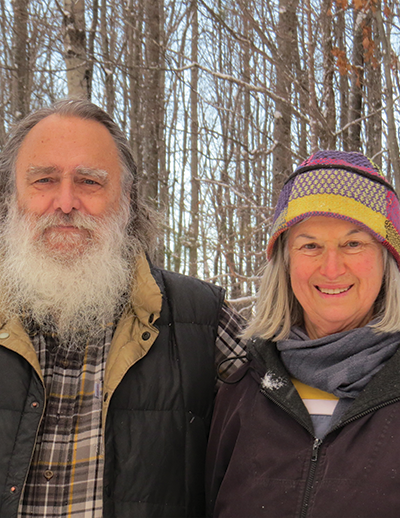
Stuart Saunders Smith and Sylvia Smith have been described as a “power couple,” defined by the Oxford English Dictionary as “two people who are each influential or successful in their own right.” Sylvia and Stuart have individually and collectively contributed to the fabric of music and percussion through composition, education, performance, and publication.
Renowned artist and PAS Hall of Fame member Steven Schick said, regarding the Smiths, “I would like to write in support of their induction into the Hall of Fame together, not just due to their individual contributions — as worthy and deserving of honor as they may be — but because of their impact taken together.”
EARLY LIVES
An interwoven view of their early lives showcases performance at the heart of those musical experiences. Stuart, born in Portland, Maine, began studying composition and percussion at six years of age with vaudeville performer Charles Newcomb. By age 13, he was performing in clubs and for dance venues. He matriculated at Berklee College of Music to further his studies in composition and performance. In 1967, Stuart continued studies at the University of Hartford – The Hartt School of Music, where he earned Bachelor of Musical Arts and Master of Music degrees. He received his Doctor of Musical Arts degree in composition from the University of Illinois in 1977, where he studied under Herbert Brün, Salvatore Martirano, and Benjamin Johnston. His primary percussion instructors were Fred Budha, Alan Dawson, Alexander Lepak, and Thomas Siwe.
Sylvia’s early musical experiences were shaped through piano study. She began percussion study at 22 years of age. Her primary percussion teacher was PAS Hall of Fame member Alexander Lepak at The Hartt School of Music. In 1981, she received a Bachelor of Arts degree with a concentration in American Studies from the University of Maryland, Baltimore County. In 1986, Sylvia earned a Master of Arts degree with a concentration in American Studies from the University of Maryland, College Park. Her thesis focused on music notation since World War II.
CAREERS
At the time of Stuart’s passing in 2024, he and Sylvia had been married over 50 years, with a life partnership that always intersected with their individual expertise in music and percussion.
Stuart
Stuart taught composition and music theory at the University of Maryland, Baltimore County for over 35 years, starting in 1975 and continuing until his retirement in 2011. Additionally, he taught at the Atlantic Center for the Arts, the Darmstadt Musikinstitut in Germany, and the Percussion Workshop in Poland, focusing on percussion performance and on composition. Stuart also served as artist-in-residence at such institutions as the University of California, San Diego; Yale University; and the University of Gothenburg in Sweden. Additionally, he authored more than 30 articles on the compositional process — his own and those of other composers. Stuart authored Twentieth Century Music Scores and co-authored/edited alongside Thomas DeLio Words and Spaces: An Anthology of Twentieth Century Musical Experiments in Language and Sonic Environments.
In the foreword to John P. Welsh’s book on the music of Stuart Saunders Smith, composer Milton Babbitt described Stuart as “one of those rare musicians who not only hears a different drummer but is-himself-that drummer.” Therefore, as a composer of over 200 works, his compositions were heavily influenced by his early percussion study and performances exploring rhythmic and melodic complexity, indeterminacy, spoken texts, and “trans-media” works blending music with narrative and visual components. His Links series for solo vibraphone continues as a standard in solo, vibraphone repertoire.
Joseph Van Hessel, Chair of the PAS New Music/Research Committee, comments, “Some standout pieces to me are his Links series of vibraphone solos, many of which are representative of music of intricacy as well as early contributions to the solo vibraphone repertoire (the first having been composed in 1974 for Thomas Siwe). ‘Return and Recall’ is a trans-media piece that has been performed as a percussion and dance duet by Equilibrium (Michael and Nancy Udow) and as a percussion trio by Percussion Group Cincinnati.”
Other percussion compositions worthy of note include “Blue Too” for solo drumset; “Songs I–IX” for percussionist-actor utilizing small percussion instruments and various household items from the kitchen; “…And Points North,” a music theatre work for solo percussionist/narrator; “Thaw” for solo orchestra bells (glockenspiel); “The Authors” for solo marimba with spoken text; “Evening Primrose” for vibraphone solo with two drumsets; “Emotion” for large percussion ensemble; and “Vermont Chimes” for chimes, two glockenspiels, two bass drums, and two triangles. Stuart’s compositions have been featured on over 30 recordings on such labels as New World Records, Ravello Records, Centaur, Innova, 11 West Records, OO Discs, Equilibrium, GAS, Soundset Recordings, and Chen Li Music.
When asked by musicology and composer Theresa Sauer in her June 2008 interview with Stuart to explain his compositional process, he responded, “When I compose, I use three types of thinking: fast thinking, slow thinking, and taste thinking. Fast thinking is intuitive, mythic, nonverbal, multi-directional, metaphoric thinking. Slow thinking is rational, verbal, uni-directional thinking, as I am doing right here. Taste thinking is the mind of the senses. No matter how well fast thinking and slow thinking go, if it doesn’t taste good, it’s time to begin again. Generally, I use all three types of thinking at once, like a rope made of three strands, with instantaneous cross-talk. Sometimes, I begin with fast thinking and flush out the idea with slow thinking. I never use pre-compositional engineering plans to compose with. I want a music that can contradict itself and go off on tangents. I am not interested in consistency, which is what most pre-compositional plans guarantee. I am in search of magic, and like a magic trick, I want my hand to turn into a bird that flies away!”
Sylvia
Known for her work in music notation, writing, and publishing, Sylvia says of the origins of Smith Publications, “I was relaxing in the bathtub one evening after work and the idea popped into view like a calling. Ideas pop into our minds all the time, if we are open to them. This one I acted on. I had little money for such a venture. I bought a shelf and a file cabinet and a justifying typewriter and found a printer who would give me credit. I had to figure out every step of the way, how to do it, what was needed, for each problem that came up. I sent out invitations to composers, and the first one to respond with music was Pauline Oliveros. I still have her letter from 30 years ago. Others followed. In 1974, I opened Smith Publications/Sonic Art Editions with a catalog of 14 pieces, some very far-reaching music.”
Later, due to the number of materials amassed over the decades in the publishing business, she created the Sylvia Smith Archives, currently housed at the Bierce Library on the University of Akron, Ohio campus. The archival holdings include correspondence, manuscripts, scores, recordings, and publications by and about such composers as Milton Babbitt, John Cage, Robert Erickson, Benjamin Johnston, Pauline Oliveros, and Stuart Saunders Smith.
Regarding those first pieces in the Smith Publications’ catalog, Sylvia said, “The music in it was for the most part very unusual. There were two of Ben Johnston’s microtonal pieces, ‘Sonic Meditations’ by Pauline Oliveros, and Herbert Brün’s set of three solo percussion pieces using computer graphics in the notational system. Various kinds of graphic notation were being explored during the 1970s, and my catalog included several kinds of unusual notation, plus a piece involving shortwave radio. I was at that time, and still am, interested in the blending of art forms, the connections between, for example, music and poetry, music and theater, and so forth. In my first catalog in 1974, along with the usual instrumental categories, I had a category called Flexible Instrumentation and Multi-Media to give these kinds of pieces a sense of legitimacy and importance.”
In 1974, Sylvia began commissioning works for Smith Publications/Sonic Art Editions that she felt were needed, with some becoming important works in the percussion canon. She asked Stuart to write a solo vibraphone piece. The result was the first composition of the Links series for vibraphone, with more added through the years for a series of 11 pieces. Sylvia said, “I thought that the vibraphone could be a serious solo instrument. At that time, it was thought of almost exclusively a jazz instrument. I thought it would be most unlikely for a composer to submit such a vibraphone solo. So, I asked Stuart to write a vibraphone solo — a piece that could really stand alone.”
Other collections that Sylvia commissioned and published include The Noble Snare (1987), Marimba Concert (2000), Summit: Compositions for Unaccompanied Orchestra Bells (2007), and Vibraphone Century (2021). In his PAS Hall of Fame nomination letter for Sylvia, University of South Florida Emeritus Professor of Percussion Studies Robert McCormick commented, “Sylvia’s leadership and service in the creation and sponsorship of music for percussion is legendary. She developed The Noble Snare series of individual soli for snare drum that bring a significant and unique vision to the idiom. Several volumes of these works contain literature by some of the most important composers of our time. Among her other innovative percussion publications include Summit, the first book of orchestral bell solos, and Marimba Concert as the unique book of marimba soli devoted to musical miniatures. In 1974, she commissioned the Links series of vibraphone essays and has since developed the largest catalogue of vibraphone literature in existence.”
Currently, the Smith Publications/Sonic Art Editions catalog features roughly 500 works by over 60 composers. In addition to Stuart, other composers within the extensive catalog for percussion, winds, orchestra, etc., include Milton Babbitt, John Cage, Barney Childs, Christopher Deane, Siegfried Fink, Benjamin Johnston, Askell Masson, Eugene Novotney, Harry Partch, Marta Ptaszynska, Emmanuel Sejourne, Michael Udow, and Christian Wolff.
Benjamin Toth, Professor of Percussion Studies at The Hartt School of Music, commented, “Taken as a whole, the composers on the Smith Publications roster could serve as an outline for any graduate-level percussion history and literature course, given their significance in our field. The eclectic nature of her publications, and particularly the innovative notational systems she has developed and utilized, are of equal importance to any serious student of percussion literature. In short, Sylvia’s work as a publisher has influenced countless composers and performers and helped to shape the current state of the percussive arts.”
As a percussionist, Sylvia has performed at Merkin Hall in New York City, Music Library Association International Convention (Vancouver, British Columbia, Canada), Cross-drumming Festival (Warsaw, Poland), and several PASICs, as well as with the Merce Cunningham Dance Company. She has toured North America as part of the Sylvia Smith Percussion duo founded in 1998 with partner Ayano Kataoka. The duo specializes in percussion with spoken text and theater and features prominently works by Stuart Saunders Smith. Her performances are recorded on OO Discs, New World Records, and 11 West Records.
Kataoka says of her duo with Sylvia, “Clearly Sylvia is the true interpreter of Stuart’s music who deeply understands his artistry both as his publisher and a gifted musician. I’ve learned a lot from both Stuart and Sylvia by working with them closely over decades. I greatly appreciate and respect their kindness, care, love of music, generosity, and passion towards percussion literature that they strongly believe as the true art form.”
Sylvia has also commented regarding the performance of Stuart’s works, “Stuart and I are husband and wife, composer and publisher, and composer and performer. I always have to guard against mixing up the roles. For example, if we have just had an argument about a household matter, I can’t let that color my judgment about publishing decisions. As a percussionist, I often perform pieces that Stuart has made. Because we live in the same house, I have the privilege of hearing each piece as it is being composed. This gives me a deeper understanding of the music. Stuart has made many wonderful percussion pieces that I am honored to perform. I tour with Stuart’s percussion theater music. It is the only percussion theater music I can find that is worthy of my time and effort. Typically, other percussion theater music involves joke-telling or silly gestures like waving the mallets in the air. Stuart’s theatrical music is centered around a text, with the instruments used sensitively and appropriately. I never feel like I have ‘used up’ one of Stuart’s pieces. I come back to them over and over, and my experience and understanding gets deeper and deeper. Some of them I have performed over 100 times.”
SERVICE, HONORS, AND AWARDS
The Smiths have provided invaluable mentorship and/or servitude to thousands of percussionists and composers. Former student John Zaro says, “I had the opportunity to study with the Smiths privately starting in 2016, working with them to engage critically and deeply in the performance of Stuart’s percussion music and the works of other composers they introduced into my life. Furthermore, I feel blessed to have studied composition, theory, and history with Stuart in preparation for my graduate placement exams, for which I was able to excel due to his teaching. As for Sylvia, I have become a much better music engraver by working for her publication house as a copyist — learning about music as a visual art and aesthetic presentation that shapes the performer’s consciousness. With their comprehensive level of musical knowledge and life experience, they have helped me become a more thoughtful musician, composer, copyist, and writer — all skills that will benefit me for the rest of my life as a young musician building a music career.”
The Smiths have served PAS and other organizations in various capacities. In 1986, Sylvia curated an exhibit on notation for the Tate Gallery in London, England. In the late 1980s, she served as Chair of the PAS Notation Research Committee, establishing the committee and organizing paper sessions for PASIC. From 1988–94, Sylvia served as a hospice volunteer at the Union Memorial Hospital in Baltimore, Maryland. Additionally, she served as Artistic Director of the UMBC (University of Maryland, Baltimore County) New Music Ensemble from 1992 to 2010.
Stuart served as a founding member of the PAS New Music/Research Committee and was Executive Editor of the Percussive Notes Research Edition from 1982–84. He also served as a lobbyist for the arts for the American Society of University Composers during the Regan presidency. Robert McCormick says regarding Stuart’s PAS service, “As I searched archives of Percussive Notes, there were 209 results (21 pages) under his name. This does not include the many theses and dissertations of which he is the main topic or citing. Smith’s music was first performed at PASIC in 1976. I cannot think of a composer who has had more performances on the PASIC New Music/Research Focus Days than Stuart Smith. He is also one of the most performed composers in European avant-garde circles. I believe his music represents a significant and perhaps one-of-a-kind contribution to PAS.”
The Smiths have been recipients of various honors and awards. In 1981, Sylvia received the University of Maryland, Baltimore County Writing Prize for outstanding research in music. In 1988, she was awarded the American Music Center Letter of Distinction, which is an annual award recognizing individuals and ensembles who have made significant contributions to contemporary American music. Sylvia has received six Paul Revere Awards for Graphic Excellence from the Music Publishers Association. These awards recognize outstanding graphic design, engraving, and production standards in sheet music publishing. In 1993, Sylvia was awarded an Honorary Doctor of Humane Letters degree from the University of Akron, Ohio.
Stuart received various and honors during his lifetime. He received three UMBC Research Grants and The Hartt School of Music Distinguished Alumni Award and East/West Artist Award. He also received a National Endowment of the Arts Composer’s Fellowship, Atlantic Center’s Master Artist Award, and PAS Service Award.
ADVICE
In the June 2008 issue of the International Alliance for Women in Music, Theresa Sauer interviewed Sylvia and Stuart Saunders Smith about their lives and music. Her final interview question was, “What message would you like to send to the next generation of new music performers, composers, and publishers?” Sylvia answered, “Take care of your body just as you take care of a musical instrument. Eat well, eat vegetarian, exercise, rest. If you play an instrument, invest in your body — zero balancing, Alexander technique, Rolfing, yoga, as often as you can afford it. It will pay off right away and in your later years.”
Stuart answered, “My advice to composers is, when composing, always tell the truth. Compose out of your experience rather than your learning. New music is not a style or genre. It is a way of life — a life of composing from the inside out. Composers are leaders. Be sure that the direction you are leading is a place you want to live.”
A “power couple” or a coupling based on a “trajectory of position,” life partners, and 2026 PAS Hall of Fame inductees Stuart Saunders Smith and Sylvia Smith have provided percussionists with examples of musical excellence in, and passion for, performance, composition, and burgeoning new music.
FOR FURTHER READING
The Drum Set Works of Stuart Saunders Smith. https://pas.org/thesis-dissertation/the-drum-set-works-of-stuart-saunders-smith-as-a-correlative-trilogy-through-compositional-unity-and-autobiographical-content-as-confession
Amidst the Noise: Stuart Saunders Smith’s Percussion Music. https://pas.org/publication-articles/amidst-the-noise-stuart-saunders-smiths-percussion-music
Night Suite Interviews with Stuart Saunders Smith and Berndt Thurner. https://pas.org/publication-articles/night-suite-interviews-with-stuart-saunders-smith-and-berndt-thurner-by-rose-martin
Stuart Saunders Smith’s ‘Ground’ for Solo Glockenspiel: Clear Complexity. https://pas.org/publication-articles/stuart-saunders-smiths-ground-for-solo-glockenspiel-clear-complexity
An Interview with Sylvia Smith on the 30th anniversary of Smith-Publications and Sonic Art Editions. https://pas.org/publication-articles/an-interview-with-sylvia-smith-on-the-30th-anniversary-of-smith-publications-and-sonic-art-editions