

PAS Hall of Fame:
Giovanni Hidalgo
b. November 22, 1963
by Rick Mattingly
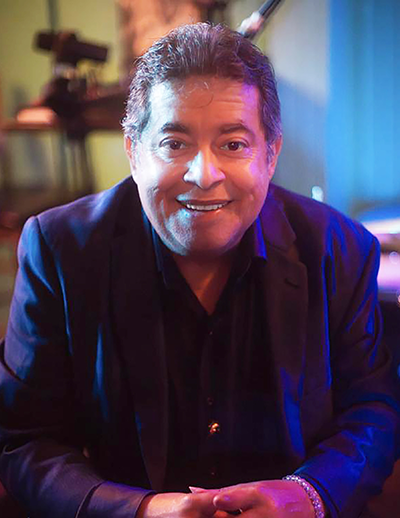
Peter Erskine recalls playing with Giovanni Hidalgo at PASIC ’97: “When Giovanni sat in with my trio,” Erskine says, “I felt like I was playing handball with God. It was truly mind-expanding. Any time you play with a great conga player, there can be a tremendous amount of rhythmic excitement, but Giovanni plays with such an incredible combination of sophisticated rhythmic ideas and the authentic Afro-Cuban language that it seems like he has the doorway to a whole other universe of rhythmic possibilities. I’ve never heard another conga drummer do those kinds of three-dimensional rhythmic layers and cross-references. He’s obviously a virtuoso, and at the same time, the stuff all sounds really hip.”
David Garibalidi played alongside “Gio” in Planet Drum. “Aside from his talent,” Garibaldi said, “he’s a very gracious person with a ridiculously cool sense of humor. We’ve had many great times together hanging out away from the drums. The drums were never far away, though. He works very hard at his craft and practices quite a bit. He has a deep knowledge of many types of music, and he works at combining those things in many ways. He’s truly a master drummer and excellent musician. Not only can he play wonderful solos, but he also can play with incredible simplicity and sensitivity. He hears rhythm in a unique way; his playing style is very spontaneous and creative. Giovanni also hears drumset grooves that are as deep as anything I’ve ever experienced. Thank God he doesn’t own a drumset!”
José Giovanni Hidalgo Journet was born in San Juan, Puerto Rico, on Nov. 22, 1963. His grandfather, father, and uncle all played with professional bands, and Giovanni was raised in a household surrounded by drums, bongos, congas, and timbales. He started developing his skills as a percussionist at age three — first on bongos, then on congas. He first learned to play by imitating the players around him, and he credits his father with helping him develop technical skills. By age nine Giovanni was playing with the PR All Stars. Justo Betancourt’s Conjunto Borin Cuba, Papo Pepin, and Hatuey. At age 12 he played with the legendary Charlie Palmieri in the Mario Ortiz Orchestra.
By the time he was 14, Giovanni had started applying snare drum techniques, such as the standard rudiments, to the conga drums. Many of the exercises he developed involving various double-stroke rolls, flams, and paradiddles are comparable to the rudimental and Stick Control studies that many apply to drumset for technical development. Just as drumset players must go beyond simply practicing sticking patterns on a pad and find ways to apply patterns to actual beats and fills on the kit, Giovanni found musical applications for the rudimental patterns so they became part of his rhythmic vocabulary and not just chops builders.
“I innovated putting snare drum techniques on congas in 1977,” Giovanni said. “By 1980, ’81, everyone was asking me to show them what I was doing. It’s difficult to use the hands the way you would use the sticks, but if you practice it, you can develop it to another level.”
The mythological image of the conguero is one who plays entirely by feel, and that reading music or notating rhythms takes away from the “soul” of the music. Conga playing must be an oral tradition, and only a select few are allowed to be part of this exclusive club. Granted, written music cannot reflect all of the nuances of a good conguero’s performance, but Giovanni says that conga players are missing out on a lot if they can’t read music. “If you try to do everything by ear, forget it,” he insists. “To be more wise, you have to study and practice, and reading is so important. That whole language is fascinating — the dynamics, the time signatures, the symbols, the different note values. It’s another world, and a lot of situations will be more comfortable if you can read music. You have to be like a Boy Scout: Be Prepared.”
There can also be a lot of machismo involved in conga drumming, and some players rate themselves according to how much hand and wrist pain they endure, the size of the calluses on their palms, or even how much blood they urinate after playing. By contrast, Hidalgo appears totally relaxed when he is playing, almost seeming to caress the drums as opposed to attacking them. “The conga is not an easy instrument,” he admits. “Sometimes you have to play hard with a lot of movement and energy. But I practice with the purpose of being relaxed and in control. When you play conga, it’s like you are in complete, deep meditation. Sometimes, when the music is very exciting, you can lose some of the control of your emotions. That’s cool, too, because we are humans. But the more you control the emotions, the better. You have to know how to breathe, how to concentrate, how to control the movements.”
However much Giovanni is in control, he always appears to be having a ball playing. “Oh, yes!” he agrees. “It’s like a combination of fury and passion, and it’s always flowing.”
At age 18 he was playing with Zaperoko before landing a gig in 1980 with an internationally known band from Puerto Rico called Batacumbele. In 1982 he began playing with Eddie Palmieri followed by a gig with Dave Valentin. From 1984–86 he played with Kip Hanrahan and Jack Bruce, and he recorded with Palmieri, David Sanborn, and Paul Simon. In 1988 he worked briefly with Art Blakey and the Jazz Messengers before becoming part of Dizzy Gillespie’s United Nation Orchestra, with whom he played for four years. In 1990 Giovanni recorded his first CD as a leader, Villa Hidalgo, featuring Gillespie and Paquito D’ Rivera. Since then, he has released several other albums as a leader, including Worldwide (1993), Time Shifter (1995), Hands of Rhythm (1997) Best Friends (1999), Tribute to the King (2023), and Jubilations (2024).
Through the 1990s and into the 2000s he worked and/or recorded with a wide variety of artists, including Linda Rondstat, Gonzalo Rubalcaba, Airto Moreira, Michel Camilo, Zakir Hussain, Tito Puente, Freddie Hubbard, Bruce Hornsby, McCoy Tyner & the Latin All Stars, Carlos Santana, Ravi Shankar, Ruben Blades, Sammy Hagar, Joan Osbourne, Candido Camero, Patato Valdés, Hilton Ruiz, Eddie Palmieri, Arturo Sandoval, John Patitucci, Ignacio Berroa, Gloria Estefan, and the rock band Phish, among many others.
“I don’t play with other people so I can be in the spotlight,” he said in a 1998 interview. “No. When I go to play with other people, I try to connect with everybody and follow the music so I can put beautiful colors in the right spot. An important thing is to help the other musicians feel good. You want to do an excellent job yourself, but you also want to help with the harmony and chemistry. If you help the other musicians look good when they do their solos, they will help you a lot when your solo comes, and then you feel so happy.
“Working with other people in a group is part of my life,” he said. “When somebody calls me to be part of something, I try to put in 500% with love and humility. It’s like being part of a circle, because it’s not about playing whatever you want. It’s about trying to follow the minds of the other musicians, following the structure of the tunes, following the cycles of the keys and the changes. If you just show up to play without putting all five of your senses into the music, forget about it. You have to be in complete connection and communication.”
In 1992, Hidalgo was hired as an adjunct professor at the Berklee College of Music in Boston, a position he held until 1996. Taku Hirano, Professor of Practice at Tulane University, studied with Giovanni when Taku was a student at Berklee. “Giovanni’s revolutionary approach to conga technique fundamentally transformed what was possible on the instrument,” Hirano wrote in his letter nominating Hidalgo for the PAS Hall of Fame. “During my four years of intensive study with him, which included every class he taught, private lessons, and countless hours of one-on-one mentorship, I learned his signature techniques, including breath control and the legendary ‘mano secreto.’ This innovation alone expanded the technical and expressive vocabulary of hand percussion in ways that continue to influence players worldwide. His ability to blend Afro-Caribbean rhythms with jazz, funk, and global influences, as well as incorporation of rudimental drumming techniques, didn’t just create a new style; it opened entirely new pathways for hand percussion in contemporary music.
“What distinguished Giovanni as an educator was his holistic approach. He taught rhythm not as isolated patterns but as expression and musical conversation. He taught us to understand Puerto Rican, Cuban, Dominican, Brazilian, African, and jazz traditions not as separate silos but as interconnected musical languages. This comprehensive musicianship has been invaluable throughout my career playing jazz, rock, pop, R&B, and hip-hop, and now informs how I teach my own students.”
Giovanni says he is proud when people call him a teacher. “I am doing my best to show other people how to play and to explain my point of view,” he said. “But we learn to be a teacher the same way we learn to be a player: from life, from experiences in the street, because the street is the real university. The schools help you to be prepared, but the streets are the real life, where we learn to be good students and good teachers. So I feel very honored when people call me a teacher, but in my heart I’m still a student.” Drumchannel hosts a five-course series in which Giovanni teaches congas, batá drums, timbales, and bongos.
Although Giovanni’s personal setup typically includes multiple conga drums, along with other percussion instruments, he insists that students begin with a single drum. “The conga drums really developed in the 1940s,” he explains. “A lot of really great conga drummers played with only one conga, because that is the main thing. I love when you see a lot of drums now, along with other instruments, because that’s the course of evolution. But we can’t forget the pioneers, and we have to deal with the past, present, and future. So I start my students with one drum only, the tumbao. When they master that, they move to two congas. I try to give good, clear exercises for my students, but I also give them things that are a little hard for them, because it’s super important to have a challenge. You learn how to make your own personal skills grow. Playing with just one conga is a difficult challenge. You have to work to make it sound like three drums in one. But if you can do it, that’s amazing!”
A characteristic of Giovanni’s style that becomes obvious when he performs on multiple instruments is his ability to produce several layers of time. Just as a drumset groove can be composed of independent rhythmic lines, so Hidalgo’s grooves can often be broken into different parts that are each complete in themselves. “A pattern can be made up of three parts that you put together into one,” he explains. “The way of the percussionist is to find the connections, the unity, the harmony between the parts you are playing and between your pattern and what the other musicians are playing.”
In 1991 Hidalgo received a Grammy Award for his contribution to the album Planet Drum, performed by an ensemble led by Mickey Hart, and he played on another of Hart’s Grammy-winning albums, Global Drum Project. Giovanni played on the 1993 album Danzón (Dance On) by Arturo Sandoval, which won the 1995 Grammy Award for Best Latin Jazz Performance. Hands of Rhythm, Hidalgo’s 1997 duet album with Michel Camilo, received a Grammy nomination, as did The Body Acoustic, an album recorded by Hidalgo, David Chesky, Randy Brecker, Bob Mintzer, and Andy Gonzalez. In May 2010, Hidalgo was awarded an Honorary Doctor of Music degree from Berklee College of Music. He won the 2023 Modern Drummer magazine Readers Poll in the World Percussion category, and in 2026 he was named a National Endowment for the Arts National Heritage Fellow.
“We are on a mission on this earth,” Giovanni contends. “My mission is through music, so I do it with humility, a lot of love, and a lot of harmony and peace. The point is to grow spiritually and do everything the best you can. That’s why, when I go on stage, I say a prayer and thank God for letting me have this opportunity. I am only sharing with the people, and music is the direct way to make the spiritual connection with the soul. There has to be a reason why God put music here, because music is as old as life. The ‘big bang’ was a sound, you know?
“What we do is our legacy that we are going to leave for the next generation. It is our blood, our essence, our soul, our feeling, and we want to put love into our work. So I put all of that into my music and my life.”