

PAS Hall of Fame:
Tom Gauger
b. December 20, 1935
by Lauren Vogel Weiss
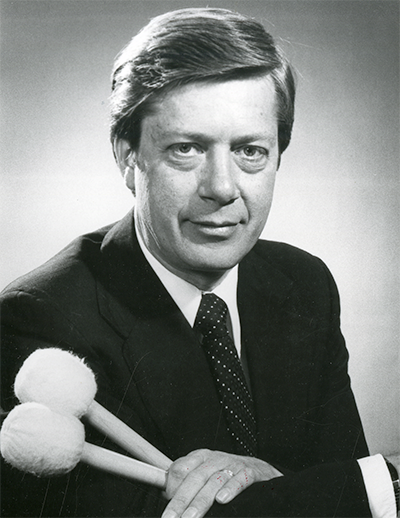
During Thomas “Tom” Gauger’s tenure with the Boston Symphony Orchestra, the BSO was considered to have one of the finest percussion sections in the world, thanks to Tom and fellow PAS Hall of Famers Vic Firth, Frank Epstein, and Arthur Press. The BSO’s percussion legacy is well-documented through the orchestra’s many recordings, archived radio broadcasts, and television programs. For a certain generation of classical percussionists, Friday night was “must-see TV,” thanks to WGBH-TV. From 1974–79, PBS broadcast Evening at Symphony, featuring the Boston Symphony Orchestra, as well as Evening at Pops concerts (1970–2004), featuring the Boston Pops.
In addition to his illustrious performing career in Boston, Gauger was also an educator, composer, and mallet designer and manufacturer, as well as a devoted husband and father of five.
“Gauger’s career is marked by an unparalleled dedication to advancing the field of percussion,” states Paul J. Pitts, Director of Fine Arts (retired) at the Boston Latin School and a former Gauger student. “His influence is not only evident in his remarkable performance skills, but also in his commitment to education and mentorship. Mr. Gauger has played a pivotal role in shaping the next generation of percussionists, instilling in them a passion for the art and a commitment to excellence.”
Tom Gauger (pronounced with a “long A” sound) was born in Wheaton, Illinois, on December 20, 1935. Raised in a musical family — his father played trumpet and his mother was a pianist and singer — young Tom was more interested in sports, serving as captain of the football team as well as a member of the basketball team. His junior high band director originally wanted Tom to play French horn, which he did for two years, but Tom was more interested in the snare drum. As a percussionist, he joined the high school’s orchestra, pep band, and marching band, which participated in President Eisenhower’s inaugural parade in 1953. Gauger graduated from Wheaton High School in 1953.
Following graduation, Tom received a full scholarship to attend Ripon College in Wisconsin, where he was the only percussionist on campus. His sister, Lois, a piano student at the University of Michigan, encouraged her brother to pursue a degree in music, so he transferred to the University of Illinois, where he studied with Paul Price and Jack McKenzie. “They were both instrumental in my pursuit of studying percussion,” Gauger remembers.
“One of my fellow students was Michael Colgrass,” Tom continues. “He attended the Tanglewood Music Center and suggested that I go there, too.” Gauger attended the prestigious music academy in western Massachusetts during the summer of 1956. At Tanglewood, the summer home of the Boston Symphony, he met percussionists and future colleagues Arthur Press, Charlie Smith, and Tommy Thompson.
During his college years, Gauger was also a member of the Harry Partch Ensemble, which, in 1957, premiered Partch’s “The Bewitched,” a satirical work of music, dance, and drama. The experimental contemporary composer created his own instruments, sometimes writing in a 43-tone octave, and Tom’s specialty was the bamboo marimba.
Gauger graduated from the University of Illinois in 1958 with a Bachelor of Music degree in percussion performance. That summer, he participated in the Saskatoon Music Festival in Saskatchewan, Canada.
AN ORCHESTRAL PERCUSSIONIST
In 1959, Tom joined the Oklahoma City Symphony as Principal Percussionist, a position he held for four seasons. During this time, he also taught at the University of Oklahoma and Oklahoma City University.
In 1963, Gauger, along with 21 other percussionists, auditioned for the Boston Symphony Orchestra. “I flew in from Oklahoma,” he recalls, “and played for several of the first-chair players, including [timpanist] Vic Firth. I made it to the final round, along with Mitch Peters.” The two finalists played a portion of Stravinsky’s “L’Histoire du Soldat,” one of the most difficult percussion passages of the time. “Mitch and I were waiting downstairs, and the personnel manager came up to Mitch and thanked him for the great audition, so I assumed that he got the job. Then the manager came up to me and said, ‘Mr. Gauger, you’re the next percussion player in the Boston Symphony!’ It was such a surprise!”
The percussion section of the Boston Symphony Orchestra was larger than that of most other orchestras: a timpanist plus four percussionists. This allowed each player to specialize in snare drum, mallets, bass drum, or cymbals. On September 27, 1963, Gauger joined Timpanist Everett “Vic” Firth, Principal Percussionist and mallet specialist Charles Smith, cymbal player Harold “Tommy” Thompson, and Assistant Timpanist and percussionist Arthur Press. At age 27, Tom was one of the youngest members of the orchestra. In his fifth season with the BSO, Gauger was featured as a soloist — along with Firth, Press, Smith, and Thompson — in William Kraft’s “Concerto for Percussion and Orchestra” during its orchestral premiere on November 3, 1967.
When Thompson retired in 1968, Frank Epstein joined the esteemed section. “Tom played the bass drum as if it was the most important instrument in the orchestra,” states Epstein, who played alongside Gauger in the Boston Symphony for the next 37 years. “His stroke was a thing of beauty all its own, and the sound was always perfect, with depth, focus, and warmth that few could match. Even the placement of the mallet on the drum caught the fullest of overtones, depth of tone, and attack.”
Epstein recalls matching his cymbal sound to Gauger’s bass drum sound. “Playing with him was easy. His upbeat was pure gold — a combination of a golf and baseball-bat swing, the timing of which was always fluid and direct at the same time. His grip on the mallet was also a thing of beauty and was in part responsible for the sound he got from the drum.”
Fellow BSO percussionist Arthur Press adds, “I have known Tom since he joined the Boston Symphony Orchestra in 1963. His musicianship is of the highest quality. Tom was a dedicated, brilliant, and outstanding performer, unfailingly collegial and generous. One might say the ‘easy’ part is getting into the BSO, but the hard part is maintaining the position and performing at the highest level of virtuosity.”
When Gauger joined the BSO, the orchestra was under the leadership of Maestro Erich Leinsdorf. Seiji Ozawa then became the BSO’s 13th music director and led the ensemble for almost three decades, including a historic 1979 tour to mainland China. Gauger also recalls touring with the orchestra in Europe. “I remember performing in the beautiful concert hall in Vienna, Austria. Berlin was also one of my favorites because the audience was very close to the stage.”
In addition to performing with the BSO, Gauger was a member of the Boston Pops — originally formed to provide year-round-work for the musicians, especially in the summer. He played under some of the most well-known conductors, including the last 17 seasons of Arthur Fiedler’s nearly half-century tenure, 15 years with John Williams, and a decade under Keith Lockhart. One of Tom’s most memorable concerts with the Pops was a 2002 pregame performance at the Super Bowl in New Orleans when the New England Patriots won their first NFL Championship. “All of my friends saw me on TV and thought I was a hero!” he says with a laugh. Throughout his orchestral career, Gauger was also a member of the jazz group WUZ, playing vibes along with fellow BSO percussionist Press on drums.
Mark Volpe was the President and CEO of the BSO from 1997 to 2021. “When I came to Boston, I was able to experience Tom’s skill and brilliance every week. Although he was an expert on all the percussion instruments, I do not believe I ever heard a percussionist play the bass drum with more sensitivity and musicianship.”
Will Hudgins, a current BSO percussionist and faculty member at the New England Conservatory of Music, remembers meeting Gauger in 1982. “I found the myth to be a genuine, thoughtful, and caring individual. Becoming his colleague eight years later, I discovered a person whose character shown though in his playing. Tom took the artistry of playing percussion, particularly bass drum, to another level.”
Gauger’s last concert with the BSO on August 28, 2005, was a season-ending performance of Beethoven’s Ninth Symphony at Tanglewood. “I walked off the stage,” Gauger reflects, “and said to myself how fortunate I was to have had a great career and been part of the BSO.”
MALLET DESIGNER
In the late 1960s, Gauger began experimenting with making mallets. As stated in his BSO bio, “The fun of developing instruments and sticks has been a big help in interpreting the more difficult works, especially since percussion has come into its own as a primary source of new sounds. Many of these new techniques have required new configurations for sticks and accessories, and my hobby of designing and making this new equipment spawned a small business on the side.”
During a 2017 NAMM (National Association of Music Merchants) Oral History interview, Gauger recalled the origins of his fledgling business. “[Between rehearsals at] Tanglewood, Vic [Firth] would be sitting out in the sun on one of the benches with his bag of white felt, sewing his timpani sticks. Since there weren’t a lot of bass drum mallets available, I decided that I wanted to develop some sticks, too. I went to a guy who worked with a lathe and asked him if he could make a stick from my design. They felt pretty good but there were always some changes that you wanted to make. My wife bought me a lathe for Christmas, so from then on, you wouldn’t believe all the sticks I made! It was a lot of fun, and I developed sticks for any problem that I had. Soon other people were asking to buy them.
“I made all of my sticks for about ten years,” Gauger continued. “Then my wife took over and actually made it into a business.” Both Lone Star Percussion and Steve Weiss Music helped bring national and international attention to the products before the Gaugers turned over the manufacturing and distribution to Vic Firth.
“When I was trying to get a big sound on the bass drum, I wanted a longer head and more weight, so that became my #3,” Tom explains. “When I needed something harder for [Stravinsky’s] ‘Rite of Spring,’ I created a chamois-covered mallet with a wooden core, my #7. I felt fortunate that I was able to create the sticks that I wanted.”
Gauger’s brochure stated, “Every design represents a success in either solving a technical problem or achieving a desired sound.” His most popular series was a line of eight bass drum mallets, including the #1 “general” and #4 and #5 roller pairs. He also had a line of five snare drum sticks, plus six combination mallets, including double-ended bass drum beaters and several snare/timpani combinations.
“Tom developed a series of bass drum mallets designed for specific pieces in the repertoire,” Frank Epstein describes. “He knew the repertoire so well and designed the balance and weight to bring out the colors and attacks that he wanted for each note.”
Will Hudgins describes Gauger as a “household name” for six decades. “At one point or another, practically every band or orchestra has had bass drum or snare drum sticks produced by Tom.”
EDUCATOR AND COMPOSER
Two years after becoming a member of the BSO, Gauger joined the faculty at Boston University, where he had a 30-plus year career teaching and mentoring young percussionists. He also taught at the Tanglewood Institute’s Young Artist Program from 1965–99. Some of his former students who have gone on to careers with major orchestras include Joseph Pereira (Principal Timpanist with the Los Angeles Philharmonic since 2007), Ted Atkatz (former Principal Percussionist with the Chicago Symphony Orchestra), Ronald Holdman (former Principal Timpanist with the Houston Symphony), and Braham Dembar (former Principal Percussionist with the Indianapolis Symphony).
Pereira studied with Gauger at Boston University from 1992–96. “As a young musician, I was very fortunate to be studying with a musical legend. I may not have realized it at the time, but I can now say how important his teaching and playing was to me and my former classmates. If I had to choose one thing that Tom impressed on me, it was that the music was always the most important thing. His wealth of knowledge and experience was always unique and inspiring. Whether it was the percussion technique needed, or the equipment he was always refining and manufacturing, everything had a musical purpose.”
George Durkin, former Principal Timpanist with the Las Vegas Philharmonic and another former student at BU, says, “Mr. Gauger’s unique blend of musicianship, motivational prowess, and unwavering dedication to excellence earned him the highest respect among percussion students and esteemed faculty alike at Boston University. His influence extended beyond performance and teaching; he exhibited remarkable entrepreneurial skills in developing innovative percussion mallets and drumsticks. These products stand as a testament to his inventive spirit and commitment to the advancement of percussion.”
Paul Pitts adds, “His impact as an educator is immeasurable. His teaching philosophy, characterized by a perfect blend of tradition and innovation, has inspired countless students to pursue excellence in the field of percussion.”
Gauger also composed numerous pieces for percussion, including 1974’s “Gainsborough,” one of the most widely performed percussion quintets of the 20th century. Other well-known pieces include “Doubles” (Two Movements for Marimba Duet) and “Nomad” (A Solo Jazz March for Multiple Percussion) — both published in 1979 — “Portico” (for Percussion Orchestra, 1983), “Round Trip” (Jazz Rock Blues for vibes, timpani, and drumset, 1989), and “Past Midnight” (1991) and “Celebration” (1995), both written for ten percussionists. “I enjoy the fact that my music is played all over the world,” Gauger states. And at the age of 90, Tom has even written a new piece called “Fun Times.”
“Tom’s output of percussion music is startling,” says Will Hudgins. “As a teacher, he has nurtured hundreds of young players though his work at Boston University, some of whom have gone on to become leaders in musical, and non-musical, endeavors, thanks to his influence as a musician and role model.”
Pereira remembers Gauger as more than just a teacher. “He had a huge influence on my interest in other kinds of music, such as jazz, contemporary chamber music, and eventually composition. His own works for percussion ensemble have become standards in the repertoire and I was lucky enough to be in his ensemble at BU premiering some of these works.
“A good teacher shows you technical things and helps you improve,” Pereira summarizes. “A great teacher and mentor can make you a better musician. Tom has shaped the musical lives of many, and without his musical contributions, many of us would not be where we are today.”