

Tips for a Wider Dynamic Range on Concert Snare Drum
Tips for a Wider Dynamic Range on Concert Snare Drum
by Robert Clayson
Educators' Companion
Volume 9
No. 1
Fall
2026
I have spent a lot of time throughout my teaching career telling my students that they need to work on what I call the “extreme” dynamic levels. In no other instrument is this more prevalent than the concert snare drum. While my comments are generally geared more towards the extreme soft dynamics, there are occasions where I find myself asking my students for more aggression when it comes time to play anything louder than forte. I must admit I have become incredibly frustrated as an educator because it seems like I have to give the “play with a wider range of dynamics” speech with every new piece of music. In this article, I hope to take a look at why playing at extreme dynamic levels is so difficult and share some of the methods that I have developed to help my students think and play more musically. While this article is written with the concert snare drum in mind, I hope that some of the things I share will cross over to other percussion instruments as well.
Tip #1: Address “Why” Extreme Dynamics are Challenging
I think that the biggest challenge of playing extremely loud and soft dynamic levels is that any inconsistency in technical aspects like bead placement, hand-to-hand velocity, and stick angles are magnified. To help fix these problems at extreme dynamic levels, we must help our students have exceptional technique at normal dynamic levels. While a magical “get good quick plan” for snare drum doesn’t exist, I can give you some ideas to help your students’ general snare drum technique:
Beating Spots:
To help with consistent beating spots, consider having students practice for five minutes a day on something incredibly small such as a 20-ounce soda bottle cap. The idea behind this is that it does not matter what they practice on this bottle cap, as long as they are spending time aiming for a target that is much smaller than the normal snare drum. Once your students are comfortable with playing on the bottle cap, they can move to a small practice pad with the outline of the bottle cap drawn onto it.
Hand to Hand Velocity:
Many students, especially younger students, experience difficulties with trying to play with even hand to hand velocity. Usually, the student’s dominant hand tends to play louder, but it can be the opposite in some cases. I struggled with this a lot as a student and the thing that helped me correct it was playing a bar of sixteenth notes with alternate sticking, but intentionally accenting the weaker hand. If your students struggle with playing sixteenth notes, this method can be easily adapted for eighth notes instead. Once your students become comfortable forcing their weaker hand to play louder, they will have to think about it less and less when they are playing. Eventually, the problem will all but solve itself.

Stick Angles:
Playing with an incorrect stick angle can lead to comfort issues, which can make playing extreme dynamic levels even harder than it has to be. While the optimal stick angle will vary slightly from player to player, it is generally accepted that a stick angle anywhere between 70 and 80 degrees works well for playing concert snare drum. With that in mind, I like to put towels on the snare drum at this angle and tell my students to keep their sticks right next to the edge of the towels as they play (see picture below). The more time the students spend visualizing where exactly the stick angle should be, the less they will need to rely on having the towels on the drum and it will start to become engraved into their muscle memory.
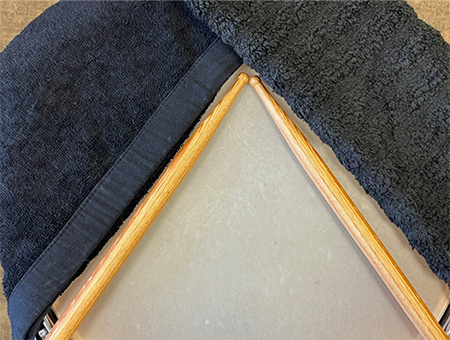
We as educators need to help our students understand that these problems do not magically fix themselves overnight. It is okay if they don’t notice much change from day to day as long as they work the process. What is more, these skills must be maintained from time to time to keep our playing in good shape. With consistent and prolonged practice, your students will start to improve their snare drumming technique and this will be the kickstart for improving extreme dynamic level playing.
Tip #2: Practice Everything as Softly and as Loudly as can Comfortably be Played
Once your students’ technique at the normal dynamic levels is progressing, you can start to hone in on the extreme dynamic levels. There is no magical method here, your students just need to spend time playing anything and everything they can get their hands on both very loudly and very softly. Are your students playing eighth-note studies in their method books during warm-up time? Are your percussion students learning a new rudiment? Is there a fun snare drum part in one of your concert band pieces? All of these situations can be used to explore dynamic extremes!
Have your students play all their music at each dynamic level, not just at what the music or the method book dictates. Place a heavy focus on the extremely quiet and the extremely loud dynamics. To make things simpler, I would recommend omitting things such as articulations, crescendos, and decrescendos for now. Leave those for when your students have achieved great sound quality at extreme dynamic levels consistently.
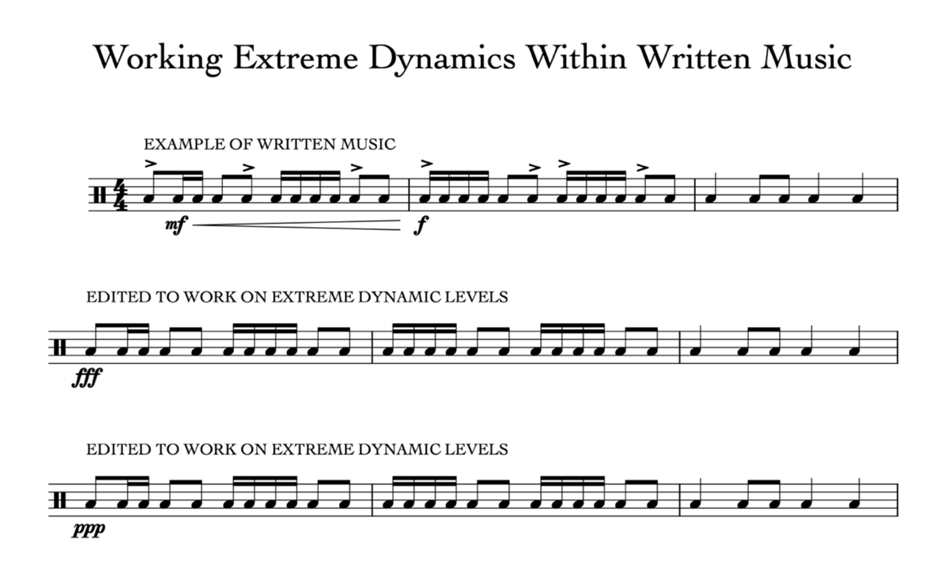
Tip #3: Practice Extreme Dynamic Changes
Once your students have become proficient in getting to the extreme dynamic levels, it is time to help them work out how they are supposed to get to and from those dynamic levels. Early on in my teaching career, I came up with a method to help students work on extreme dynamics and dynamic shifts at the same time. The idea behind this exercise is that you take a musical figure of your choice and start by playing it at four distinct dynamic levels: as loud as possible, mezzo forte, piano, and as softly as possible. This can be customized with different rhythmic patterns, rudiments, or short excerpts of challenging rhythms in your concert band music. For example, here is the exercise with a short rhythmic pattern of four sixteenth notes and a quarter note:

Possible customization #1: reverse the dynamic changes so that it starts as softly as possible.

Possible customization #2: mix the order of dynamics so that it is not sequential.

Possible customization #3: add in things like crescendos and decrescendos to the individual rhythmic figures.

-or-

Possible customization #4: include both crescendos and decrescendos in the exercise.

A short video demonstration of this exercise:
Conclusion:
I’d like to end by offering some encouragement. There are very few players who are naturally proficient with the extreme levels of dynamic contrast demonstrated by world-class musicians. If a lot of professionals were honest with themselves, they would probably admit that they are not as proficient with extreme dynamic levels as they should be. The good news for us educators is that you do not have to work on extreme dynamics for an extreme amount of time every day. As long as you are dedicating some time to it consistently each practice session, these dynamic levels will naturally become easier and easier until they are second nature.
RELATED ARTICLE
Seven Steps to Achieving a Great Snare Drum Sound
by William M. Shaltis
Percussive Notes
Volume 56, No. 3, July 2018
Robert Clayson currently serves as a Lecturer of Music for the Troy University John M. Long School of Music. His duties at Troy University include teaching the marching percussion section for the Troy University “Sound of the South” marching band, teaching private lessons, and teaching music theory and aural skills classes. Mr. Clayson earned his Bachelor’s Degree in Music Education from Troy University in 2015 and his Master’s Degree in Percussion Performance from Indiana University in 2017.
As a performer, Mr. Clayson is an active member of several regional orchestras across the Southeastern United States, including the LaGrange Symphony Orchestra and the Northwest Florida Symphony Orchestra. In 2012, Mr. Clayson performed with the Troy University Percussion Ensemble at the Percussive Arts Society International Convention as a member of the winning ensemble in the International Percussion Ensemble Competition. Mr. Clayson is an award-winning percussionist whose solo performances have been recognized and across the nation. In 2013, he received first place in the Percussive Arts Society Marching Festival Individual Collegiate Keyboard Competition, and he received first place in the 2017 Indiana Day of Percussion Collegiate Solo Marimba Competition. In addition to these honors, he was selected as a semi-finalist in the Great Plains International Marimba Competition in both 2014 and 2017.
Mr. Clayson is a member of the Blackswamp Percussion Educator Network, an Innovative Percussion Artist, and a Remo Artist. His compositions are available through C-Alan Publications, Excelcia Music Publishing, Row-Loff Productions, Studio 4 Music, Tapspace Publications, and Wildlight Publications.