

Sundaland: Sonic Architecture, Rhythmic Patterns, and Contemporary Virtuosity of the Sundanese Kendang
Sundaland: Sonic Architecture, Rhythmic Patterns, and Contemporary Virtuosity of the Sundanese Kendang
by Djati Rekso Wibowo (Bowie Djati)
Percussive Notes
Volume 64
No. 5
October
2026
The article “Sundaland: Sonic Architecture, Rhythmic Patterns, and Contemporary Virtuosity of the Sundanese Kendang” explores the rich percussion tradition of West Java, Indonesia. Sundaland, comprising 27 regions, shares foundational artistic roots expressed through the traditional kendang drum ensemble. The session features three key figures: Prof. Endo Suanda, an ethnomusicologist who provides historical context; Gilang Ramadhan, a master drummer integrating traditional rhythms with modern music; and Endang Ramdan, a virtuoso demonstrating traditional playing techniques.
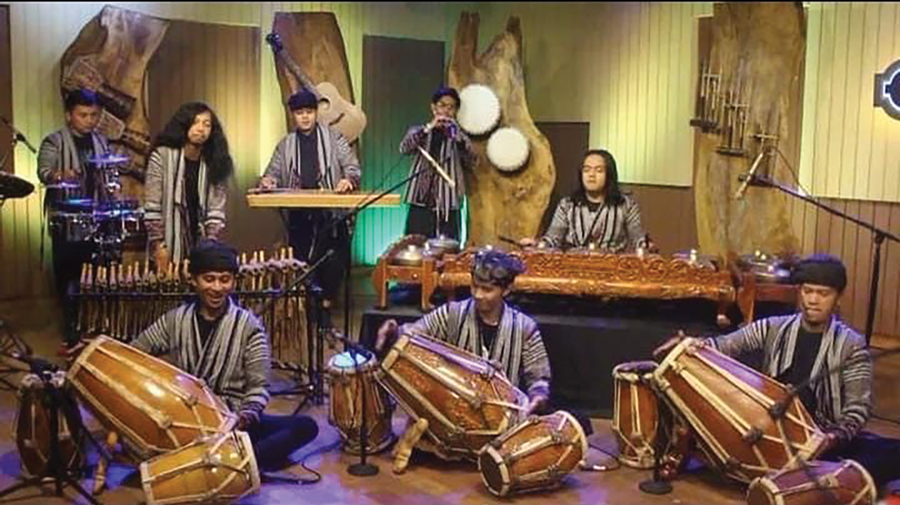
The soundscape of West Java, Indonesia, is shaped by an intricate interplay of rhythm, timbre, and cultural heritage. Across this lush, mountainous region lies Sundaland — not merely a geographical descriptor, but a living, cultural concept. Spanning 27 regencies and cities across West Java, Sundaland shares foundational artistic roots, while each region maintains distinct rhythmic dialects and stylistic characteristics.
In this PASIC 2026 Virtual Session, Sundaland comes alive through Rampak Kendang, the traditional Sundanese drum ensemble. Pairing master percussionists with complementary traditional instruments, the presentation explores the construction, performance techniques, rhythmic patterns, and modern evolution of the Sundanese kendang.
ARTISTIC AND ETHNOMUSICOLOGICAL VISION: THE FIGURES BEHIND SUNDALAND
To explore the depth of Sundanese rhythm, this session brings together three figures who bridge academic research, traditional mastery, and contemporary percussion:
Prof. Dr. Endo Suanda (Ethnomusicologist and Scholar): A seminal figure in Southeast Asian ethnomusicology, Prof. Suanda has spent decades documenting and analyzing the performing arts of West Java. His scholarship provides a historical framework for understanding how the kendang functions as the musical conductor across Sundaland.
Gilang Ramadhan (Master Drummer and Cultural Catalyst): One of Indonesia’s celebrated modern drum and percussion virtuosos, Ramadhan has spearheaded the integration of traditional Indonesian rhythms into contemporary drumset performance. His work highlights the Kendang Sunda as an instrument capable of driving fusion, world music, and global percussion dialogues.
Endang Ramdan (Kendang Virtuoso and Traditional Master): Renowned for his dexterity, speed, and command of traditional tepakan (striking techniques), Ramdan represents the living mastery of Sundanese drumming. His performance demonstrates heel dynamics (tungku), pitch bending, and rapid accent shifts characteristic of Rampak Kendang.
Together, these three masters show how Sundanese percussion connects historic folk traditions, academic study, and modern global stages.
ANATOMY AND ACOUSTIC DIMENSIONS: KENDANG INDUNG VS. KULANTER
The Sundanese kendang set is an asymmetrical acoustic system crafted from hardwood, often jackfruit or mango, and fitted with natural-hide heads, typically water buffalo or cow. A standard setup balances the primary mother drum with high-pitched accent drums. (See Illustration 1.)
|
Instrument Name |
Physical Characteristics |
Role & Pitch Profile |
|---|---|---|
|
Kendang Indung (Mother Drum) |
Large barrel body (60–70 cm); unequal head diameters (kempyang at the small end, bam at the large end). |
Deep bass and variable low tones; leads tempo and metric shifts. |
|
Kulanter / Kendang Anak (Accompanying Drums) |
Compact, high-tension drums (30–40 cm) mounted adjacent to the indung. |
Sharp, high-register articulation; syncopated accents and rapid fills. |
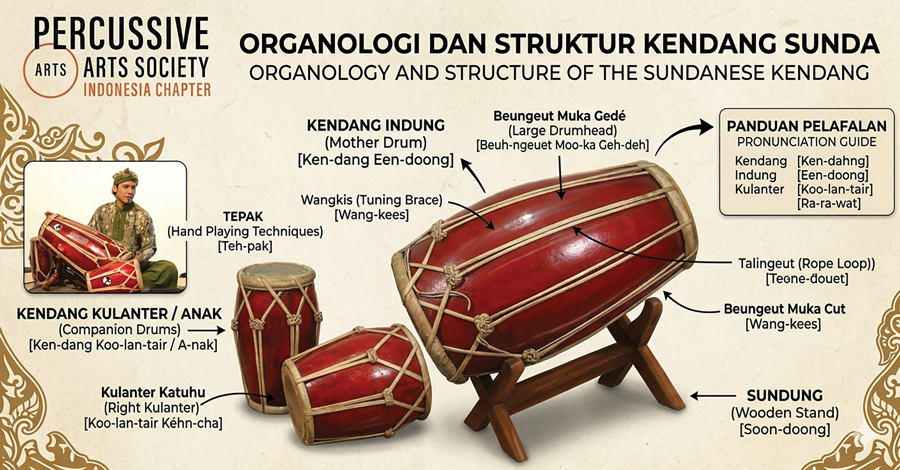
PERFORMANCE TECHNIQUE: HEEL MANIPULATION AND ORAL SOLFÈGE
The Sundanese kendang is distinguished from other regional Indonesian drums, including Javanese and Balinese kendang, by its wide range of timbral manipulation — most notably the use of the heel (tungku) — and a phonetic oral notation system (tepakan).
The Heel Technique (Dampal Suku)
While striking the kempyang (small head) or upper edge of the bam (large head) with the fingers and palms, the player presses the bare heel directly against the membrane of the large bam head.
Pitch Bending: By sliding the heel or varying its pressure on the drumhead while striking with the hand, the performer alters the membrane tension and pitch.
Low-Tone Glissando: This technique produces a sliding bass pitch — a distinct “dhum-woah” sound — that resembles vocal inflection.
Dynamic Muting: The foot acts as a real-time dampener, allowing the player to alter sustain, turn resonant bass tones into dry accents, or execute rapid polyrhythmic bass lines.
Oral Solfège
Sundanese drumming uses mnemonic syllables corresponding to hand placement, contact point, and foot mechanics: Dung/Dut (deep bass), Pang (slapped edge), Tung (open small head), and Tak/Tut (high-tension accents on the kulanter).
KEY RHYTHMIC PATTERNS (TEPAKAN) AND THEIR STRUCTURAL ROLES
Central to Sundanese kendang performance are distinct rhythmic patterns known as tepakan. Each carries a specific musical function, structural role, and expressive character:
Tepak Ketuk Tilu
Cultural Context: Rooted in the folk dance traditions of West Java, Ketuk Tilu is an important historical foundation of modern Sundanese drumming.
Musical Function: Characterized by a steady, grounded groove, Tepak Ketuk Tilu serves as a rhythmic anchor, providing a metric frame for dialogue with dancers or solo instrumentalists.
Tepak Jaipong
Cultural Context: Developed in the late 1970s by Gugum Gumbira, Jaipongan transformed West Javanese performing arts by blending Ketuk Tilu, Wayang Golek drumming, and the dynamics of Pencak Silat martial arts.
Musical Function: Highly syncopated and energetic, Tepak Jaipong features rapid fills and sudden metric shifts. The drummer reacts in real time to the dancer’s accents, creating an intensely interactive performance.
Tepak Pop Sunda
Cultural Context: Emerging alongside modern regional popular music in West Java, Pop Sunda adapts traditional drumming techniques to contemporary verse-chorus song structures.
Musical Function: This pattern balances traditional timbres, including heel pitch bending and kulanter clicks, with a modern, groove-oriented backbeat. It demonstrates how traditional percussion vocabulary can replace or complement Western drumset patterns.
Tepak Pangjadi Sawilet
Cultural Context: Derived from classical Sundanese gamelan and theatrical accompaniment styles.
Musical Function: Pangjadi serves as an introductory or transitional formula, while Sawilet defines a 16-beat structural cycle. Together they guide transitions, tempo changes, and formal boundaries within a composition.
THE POWER OF RAMPAK KENDANG: SYNCOPATION, UNISON, AND POLYPHONY
When multiple kendang players perform together, the ensemble becomes Rampak Kendang (rampak meaning “together” or “in unison”). The result balances precise synchronization with individual artistic expression.
Key Elements of Rampak Performance
Call-and-Response (Senggol): A master drummer initiates a complex rhythmic phrase, which the ensemble answers in tight formation.
Unison Accents (Tepak Rampak): Despite individual playing styles, the drummers perform high-energy, synchronized unison patterns that create powerful wall-of-sound moments.
Interlocking Patterns (Kotekan): Players divide complex subdivisions among themselves, creating high-speed hocketing rhythms.
Visual Choreography: Drummers synchronize head turns, arm flourishes, and bodily gestures with the rhythm, emphasizing the physicality of the performance.
THE KENDANG IN CONTEMPORARY MUSIC: TRADITION MEETS MODERNITY
Beyond traditional ceremonial settings, the Sundanese kendang has found a place in modern cross-genre music, including jazz fusion, contemporary pop, world music, and experimental electronic soundscapes. Rather than replacing the Western drumset, the Kendang Sunda offers a traditional voice within modern music-making:
Organic Tactility: In an era of quantized digital production, the kendang’s pitch glissandos and foot-modulated dynamics introduce a warm, human, and unpredictable texture.
Polyrhythmic Sophistication: Contemporary rhythm sections can draw on kendang patterns such as Tepak Jaipong and Pop Sunda to create grooves that connect Indonesian rhythmic traditions with modern funk, Latin, and progressive jazz.
A Dual Identity: The instrument moves from a melodic, voice-like solo role to an explosive rhythmic engine, allowing traditional percussion practices to lead modern musical explorations while retaining their cultural identity.
CONCLUSION: WHY SUNDALAND MATTERS FOR GLOBAL PERCUSSIONISTS
The Sundanese kendang represents a sophisticated hand-drumming tradition that combines articulation, pitch bending, finger dexterity, and foot technique. Through the scholarship of Prof. Endo Suanda, the modern versatility of Gilang Ramadhan, and the mastery of Endang Ramdan, this PASIC 2026 Virtual Session offers a window into West Java’s vibrant rhythmic landscape. Sundaland invites listeners to hear not only the rhythms, but also the stories, structures, and evolving future of the Sundanese kendang.
Djati Rekso Wibowo (Bowie Djati) is an Indonesian timpanist, percussionist, and advocate for the professional rights of performing artists. He has participated in intensive timpani summer courses in the United States and works to advance the welfare and professional standards of musicians in Indonesia. As president of the PAS Indonesia Chapter and a member of the PAS Symphonic and International Committees, he connects traditional Indonesian percussion heritage with global classical and contemporary practice.