
Uncommon Meters in Irish Traditional Music
Uncommon Meters in Irish Traditional Music
and how to use LEGO to teach them
by Andy Kruspe
Percussive Notes
Volume 64
No. 5
October
2026
This article by Andy Kruspe discusses the presence of uncommon time signatures such as 7/8 and 5/8 in contemporary Irish traditional music, which traditionally features meters like reels (cut time), jigs (6/8), slip jigs (9/8), and polkas (2/4). Kruspe and collaborators aim to demonstrate these irregular meters in a live session, including hands-on teaching using bodhráns. To aid learning, they propose using LEGO blocks to break down complex rhythms (like 7/8) into smaller groupings (e.g., 2+2+3 or 3+2+2), helping students grasp rhythm patterns without relying on standard notation, since Irish traditional music is primarily an oral tradition.

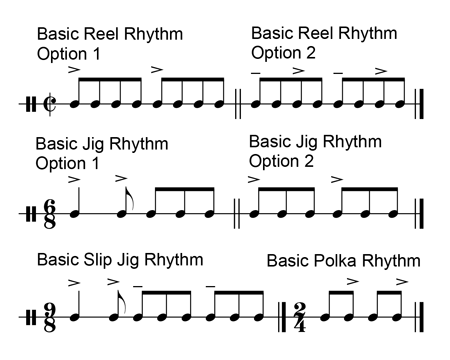
Irish traditional music is a genre of folk music that includes numerous types of compositions, including slow airs, unaccompanied singing, and dance tunes. Dance tunes are divided into several categories — including reels, jigs, slip jigs, and polkas — and are primarily distinguished by their meter — reels in cut time, jigs in 6/8, slip jigs in 9/8, and polkas in 2/4 (see Figure 1). These meters feature prominently in Saint Patrick’s Day celebrations, Irish dance shows, or other events that feature the music that many would recognize as part of the genre.
As Irish traditional music has evolved, contemporary “trad” musicians have begun to incorporate time signatures that do not fit neatly into more “traditional” tune types. Such meters as 7/8 and 5/8 can be heard in the music of such artists as Michael McGoldrick, Goitse, and Ímar. There are numerous reasons for the use of these atypical meters, but the most common is the influence of music from other cultures and locales.
Visit this YouTube playlist to hear examples of the aforementioned tunes in 7/8 and 5/8: https://youtube.com/playlist?list=PLJgmNV8KUOT8&si=4131guOIJfteqtX4).
In this PASIC 2026 session, fiddler Hannah Harris, guitarist Alberto “Bear” Whitmer, and I (on bodhrán) will share some of these irregular tune types in a live setting. Our “informance” will begin with examples of reels, jigs, slip jigs, and polkas for context. We will then perform examples of tunes with “uncommon” meters, featuring the following compositions: “Waterman’s” by Michael McGoldrick; “Invasion” by Áine McGeeney; “Transformed” by Áine McGeeney; “Fruit on the Snoot” by Liz Carroll; and “Fig for a Kiss/Olive for a Kiss” (traditional/contemporary adaptation).
TEACHING THIS MUSIC
It’s one thing to share this music with an audience, but it’s another to teach it. The back half of this session will be a hands-on experience with one of these tunes. We will distribute bodhráns and tippers to the audience, and then we will teach the group how to play a tune in 7/8.
It should be noted that Irish traditional music is fundamentally an oral and aural tradition. Tunes and songs are often passed from teacher to student without standardized musical notation. In these situations, alternate teaching aids can benefit both the student and the teacher, and they can often be found in unexpected places — such as a collection of children’s toys!
LEGO blocks can be a very effective way to teach students who do not know how to read standard notation. 7/8 can be broken down into smaller eighth-note groupings, such as 2+2+3 or 3+2+2 (see Figure 2).
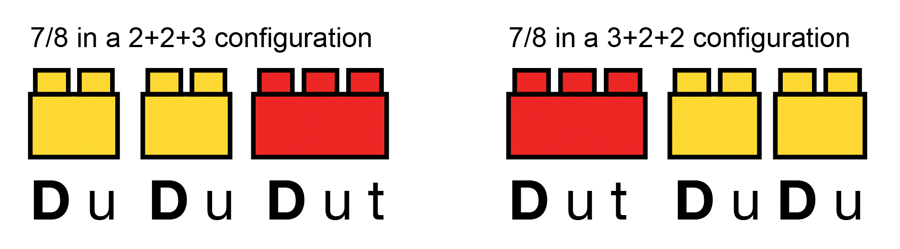
Once students understand the sequence of these groupings, sticking patterns and accents can be assigned to each grouping in order to perform these rhythms. Groupings of two are played with a loud down-stroke using an open tone (D) immediately followed by a soft up-stroke using a muted tone (u). A grouping of three is played with a loud down-stroke using an open tone (D) immediately followed by a soft up-stroke and tap-stroke using muted tones (u t). These sequences can then be combined and adjusted for the tune that is being taught. Once the rhythmic structure and sticking has been learned, other tones can be added in order to compose a drum part that is most complementary to the tune.
For those who are not familiar with “down,” “up,” and “tap” strokes in this context, it might be easiest to think of these as “right” and “left” when drumming with two sticks. The bodhrán is played with a single stick or “tipper.” Rhythms with alternating sticking such as “right-left-right-left” would be played “down-up-down-up.” The “tap” stroke functions as the first note of two successive notes on the same hand; “right-right” would be played as “tap-down.” This will be explained in greater detail in this session.
It is our hope that this session will introduce the audience to some of the “irregular” tunes that are becoming more popular in Irish traditional music today, thus showing that the genre is more than just jigs and reels. In addition, we hope that the “hands-on” portion will introduce instructors to additional resources for teaching similar meters to their own students.
We look forward to seeing you all there!
Andy Kruspe is a freelance percussionist and instructor from Huntsville, Alabama. He teaches privately in his own percussion studio, The Irish Drum Center at Lowe Mill Arts & Entertainment, and is an adjunct faculty member at The University of North Alabama. He is the author of several books for the bodhrán, including The Bodhrán Primer and Playing the Tune. You can find out more about him at www.andykruspebodhran.com.
Hannah Harris (fiddle and voice) and Alberto “Bear” Whitmer (guitar) initially connected at The Ark’s Gavin Family Crossroads Ceili and local sessions in Plymouth and Ann Arbor, Michigan. Harris studied at University College Cork (Ireland) and Whitmer honed his skills at the University of Limerick (Ireland). Harris’s fiddle playing, both lyrical and driving, echoes the styles of Matt Cranitch and Liz Carroll, while Whitmer’s sensitive yet lifting guitar work draws inspiration from Tony McManus and John Doyle.