

Key to Successful Audition
Key to Successful Audition
Unique sound as a core skill of every orchestral percussionist
by Mikolaj Graczyk
Percussive Notes
Volume 64
No. 5
October
2026
The article by Mikolaj Graczyk emphasizes the importance of developing a unique personal sound for orchestral percussionists, particularly in auditions where subtle differences in tone and musical intention can distinguish candidates. It highlights how small percussion instruments—such as the triangle, cymbals, tambourine, and bass drum—play a crucial role in shaping the overall orchestral texture, often influencing audition outcomes. The piece encourages percussionists to focus beyond technical perfection and cultivate listening skills, imagination, and flexibility to create a recognizable musical voice. Graczyk illustrates these ideas through collaborative performance examples and draws from his diverse orchestral experience.
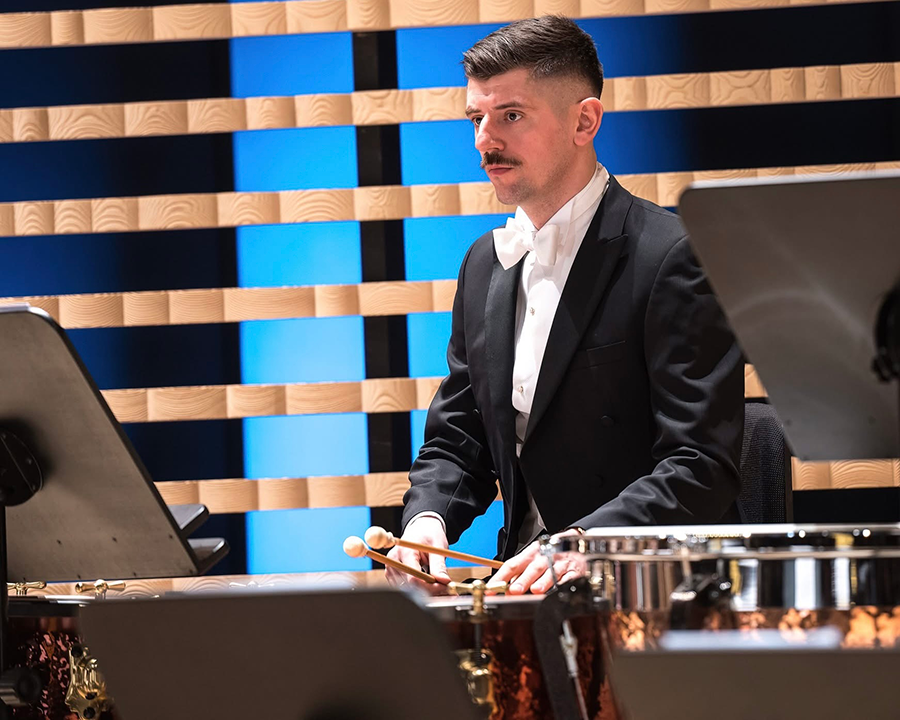
Every orchestra has its own identity, traditions, and expectations. I will begin by sharing my experience as a percussionist performing with the Representative Orchestra of the Polish Armed Forces and the Polish Royal Opera, where versatility, precision, and the ability to adapt to different musical environments are essential parts of everyday orchestral life.
Building on the inspiring discussions from last year’s Mock Audition about the importance of developing an individual sound, my PASIC 2026 session explores one of the most overlooked aspects of orchestral percussion: creating a personal musical voice in audition, where behind-screen sound is often the only thing that distinguishes one candidate from another.
Together with percussionists from different countries, we will perform an excerpt from Igor Stravinsky’s “The Firebird.” The passage will be played four times, with every performer rotating through each position in the percussion section. This unique format allows the audience to hear how different musicians approach the same musical material, demonstrating how choices of touch, articulation, sound production, tone color, balance, and musical intention can completely transform the character of a performance.
For most orchestral percussionists, a professional career begins not with playing the timpani in Beethoven’s “Ninth Symphony” or the snare drum in “Scheherazade,” but with mastering the instruments that are often considered secondary within the percussion section. While today’s audition candidates frequently achieve extraordinary technical standards on the snare drum, marimba, and xylophone, success is often decided by the instruments that receive the least attention during practice.
This presentation highlights the artistic importance of such instruments as triangle, cymbals, tambourine, and bass drum. A single triangle note, a perfectly balanced cymbal crash, or just a few carefully shaped bass drum strokes can define the color of an entire orchestral texture and ultimately determine the outcome of an audition. The goal of this session is to encourage young percussionists to look beyond technical perfection and discover that the true art of orchestral playing lies in listening, imagination, flexibility, and the pursuit of a unique and recognizable sound.
Mikolaj Graczyk won an audition for the position of percussionist with the Warmian-Masurian Philharmonic in Olsztyn in 2016. He was a member of the NFM Orchestral Academy in Wrocław in 2016–17 under the guidance of Christopher Lane. He also took part in numerous workshops, including the International Lutosławski Youth Orchestra (2017, 2019), I Culture Orchestra (2017, 2018), and Pan-European Philharmonia (2017). In 2018, he won an audition for the Polish Sinfonia Iuventus Orchestra. In October 2024, he collaborated with the Malta Philharmonic on a production of Verdi’s “Joan of Arc.” In 2025, he won an audition for the international Grafenegg Academy Orchestra. He currently serves as a musician in the Representative Regiment of the Polish Armed Forces and is a percussionist/timpanist in the Polish Royal Opera.