

The Role of the Timpani Roll
The Role of the Timpani Roll
Finding your musical voice and communicating contextual understanding through the art of the timpani roll
by Alana Wiesing
Percussive Notes
Volume 64
No. 5
October
2026
The article by Alana Wiesing highlights the importance of the timpani roll as a vital expressive tool in orchestral performance, not just a technical skill. It explains that various factors—such as drum tension, mallet type and size, dynamic level, and orchestration—impact the roll’s sound and character. Wiesing emphasizes that mature timpanists must make intentional artistic decisions to adapt rolls to each musical context. Her PASIC 2026 session aims to teach practical strategies and demonstrate how subtle technique changes can dramatically affect musical outcomes, encouraging players to view rolls as a powerful language for communication and expression.
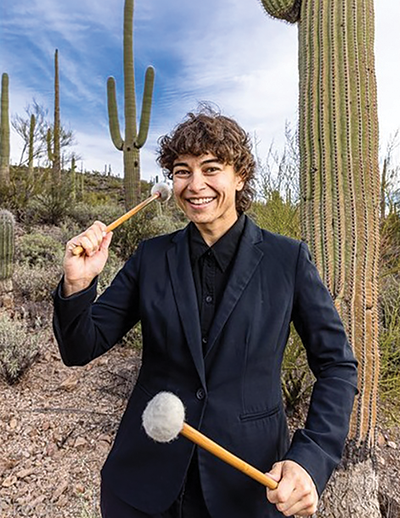
For timpanists, few techniques and musical passages are more fundamental, or more misunderstood, than the roll. We begin learning and practicing rolls early in our musical development, often focusing on evenness, consistency, and endurance. While these technical foundations are essential, they are only the beginning. In performance, a roll is much more than an even, sustained sound; it is one of the timpanist’s most underrated and powerful tools for shaping color, energy, and musical direction. Whether creating a barely perceptible, tranquil shimmer beneath a peaceful soundscape, driving the loud intensity of a full orchestral climax, or anything between and outside those bounds, the quality of a roll can profoundly influence the character of an ensemble.
Yet, there is no single “correct” timpani roll. Every musical situation demands thoughtful artistic decisions. The tension of the timpani head or register of the pitch on the drum, the size of the mallet heads, the type of covering on the mallets, the material of the core of the mallets, the dynamic level, and the surrounding orchestration all affect how a roll should sound, and these should all be properly considered in the pursuit of optimal execution to most effectively complement the musical context. Developing the ability to recognize these variables and make intentional, inevitable adjustments in response is a defining characteristic of mature timpani playing.
My PASIC 2026 session will explore the artistic and practical considerations behind determining and playing expressive, reliable timpani rolls. Through presentation and demonstrations, I will examine how physical approach, stroke quality, mechanical considerations, and mallet selection influence tone and character across a wide variety of musical settings. Using representative examples from the repertoire, attendees will learn and hear how subtle changes in technique and/or drum selection can dramatically alter the musical result, in addition to gaining practical strategies for refining consistency, control, and expression in their own playing.
Rather than viewing the timpani roll as simply a technical requirement to be mastered, I hope attendees leave thinking of it as an expressive language that is capable of supporting, inspiring, and even leading an ensemble. By approaching every roll with intentional musical purpose and perspective, timpanists can strengthen not only their technical command but also their artistic voice, allowing one of our instrument’s most recognizable techniques to become one of its most compelling means of communication and expression.
Alana Wiesing is an award-winning timpanist and percussionist from Phoenix, Arizona. She holds Bachelor of Music and Master of Music degrees from the Indiana University Jacobs School of Music. She is the Principal Timpanist of the Tucson Symphony Orchestra and Arizona Musicfest Festival Orchestra and plays timpani and percussion with the Mainly Mozart All-Star Orchestra, Oregon Bach Festival, and the International Pride Orchestra. Wiesing has appeared as guest Principal Timpanist with the National Symphony Orchestra, Utah Symphony, Florida Orchestra, and Pacific Symphony, and has also served as Principal Timpanist with the Sphinx Competition Orchestra and the Gateways Festival Orchestra. She serves as President and Board Chair of the Network for Diversity in Concert Percussion, Chair of the Equity, Diversity, and Inclusion Workgroup for the Regional Orchestra Players’ Association (ROPA), a member of the ROPA Executive Board as the Delegate-at-Large to the American Federation of Musicians (AFM) Convention, and President of the Tucson Federation of Musicians (AFM Local 33).