

Orchestral Principal Percussionist in A Changing World
Orchestral Principal Percussionist in A Changing World
by Brian Del Signore
Percussive Notes
Volume 64
No. 5
October
2026
The article by Brian Del Signore outlines the evolving role and responsibilities of the orchestral principal percussionist in American orchestras. Performance remains the top priority, requiring years of rigorous training, mastery over a wide range of percussion instruments, and successful audition preparation. The principal percussionist also undertakes significant administrative duties, including assigning parts based on players’ strengths and managing equipment setup and stage layout. Leadership within the percussion section is crucial, requiring clear communication, respect, and fostering camaraderie. Del Signore emphasizes the importance of professionalism, ongoing preparation, and maintaining a positive attitude to succeed in this demanding but rewarding role.
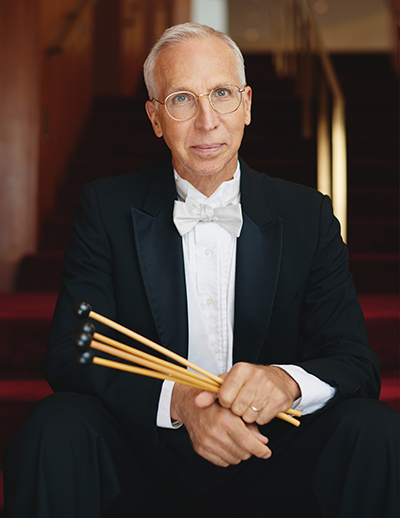
To be an orchestral principal percussionist in our changing world takes a diverse set of skills. In my PASIC 2026 clinic, I will discuss the wide range of responsibilities of the principal percussionist in American orchestras today. The responsibilities have broadened since I became principal percussionist of Houston Symphony in 1986. Certain responsibilities remain as before, but new ones are added. I’ll separate the responsibilities into three subgroups. Let’s start with the first responsibility.
PERFORMANCE
Performance is still job number-one. We spend years practicing drums and percussion because we want to become better percussionists, i.e., better performers. We could spend a long time talking about player development. Suffice it to say that we expect that percussionists have developed a very high level of proficiency and then refined their ability further, to be able to get an orchestral job. To get that job, you must first prove your ability to perform by winning the audition. What this entails in technical playing ability, understanding of repertoire, performance traditions, and forward thinking, is measured at the audition. It is measured further during the tenure process.
When an audition is won and a job is accepted, a probationary period of one to two years is usual, where the new musician must do the job, while a critique is made by the music director, with input by the audition committee. At some point, up to a specified end date of the probationary period, the music director will either grant or deny tenure to the musician. This is a very important time to prove your ability beyond the audition.
Training for the principal percussion position is much the same as the training for a section percussion position. It is the most important playing position in the percussion section, because it is the principal position. You are expected to play the most important percussion parts. It takes years to acquire the technical skills, musical knowledge, and understanding of the vast amount of music and instruments orchestral percussionists must master.
Audition Preparation
Audition prep is the final phase of orchestral percussion training. The audition is a short showcase of your talent and ability, playing orchestral repertoire. It takes multiple hours of daily practice on the material to prepare for the audition. But before preparing for the audition, years of practice becoming a good percussionist who is proficient on the orchestral percussion instruments must happen. Years in a music school or conservatory of music working towards a college degree in music can provide the time needed to develop these abilities. Quality and knowledgeable instruction is also essential.
Percussion is a multifaceted ability. Some of the most important skills for the orchestral job, and thus the audition, are soft snare drum playing, keyboard mallet playing — especially two-mallet xylophone and glockenspiel — and four-mallet marimba and vibraphone. Skilled use of cymbals, tambourine, and bass drum also count highly. Understanding how to play triangle elegantly is important, and sometimes drumset or timpani is asked. Any number of other percussion instruments can be added to judge a player’s ability in different ethnicities and groove.
Orchestral Performance as a Professional
Outside of rock and pop stars, many people don’t realize that there are people who make a living playing music. There have been times when I’ve heard people who saw Houston Symphony play on weekday morning say, “It was nice of you all to take off work today to come play music for us.” Or “Congratulations,” not knowing that you will come back the following night, and the night after that, and next week, and the week after that, to do it again. Having an orchestral playing job in a major U.S. orchestra is a full-time job. That means it is the most important thing you do each day, especially on concert days. So you must prepare for each concert and give most of your daily focus on performing well. It is what you are paid to do. Most major cities in the U.S. have professional orchestras with salaried musicians. Keep in mind the responsibility and privilege it is, and don’t disrespect it.
Doing the job will most often be easier than winning the audition. That is because you will have proven your ability in the highly competitive and musically dense playing situation of the audition. Preparing and playing your parts weekly and from concert to concert will not be as overwhelming as performing a boat load of the most difficult percussion excerpts one after another in an audition. But it will be an ongoing task for the rest of your career, if you stick with it. It is quite often a very exciting job, musically, requiring the same kind of preparation and skill maintenance that your audition prepared you for.
ADMINISTRATIVE WORK
What else do we do besides play the principal part? Lots of stuff!
Assignments
Yes, there is desk work. Organizational skills are needed. Assignments must be made of who is going to play what part on what instruments in the percussion section. The responsibility of those decisions is included in the principal percussionist’s job.
How do you do assignments? If I were to say, “I don’t know,” that would not be untrue. That is because every piece of music takes emersion of yourself into the percussion score from each player’s perspective, as well as a global view of how the parts work together. Also to be considered in assigning parts is what equipment is going to be used, and how and where it will be set up onstage. At my PASIC 2026 clinic, I will show examples of assignment sheets and equipment layouts and discuss them.
When assigning parts, you must decide what part you as principal are supposed to play. Sometimes it is more obvious than others. In traditional classical repertoire, it is expected that you will play only one part. For example, in “Don Juan” by Richard Strauss or “Sorcerer’s Apprentice” by Dukas, you will play one part, even if you aren’t busy when other parts are being played. Don’t assign yourself glockenspiel and add some of the cymbal part, too. Choose one part and respect your section players to play theirs. And it is not always clear in the music what part is the most important.
Sometimes in modern percussion scores, there are multiple “most important” parts that can be considered principal, and multiple instruments may be played and shared by several percussionists. What do you do then? Once you have mapped it out, do you play the most exposed part? The most difficult part? The part that takes the most preparation? The most rhythmically involved part or the most melodically solo part? You can’t play everything, and this is where knowledge of your section players’ and extra players’ abilities comes into play.
Assign according to their strengths and trust in their abilities. Extra players, too. If there are many strengths individually, allow them to play different parts in different pieces, especially in different concerts. This keeps them in shape. And for players who play for many years, this helps them to stay able and strong on many instruments through the years. It also keeps them happy and interested.
Once you have made the assignments, it will become clear what part you as the principal should play. However, there will be many important parts. Truthfully, all of them are important. Once you have made assignments, it is the responsibility of each player to perform the part you have given them. So don’t fret about how they are playing it, once you have assigned it. Just assign according to what you know about their abilities.
Which brings us to the idea of interpretation. Interpretations can be very similar, same school, or quite different. What to do about that? The key here is to have an open mind and non-judgmental communication. That is possible when the players are secure in themselves and their abilities, and in their training. There are people who don’t want to talk about how they should play something. That is not an asset. Defensiveness does not lead to comradery among the players or to better music. Everybody loses when we can’t talk to each other about what we do. And we have a lot to do!
So, keep communication healthy by giving people the space to play it differently, while being willing to talk about approaches when it’s appropriate and comfortable. With students or very young professionals, it is different. Guidance is good. But a principal can come off as overbearing to experienced players with demands for changes. Keep your ego in check. Don’t boss people around. You will find that tolerances of differences, especially well-thought-out and trained differences, enrich the music.
Equipment and Stage Layout
The principal percussionist is expected to figure out what equipment is needed and how it should be put out onstage. This responsibility comes from making the assignments. We understand best what instruments each player needs and where each player will be onstage, because we, as the principal, made the assignments. There are a few different ways to go about this. Some people prefer software programs for staging. I prefer typing a list of instruments from stage left to stage right, including a second row of instruments when needed, and noted variations. A list allows me to clearly show numbers and details. I include everything I want the stage crew to put out there, including chairs, stools, trap tables, and music stands (upright and flat). I also include offstage setups and instructions, such as what trunks we will need close by that will have smaller gear for the percussionists to get themselves.
Once the crew puts everything out as specified, it will not be perfectly placed. To make sure the equipment is where it needs to be, I like to be the first one there at the first rehearsal, to refine the placements properly before the rest of the percussionists show up. That’s not always necessary in traditional classical pieces, but in our modern, complicated percussion scoring world, it is important to do this for the section players to be able to get their setup put together without confusion. The assignments are your interpretation of how to play a piece, and their gear needs to be where you envisioned it.
Sometimes equipment that the orchestra does not own must be rented or purchased. Always look weeks ahead of time at what the orchestra will be playing. Acquiring the equipment should not be a last-minute task. Instruments might need to be shipped in, and money appropriated from management to pay for it. Always look ahead. It’s a multitask job!
LEADERSHIP
The final important quality of being a principal percussionist in an orchestra is leadership. Unlike some other instruments in the orchestra where you might be able to come in and play the principal part and still not engage with your section, the principal percussionist has too many responsibilities to ignore the other players in the section. It is impossible to be a principal percussionist and not communicate with your section. So do it with respect, positive expectations, comradery, and support of their efforts. Your leadership is shown by how well you do the things I discussed above, and your attitude. Your attitude will set the tone for everyone else in the section. Make it positive. After all, you are the principal. You are the leader.
Brian Del Signore retired from his position as principal percussionist with Houston Symphony in July 2026 after 40 years of service. He studied at Carnegie Mellon University and Temple University, where he was a student of Philadelphia Orchestra’s Alan Abel.