
HealthRHYTHMS: Group Empowerment Drumming for Improved Wellbeing
HealthRHYTHMS: Group Empowerment Drumming for Improved Wellbeing
by Arlene de Silva
Percussive Notes
Volume 64
No. 5
October
2026
HealthRHYTHMS Group Empowerment Drumming is an evidence-based recreational music-making program designed to improve health and well-being by fostering social connection, stress reduction, and emotional expression. Unlike traditional music therapy, it focuses on fun, non-performance group drumming activities led by trained facilitators who guide participants rather than lead them. Research has demonstrated significant benefits including reduced stress at a biological level, improved mood, lower burnout, enhanced immune function, and increased social bonding across diverse populations such as veterans, older adults, youth, and corporate employees. The program’s structured 10-step protocol provides a supportive, inclusive environment requiring no prior musical experience, encouraging creativity and wellness through group rhythm making.
Drumming is a well-known immune booster! At PASIC 2026, attendees will be able to learn about HealthRHYTHMS Group Empowerment Drumming and its health benefits. The program is evidence-based recreational music making, which is not about musicality or musical outcomes, rather it is about achieving health outcomes. According to the Merriam Webster dictionary, the term “recreational” is derived from the Latin root, “recreatio,” which means “restoration to health.”
Recreational Music Making (RMM) has its roots in the early work of Karl T. Bruhn, the father of the Music-Making and Wellness movement, and scientific research from Barry Bittman, MD, neurologist, researcher, classically-trained pianist, and pioneer in the field of mind-body medicine, whose studies have demonstrated a link between playing music and the positive effects on one’s overall health — lowering stress, blood pressure, and heart rate. Through his research, Dr. Bittman determined that playing music within the context of a group in a pressure-free environment could reduce stress at the DNA level. His philosophy was that music making was for all people, According to Dr Bittman, “it’s about inspiring extraordinary living.” The unique format of RMM is its emphasis on group-based activities.
HealthRHYTHMS is not a performance-based music program or a traditional music therapy program. Rather, it is an evidence-based recreational music-making wellness program that provides a non-threatening opportunity for people to express their creativity.One ofthe unique features of the program is the quality of its trained facilitators. Remo Inc., owner of HealthRHYTHMS, designated qualified individuals to conduct facilitator trainings. Facilitators are taught to guide rather than lead. They learn that facilitation builds bonds that strengthen progressively. These expert facilitators are caring, compassionate, and intuitive guides who empower individuals to make meaningful changes in their lives by making wellness a fun activity. No prior musical experience is required.
Research conducted on HealthRHYTHMS has documented statistically significant improvements in quality of life, including physical, emotional, and social benefits. The program creates a non-threatening environment and builds support.
HealthRHYTHMS is all about bringing people together for camaraderie, connection, and community. The 10-step protocol innovated by Dr Bittman includes opportunity for breathing/stretching exercises, learning the art of giving and receiving, an introduction to the drum if it’s an individual’s first time connecting with the instrument, getting comfortable, a short jam session with drums and rhythm instruments, followed by an opportunity for non-verbal communication. The drum becomes a tool to express oneself. The conclusion includes a journey through guided imagery drumming, a cool down, and a quick one-word share.
The program is used in over 20 countries with older adults, caregivers, veterans, developmentally disabled, people with autism and Down’s syndrome, individuals recovering from mental illness and substance use, children, college students, people with Parkinson’s, patients with Alzheimer’s/dementia, wellness groups, heart failure support groups, cancer survivors, and corporate employees. There’s no limit to the populations that could benefit from this intervention.
HealthRHYTHMS is used as a prevention tool as well in recovery.
It is worth mentioning a few of the outcomes from Dr Bittman’s peer-reviewed research studies:
• A study conducted on long-term-care workers demonstrated a 46% improvement in mood disturbance (depression, anxiety, anger, tension, fatigue, hostility, vigor, and confusion), and 62% improvement six weeks post intervention.
• 18.3% reduction in employee turnover and improved overall employee retention.
• A study conducted on at-risk youth documented the utilization of this program as a catalyst for nonverbal and verbal disclosure leading to improved quality of life for inner-city youth in a court-referred residential treatment program. The results suggested that the protocol could be utilized as a meaningful step toward enabling adolescents to build self-control, self-esteem, respect, empathy and tolerance for others.
• A study conducted on first-year nursing students utilized the protocol focusing on group support and stress reduction. Burnout and mood dimensions were assessed with the Maslach Burnout Inventory and the Profile of Mood States respectively. Statistically significant reductions of multiple burnout and mood dimensions as well as Total Mood Disturbance (TMD) scores were noted. Potential annual cost savings for the typical associate degree nursing program ($16,800) and acute care hospital ($322,000) were projected by an independent economic analysis firm
• The effects of a Recreational Music-Making (RMM) group drumming protocol was evaluated on Japanese male corporate employees. A total of 20 volunteers participated in a one-hour RMM session while 20 volunteers engaged in leisurely reading for one hour (controls). After a six-month interval, the groups switched activities and underwent one session each. Pre- and post-intervention data were collected using mood state questionnaires and blood samples. The RMM group demonstrated enhanced mood, reduced stress-induced, and higher natural killer cell activity when compared to the control group.
• A study conducted on Japanese older adults showed that RMM group drumming intervention improved mood and modulated certain immunological responses of healthy older participants in a direction opposite to that expected with chronic stress.
It would be remiss not to share a few testimonials from HealthRHYTHMS group empowerment drumming participants:
“A simple introduction to the ancient tradition of producing rhythms has been the genesis of a new passion for me, and has profoundly impacted my newfound sobriety… Perhaps the most poignant compliment regarding the success of HealthRHYTHMS can be demonstrated in the form of me purchasing my own drum, as well as joining a drum group!” —Participant, Alcohol & Drug Treatment Program
“When we did a (HealthRHYTHMS) group outside…the nurse said, ‘Who are you two and where have you been with these drums?!’ She had never seen the kids so engaged, joyful, and seemingly ‘neurotypical’ as during our session…(it) was a blessing, as they had all been admitted suicidal.” —HealthRHYTHMS Facilitator, mental health facility
“Strangers relaxed around each other, experienced bridge-building, and had fun.” —Public Library Staff Member
“Making and playing my own rhythms was fun!” —Teenager
HealthRHYTHMS is fun-filled and full of health benefits!
I encourage you to attend this PASIC session and learn about HealthRHYTHMS evidence-based recreational music making, and have fun enjoying the drumming and camaraderie. You will learn the science of the mind-body connection in the context of music–making, and about the 10-step HealthRHYTHMS protocol for individuals to benefit from active participation. Drums and rhythm instruments will be provided.
For more information about HealthRHYTHMS, visit www.musicandwellness.net.
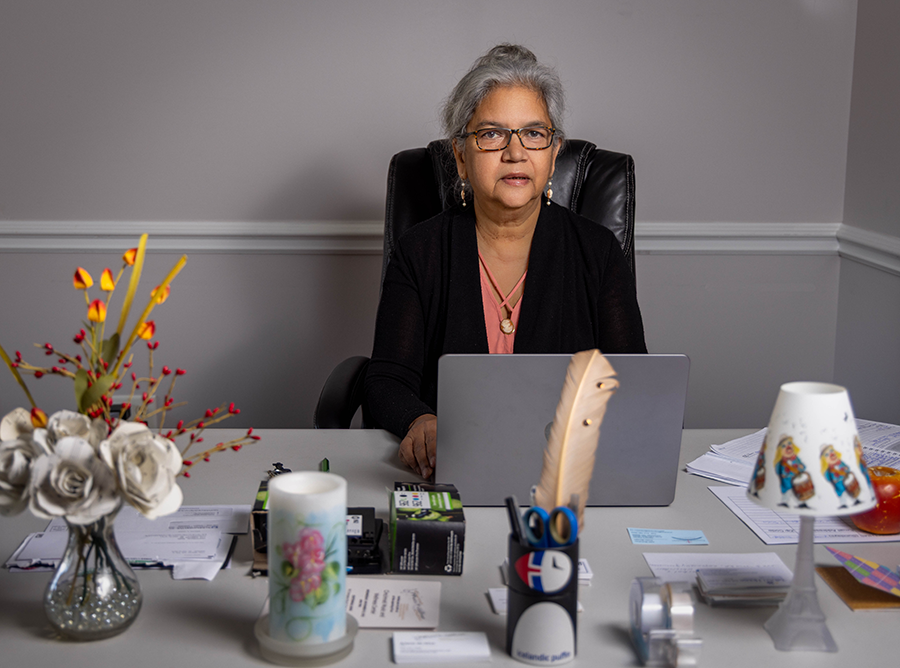
Arlene de Silva is founder and CEO of Cincinnati Music & Wellness Coalition, a non-profit with a mission to promote a culture of wellness in diverse populations through evidence-based recreational music making, education, and arts engagement. She is also a national trainer for Remo HealthRHYTHMS. She holds a Licentiate from the Royal College of Music, London, England, and a BS in Accounting from the Aquinas University in Sri Lanka.