

Marching Cymbal Independence
Marching Cymbal Independence
Transcribing drumset parts for drumline without holding cymbals for the snare line
by Christopher Wilson
Percussive Notes
Volume 64
No. 5
October
2026
The article by Christopher Wilson discusses the challenges of arranging popular music for college marching band drumlines, focusing on integrating marching cymbals effectively. It addresses decisions about how much of the original drumset parts to include and suggests using marching cymbal independence to handle issues like drill formation and cymbal durability. Wilson explains various cymbal tones (hi-hats, sizzles, sizz-suck, crashes, chokes) and techniques such as splitting the cymbal section to imitate complex drumset parts. The article draws on Wilson’s experience arranging for the Washington State University Cougar Marching Band and includes practical examples and performance recordings.
The college marching band presents percussion instructors with a myriad of challenges. These include writing multiple shows per season, the fast turnaround of teaching some shows in one week, and contending with disparate talent levels within the ensemble. Another challenge is in arranging popular music for marching band, which is common in the music selected for halftime performances.
As a drumline arranger, how much of the original drumset part should one include? Should the arranger quote as much as possible, quote minimally while implying the backbeat, or not quote the original part at all? How much of the original bass drum part should be included versus a more traditional split bass line?
Many stock arrangements of popular music for marching band still ask the snare drum section to play on marching cymbals in a manner similar to playing drumset. However, this can create dilemmas on the field. First, the drill writer might want to incorporate the drumline into the forms, including not wanting the cymbal section directly in front of the snare section. Second, playing on cymbals with marching snare drum sticks may cause the cymbals to break at a faster rate.
If the arranger is trying to challenge the musicians, then marching cymbal independence may be the best solution for these problems. This session will focus on how one can write for marching cymbals to imply the original cymbal patterns, and arrange for drumline while implying or mimicking original drumset parts with the snare drums and cymbals operating independently.
The first thing drumline instructors must do is familiarize themselves with different tones on the marching cymbals. Many of today’s marching ensembles make use of mounted cymbals in the front ensemble, so it’s not uncommon for an instructor or arranger to have not worked with a marching cymbal section. These different tones include examples that percussionists are likely familiar with, including hi-hats, sizzles, the sizz-suck technique, crashes, and chokes. Some other examples include clicks for a faster and more articulate sound than hi-hats, and taps that can mimic ride cymbals.
If the cymbal section is big enough, the arranger can also consider splitting the section. An older approach to marching band saw drumlines march with different sized cymbals, and arrangers writing individual lines for each to create melodies similar to split bass drum parts. This approach can be co-opted even if the drumline is marching cymbals that are all the same size. In this approach, splitting the cymbal section will help with mimicking drumset parts that may be too quick for an individual cymbal player to achieve.
In the accompanying examples, the original drumset part included open and closed hi-hats, then sixteenth notes on the hi-hats. To achieve this in the marching cymbals, I first split the section in two: the bottom line would only play sizz-sucks while the top line would play hi-hat tones. Then, the top line was split in two, as the sixteenth notes were likely too fast to execute. Half of the group played stems up, the other half stems down.
Techniques like these and more will be explored with more examples from my experiences arranging for Washington State University’s Cougar Marching Band. The presentation will include a breakdown of the different cymbal tones listed above, as well as how to utilize different articulations on snare drum and bass drum. Each musical example will be accompanied by a recording from the performance on the field.
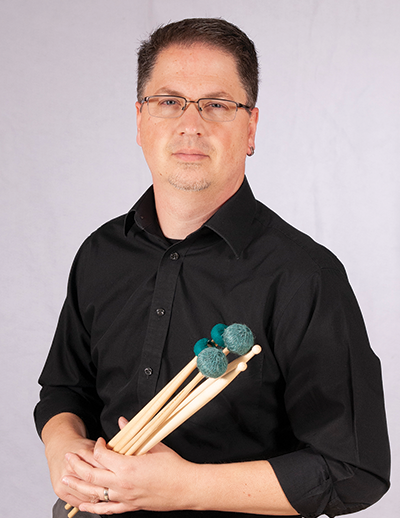
Christopher Wilson is an assistant professor of music and the coordinator of percussion at Washington State University, where he teaches applied percussion lessons, conducts the percussion ensemble, and serves as assistant director of the Cougar Marching Band. In 2025, he released his first solo album, Solemn Music, a collection of the three unaccompanied marimba solos by David Maslanka: “Variations on Lost Love,” “My Lady White,” and the first professional recording of “A Solemn Music.”