

The Marimbas of Costa Rica
The Marimbas of Costa Rica
A history of cultural identity through its national instrument
by Fernando Meza on behalf of Ensamble de Marimbas y Percusión UCR Guanacaste
Percussive Notes
Volume 64
No. 5
October
2026
The article traces the marimba’s rich history from ancient lithophones to its current form. Originating as wooden slab instruments in Africa, it evolved into xylophones and marimbas. In Mesoamerica, musicians like Sebastián Hurtado Mazariegos transformed the traditional diatonic marimba into a chromatic double-keyboard instrument. The marimba remains culturally significant in Central America, especially Costa Rica, where it plays a central role in community celebrations and cultural identity. The article highlights the ongoing preservation and celebration of marimba traditions through groups like Ensamble de Marimbas y Percusión UCR Guanacaste.
As with all instruments, the marimba has its own history — a very rich one — but unlike others, looking back in time leads us to try to ascertain its moment of birth, as well as to follow its path of development, getting to know the cultures and people that have contributed to it over time, until arriving at its present configuration. It certainly did not arrive overnight, birthed from a factory!
The concept of a “keyboard” may perhaps be better considered as a “grouping” or “organization” of keys (or bars, in the case of mallet instruments). The marimba can be traced back thousands of years to a concept first encountered in lithophones (stone instruments), where a few slabs, organized from larger to smaller, presented a kind of “keyboard” that produced sounds either lower or higher. Over time, that concept established itself in Africa with a great number of instruments made from wood, and the first versions of xylophones and marimbas were born.
The importance of the etymology of the word “xylophone” cannot be overstated, as its Greek roots help to tell us much about the encompassing character of these instruments (xylos: wood; phono: sound). The marimba, itself a word from the bantu language family (ma: many; rimba: single wooden bar; thus ma-rimba: many wooden bars), has developed in unique ways over the years and crossed geographical barriers to arrive at the instrument percussionists know today. Prior to arriving at its current format commercially, the marimba underwent transformative changes in the Mesoamerican region, converting a diatonic instrument into a fully chromatic one. Through the work of Sebastián Hurtado Mazariegos in Guatemala (along with his brother Toribio and Julián Paniagua Martínez, music director of a military band), and Corazón de Jesús Borraz Moreno in Mexico (along with his father and his uncle Mariano Ruperto Moreno), the traditional marimba sencilla or “single marimba” (an instrument consisting of a single diatonic keyboard) evolved into a marimba doble or a marimba with two keyboards (one diatonic equivalent to the white keys on the piano, and one for the accidentals or black keys).
Notwithstanding the changes implemented in converting the instrument from its diatonic roots to a more sophisticated chromatic version, the sound of the traditional marimba remained in the Mesoamerican instruments, and their characteristic buzz (originally produced, as in its African counterparts, by the use of a spider web attached to the resonator, and nowadays by a thin layer of pig’s intestine or by commercially available Teflon tape) is not only heard on all of these instruments, but greatly appreciated by those who recognize it as a part of their cultural heritage.
Once converted into a fully functional chromatic keyboard, the marimba became capable of wider artistic reach and embarked on a journey that took it north to the United States and eventually Japan, where it caught the attention of pioneers in the field of instrument development and underwent further changes in its presentation and sound, allowing it eventually to reach the entire world in the format of commercially available instruments.
The roots of what we know today as commercial/industrial marimbas remain an important element of the instrument’s history, but it is important to understand that they are a breathing and living thing and constitute a crucial component of cultural identity for those for whom the instrument functions as a defining component of their heritage. The marimba is the national instrument of Costa Rica and Guatemala, and it is equally important in the rest of Central America, as well as Mexico. In all of these, there are several instrument makers, performers, teachers, composers and enthusiasts, who are enhancing the marimba tradition of each country. We feel particularly proud to have some of the very best representatives from Costa Rica in the group that will perform at PASIC 2026.
In Costa Rica, the role of the marimba is quite encompassing, particularly in the northern region of the country, in the province of Guanacaste, where it has an active role in religious, political, social, cultural, and artistic contexts. In the city of Santa Cruz in particular, considered as the birthplace of the marimba tradition in the country, the marimba functions as one of several cultural imprimaturs, along with traditional foods and drinks, bull-riding and related activities, traditional dances and dress design, Catholic celebrations centered around the Christ of Esquipulas (patron of the city), and others.
A particularly important display of the marimba’s reach into the cultural fabric of the country can be experienced during the Fiestas Típicas Nacionales, a week-long celebration in Santa Cruz, anchored in a religious context, but non-religious in its everyday activities. During this time, a different marimba group can be heard in each corner of the city, bringing together performers and singers, as well as dancers who fill the streets dancing to the sound of the various marimba ensembles. The majority of these performers are not musicians by trade, but rather, are amateur players who enjoy playing the instrument and are actively engaged in the preservation and continuation of cultural legacies inherited by them across generations. Many of these players are quite sophisticated technically and musically (particularly considering that they do not practice much during the year), and some are indeed professional musicians who excel at all areas of performance, including improvisation, an element highly respected within the tradition. Marimba groups during Fiestas Típicas Nacionales can be heard throughout the day and well into the night, creating an environment that is rich in music, camaraderie, and deep respect for the marimba.
Contemporary marimbists at PASIC would benefit by attending this scholarly presentation, as well as the performance by Ensamble de Marimbas y Percusión UCR Guanacaste (the Marimba and Percussion Ensemble from Santa Cruz, Guanacaste), as it will enhance their understanding of the heritage of the marimba and the knowledge about the history of the instrument they embrace as their own.
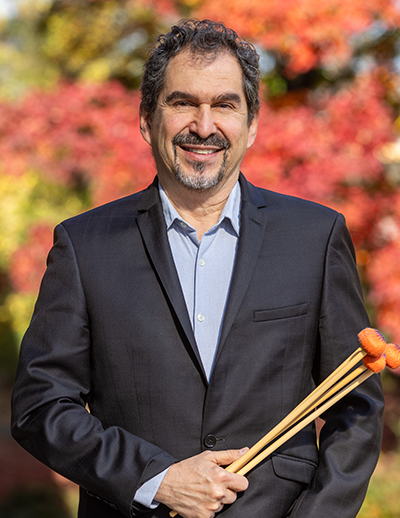
Fernando Meza is Professor of Music and Chair of Percussion Studies at the University of Minnesota School of Music in Minneapolis.
The Ensamble de Marimbas y Percusión UCR Guanacaste is a group of professional musicians based in Santa Cruz, Guanacaste (Costa Rica), who are performers, educators, and carriers of a tradition. Their work objective is predicated by the social fabric of the marimba within the province of Guanacaste, and is represented through the compilation, writing and dissemination of the musical and cultural heritage of the region. Many of their members are teachers at the “Escuela de Etapa Básica” in Santa Cruz, and they have presented performances nationally and internationally. They have recorded many important compositions by Costa Rican composers and are continuously developing opportunities for young people to become involved with the traditional marimba, following on the legacy of the founder of the school, Ulpiano Duarte.