

From Chiapas to the Concert Stage
From Chiapas to the Concert Stage
Stylistic translation of Southern Mexican genres for the concert marimba
by Dr. Roberto Palomeque
Percussive Notes
Volume 64
No. 5
October
2026
Roberto Palomeque, raised in Chiapas, Mexico, grew up surrounded by the traditional marimba music his family helped shape. He noticed a gap between this rich Mexican marimba tradition and the international concert-marimba repertoire encountered in academia. Palomeque works to bridge these worlds by stylistically translating traditional southern Mexican marimba genres into contemporary solo marimba performances. His PASIC 2026 presentation showcases four pieces blending traditional rhythms, techniques, and improvisation with modern concert marimba approaches. This integration preserves and honors Mexican marimba heritage while expanding its expressive possibilities on the global concert stage.
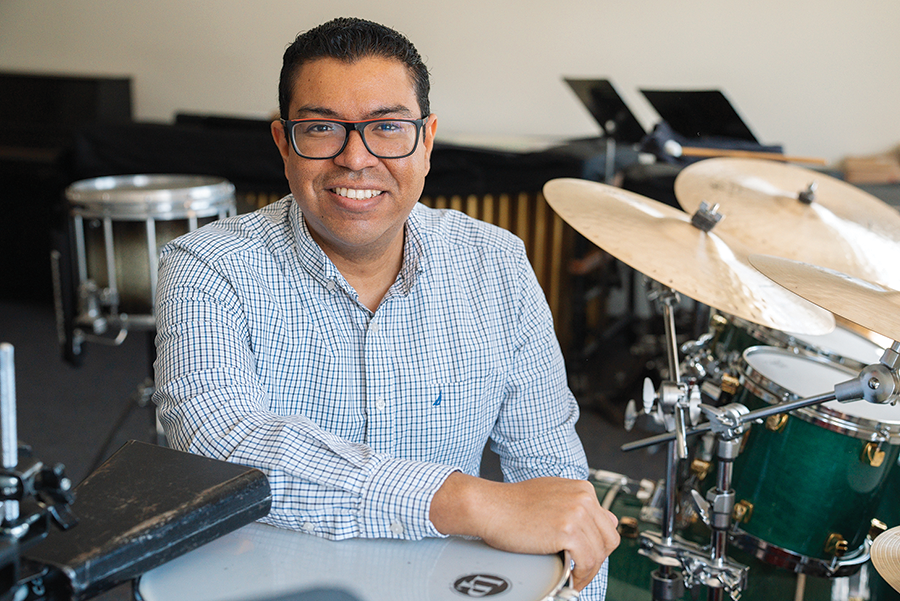
I started playing marimba when I was six years old, alongside my relatives in Chiapas, Mexico. At that age, I did not think of the marimba as a concert instrument; it was simply part of my life. In Chiapas, the marimba is everywhere — in family gatherings, celebrations, funerals, and community events. My family has been part of this tradition for generations. In 1958, my grandfather, Roberto “Tito” Palomeque Celaya, founded Marimba Hermanos Palomeque with his six brothers, developing their unique approach to arranging, orchestration, and performance of traditional Mexican music as well as jazz and Latin American styles. Growing up in this environment gave me an understanding of the marimba that was very different from what I encountered later in my academic training.
After studying at UNICACH University, completing a master’s in Belgium, and earning my DMA at the University of Southern Mississippi, I recognized a gap between two worlds: the international concert-marimba repertoire I encountered in academia, and the musical language rooted in the Mexican marimba tradition I’d grown up with. I began asking: What if these two worlds did not have to remain separate?
A TRADITION WITH ITS OWN LANGUAGE
Traditional southern Mexican marimba ensembles developed a sophisticated division of musical roles: leading voice, second voice, harmony, and bass. The second voice can harmonize or create countermelodies, the harmony player shapes chords and rhythmic patterns, and the leading voice carries the principal melody, soul, and much more.
The tradition also developed a distinctive approach to four-mallet playing. In Chiapas, the tenorista, a specialized four-mallet soloist, uses improvisation, accompaniment, countermelodies, and melodic elaboration. Traditional Mexican players developed close-position voicings, double vertical strokes, characteristic chord structures, and a flexible approach to improvisation.
These concepts are learned when young through a natural process. Undergoing this process shaped me: memorizing repertoire, developing my ear, performing for large audiences without stage fright, building stamina for gigs as long as five hours, developing muscle memory for challenging passages, and, most importantly, developing respect and love for the instrument as another family member.
This background was essential to me as a performer, educator, and composer. The question wasn’t simply how to arrange Mexican music for solo marimba, but how to translate the musical language of the traditional ensemble into contemporary solo performance.
FROM ENSEMBLE TO SOLOIST
As the chromatic marimba developed, Mexican performers expanded their repertoire through arrangements and original compositions, incorporating genres such as waltz, danzon, cha cha chá, cumbia, and Afro-Latin rhythms — with some ensembles moving toward concert repertoire. Traditional marimbists were already adapting the instrument and repertoire to new contexts.
I extended this history in my doctoral project, synthesizing it with my own experience as a performer and adding influences from contemporary North American, European, and Asian repertoire. However, Latin American contemporary repertoire remained largely absent from concert and recital programs worldwide, with almost none from Mexican composers specifically.
Only a few Latin American works have achieved international recognition: Argentine composer Guillo Espel’s “Zamba para Escuchar tu Silencio,” Alejandro Viñao’s “Khan Variations,” and Brazilian composer and marimbist Ney Rosauro’s work, which provided an important example. Rosauro integrated national musical language into the concert repertoire, paving a path for Latin American voices — but there is still a long way to go.
Mexico’s variety of regional styles, and southern Mexican marimba especially, provides rich material for exploring rhythm, melody, harmony, articulation, phrasing, improvisation, and four-mallet technique. This is what I mean by stylistic translation: creating a context for the marimba to embrace genres, as the Mexican mariachi and marimba ensembles already do by playing all kinds of genres, from western to contemporary repertoire.
FOUR PIECES, FOUR APPROACHES
For my PASIC 2026 presentation, I’ve selected four pieces. Two are original solo compositions from my doctoral work: “One for Tito” and “Waltz Chiapa de Corzo.” Each approaches the relationship between tradition and marimba solo technique differently. Two more pieces deeply connect my topic: my arrangement of “Libertango” by Astor Piazzolla and “Travesía de un Migrante (The Journey of a Migrant)” by Israel Moreno. Together, these works represent different stages of translating the Mexican marimba tradition into the concert setting.
“One for Tito” is dedicated to my grandfather. The piece incorporates danzón, cha cha chá, and Son Latino into a solo-marimba work. Its rhythmic language, four-mallet writing, and voicing draw directly from the musical world where I grew up. The solo section in the middle is an homage to Mexican marimba players, especially to my grandfather’s playing style. This piece represents the beginning of the transition from traditional marimba ensemble to contemporary repertoire.
“Waltz Chiapa de Corzo” takes the next step toward the concert setting. Based on traditional waltz material by Abraham Cuesta Grajales, the piece uses modern harmonies, technique, and four-mallet writing while maintaining the character of the original music. Here, the traditional style begins to move farther into the language of the solo marimba. The piece was conceived more from the perspective of a four-mallet concert marimbist, with the traditional ensemble influence becoming more distant while its musical character remains present.
My arrangement of “Libertango” by Astor Piazzolla represents a fusion of these two approaches. It brings together my experience and training as a Mexican marimba player with my academic work and experience with contemporary solo-marimba repertoire. The arrangement maintains recognizable sections and patterns from Piazzolla’s original while incorporating four-mallet techniques and an improvisational section inspired by the playing practices of early Mexican marimbists. The improvisation makes each performance unique and allows the performer to bring a personal voice to the piece.
Finally, “Travesía de un Migrante (The Journey of a Migrant)” by Israel Moreno represents modernity, evolution, and the development of the performer as an artist. The piece is dedicated to Keiko Abe and was the required work for the Latin American Marimba Competition in 2011. “Travesía” moves beyond simply adapting traditional material and uses elements of the Mexican marimba tradition as part of a contemporary musical language. Through this work, Moreno tells the story of an immigrant crossing the border into the United States in eight acts, combining compositional elements associated with Keiko Abe with the Mexican marimba style. In this way, the work shows how tradition can become a starting point for developing new techniques, musical ideas, and artistic expression. The work has eight sections: La tierra (The Earth), La Partida (Departure), La Travesía y Persecución (The Journey and Persecution), Escape (Escape), Un Poco de Esperanza (A Little Hope), El Desierto (The Desert), Frontera (Border), and Nuevas Expectativas (New Expectations).
Here, traditional musical language becomes more than a stylistic reference. It becomes a means of storytelling and communicating cultural identity, belonging to new ideas, developed technique, and sonorities.
Together, these four works show different possibilities for stylistic translation: beginning with tradition, moving toward the solo-marimba repertoire, combining traditional and contemporary approaches, and ultimately using that foundation to develop new techniques and artistic voices. This development is not only about moving forward but also serves to preserve and honor tradition.
CONCLUSION
I believe the future of Mexican marimba lies in both safeguarding its identity and integrating it with the instrument’s international development. PASIC 2026 is a perfect place to share this tradition and explore how it can be appreciated, incorporated, and developed within the contemporary concert-marimba world. My goal is to expand the established repertoire’s possibilities by bringing forward musical ideas from generations of southern Mexican marimbists. For me, this journey began with my family in Chiapas in an existing tradition.
The next step is to carry that tradition forward.
Dr. Roberto Palomeque embraces the traditions of Mexican marimba music and unites his roots with academic training, combining popular music and jazz with contemporary and concert repertoires. Dr. Palomeque has received several awards, including first prize in the Universal Marimba Duo Competition in Belgium and first prize at the 1st Keiko Abe Latin-America Marimba Solo Competition, with Keiko Abe as jury president. He has performed as a soloist at festivals and venues worldwide, including PASIC and many more. He is percussion professor and Director of Percussion Studies at Concordia College in Moorhead, Minnesota.