

Contemporary Fusions: Interpreting and Performing the Music of Roland Dyens on Marimba
Contemporary Fusions: Interpreting and Performing the Music of Roland Dyens on Marimba
by John Dawson
Percussive Notes
Volume 64
No. 5
October
2026
Roland Dyens, a renowned French-Tunisian classical guitarist and composer, integrated Brazilian music styles like bossa nova and samba into his works, which have become staples of modern classical guitar repertoire. His music naturally translates to marimba due to similarities in pitch range, chord voicing, and lack of sustain. John Dawson explores how adapting Dyens’ pieces, such as “Felicidade” and “Hommage à Villa-Lobos,” challenges and enriches marimbists with complex textures, extended techniques, and opportunities for improvisation. These transcriptions broaden the marimba repertoire and invite personal interpretation, blending classical guitar idioms with jazz and Brazilian influences.
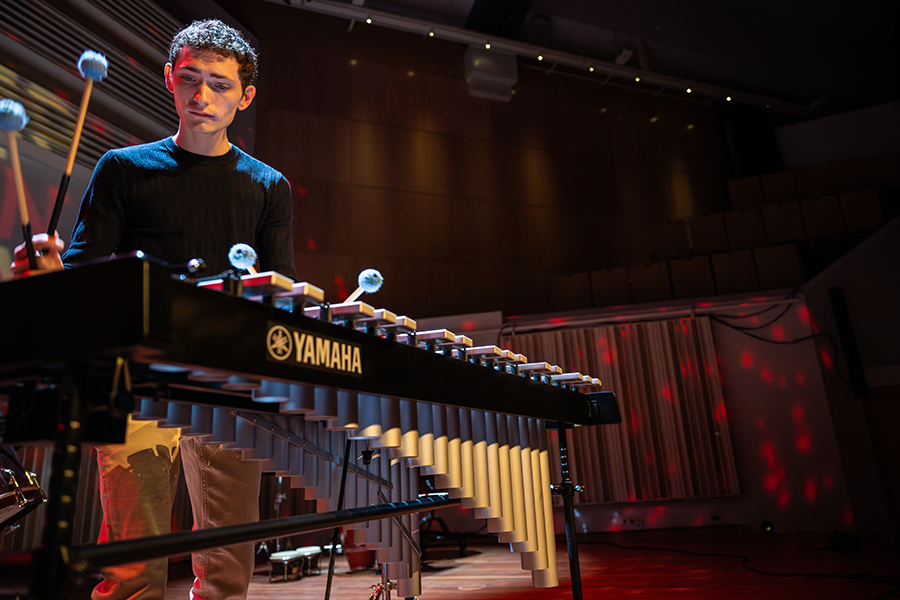
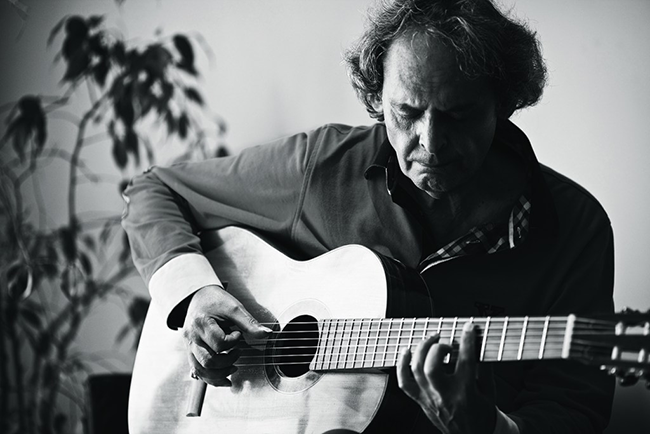
While surveying composers of the classical guitar whose output came in the generations following Andrés Segovia, I developed a fascination with the music and performances of Roland Dyens. He and other classical guitar composers who gained notoriety in the waning quarter of the 20th century and into the 21st were, similar to some of the most influential figures in marimba repertoire of the past 50 years, characterized by their inseparability as performer-composers.
Born in 1955, French-Tunisian guitarist Dyens received rigorous classical training with Manuel Ponce before traveling to Brazil at age 18. There, he studied the genres of bossa nova, samba, and choro, and familiarized himself with the music of such musicians as Antônio Carlos Jobim and Pixinguinha. Dyens went on to become one of the most prolific guitarists of his generation with many of his works becoming standard pillars of the modern classical guitar repertoire. Dyens died on Oct, 29, 2016 after serving as Professor of Guitar at the Conservatoire National Supérieur de Musique de Paris.
This PASIC 2026 virtual keyboard clinic represents some of my recent work in uncovering guitar repertoire of the 20th and 21st century that expands the breadth of musical idioms that marimbists are able to perform, and offers a unique experience as both a performer and a listener. I will perform several original works and arrangements by Dyens, discuss my process in bringing the works to the marimba, and reflect on the qualities that make these works a valuable addition to the collection of transcriptions that are frequently performed.
Numerous elements of guitar music naturally transfer to the marimba: pitch range, inherent lack of sustain, and the tendency for an open voicing of chords that use the 5-octave marimba’s most resonant area. These qualities are demonstrated by the various popular transcriptions of guitar and lute music that have made their way into our performance practice. These same qualities are found in Dyens alongside technical and musical challenges that are as rewarding to confront as any piece originally written for marimba.
FELICIDADE
“Felicidade,” which served as my introduction to Dyens, is representative of the many arrangements of jazz standards and popular Brazilian tunes Dyens created. “A Felicidade,” the bossa nova song, was composed by Antônio Carlos Jobim with lyrics by Vinícius de Moraes for the French film Black Orpheus (1959). While this arrangement has made it onto countless guitar recitals and albums, my favorite interpretation is from Dyens himself on his 2004 album Nuages. In it we hear absolute smoothness and transparency of line, supreme technical control, and an earnest respect and understanding of the borrowed style. I strive to carry these traits over into my interpretation while confronting the many technical challenges that a piece like this presents.
Like many of Dyens’s works, “Felicidade” is densely and meticulously notated. One principal challenge in interpreting this work is achieving a smooth melodic line amongst a rich accompanying middle voice and a demanding, constantly leaping bass voice. A musical texture such as this differs highly from a typical marimba composition that intertwines rhythmic, harmonic, and melodic components into one flowing mallet permutation. In particular, the demands of the left hand give Dyens’s jazz arrangements a characteristically fresh sound on the marimba. Many sections contain jumps of an octave or more, including some that involve movement of a single bass note into chord tones an octave higher in quick succession, as well as extended passages of cyclic and constant left-hand motion reminiscent of the Moeller technique, all while the right hand is engaged with an exposed melodic line.
In working on “Felicidade,” I found a need to develop my delineation of articulations between mallets, proactively planning which notes will be struck with the broad face of the mallet to achieve a clearer core and which notes were to be played with the upper crown of the mallet to achieve a softer and less immediate timbre. Often, these distinctions in color need to be made in quick succession, demonstrated in moments where mallet four must alternate between single melodic notes and subdued chord tones that pepper the forward momentum of the texture. The choice between an “idiomatic” sticking on marimba and one that is less technically straightforward but better defines the voices is a constant consideration here. The need for clear control of the multi-voice texture is immediately apparent in the A section’s main motive following a short, rhythmic introduction. Skilled guitarists have close control over the duration and precise timbre of notes, and seeking to achieve that ideal on the marimba is an enriching process that builds sensitivity of touch, technical finesse, and musical awareness of the instrument.
How and with what level of specificity to manage note durations is a decision the player is immediately confronted with when studying this music. Dyens liberally applies staccatos, tenutos, staccato-tenutos, and secco markings throughout the piece. One of our tools as marimbists is the “deadstroke,” and the degree to which we apply pressure to the bar dictates the precise timbre and length of shortened notes. However, applying a deadstroke to every staccato marking is not feasible in craft or physicality. Instead, I use very light quasi-deadstrokes in the opening of the piece, and use an aggressive full deadstroke only when observing the secco markings. The degree to which one applies deadstrokes and quasi-deadstrokes to observe shortness of note can lend a great deal of variety to an interpretation.
The remainder of our options related to note duration come from our application of varied stroke speeds, manipulation of the mallet angle, and our use of tremolos, particularly one-handed rolls. Marimbists are unfortunately limited by the physical space the marimba occupies and the obtuse angles that executing certain note combinations put us in, but there are various opportunities for careful observation of the exact length of notes in “Felicidade.” Additionally, percussive sounds and extended techniques are almost a staple of Dyens’s works. “Felicidade” features a short moment of percussive string slaps that provide an upbeat groove. Many options exist to observe this technique, but I’ve found that striking the edges of the bar with the mallet shafts grants the ideal combination of pitch and percussive timbre. This is not the case for percussive moments in some of the other works on this program where shaft-clicks, foot stomps, or a hyper-aggressive deadstroke are better options.
One of the most exciting aspects of this repertoire is the opportunity for us as marimbists to work on technique and musicianship through the jazz idiom, as the genre demands knowledge of style and a sensitivity of touch that varies widely from the typical study of Baroque lute music or even some of our most iconic works for marimba.
HOMMAGE À VILLA-LOBOS
Dyens’s admiration for Brazil and its composers makes its way into his fully original compositions. His “Hommage à Villa-Lobos” (1987), a suite of four movements, serves as a dedication to one of Brazil’s greatest musical figures. The first movement, “Climazonie,” juxtaposes a rhythmic droning of repeated notes with a colorful and airy B section that creates cloudy textures through rapid figuration. The movement demonstrates the occasional need to fill out certain textures with octaves when adapting modern guitar works to the marimba in order to match the same richness, length of note, and dramatic intensity of the open low strings of a guitar.
“Danse caractérielle et Bachianinha,” the second movement, again contrasts a slow and fast section, but this time through two distinct characters of Brazilian music: one festive and dance-like and the other lyrical and sentimental, paying homage to Villa-Lobos’s series of nine Bach-inspired “Brasileiras.”
The third and fourth movements, “Andantinostalgie” and “Tuhú,” are more internally homogenous than the previous two. The third provides another opportunity for the marimbist to manage a long, singable melody over a swaying rhythmic accompaniment through careful observation of stroke speeds and dynamics. The fourth movement’s sixteenth-note driven moto perpetuo character presents several technical challenges on marimba, many of which find solutions in creative stickings. Both movements feature extensive glissandi, which can be approached via smooth, alternated chromatic stickings, or via singular, undefined but aggressively fast swipes across the lower manual.
The ending of the work features an opportunity for improvisation, a practice that was deeply important to Dyens and that can be heard in his live performance recordings. Before the final restatement of the opening motive, Dyens creates a rugged groove through extended techniques and strumming characteristic of popular guitar music.
ADDITIONAL WORKS
I will also showcase two other jazz arrangements by Dyens: “’Round Midnight” by Thelonious Monk and “Nuages” by Django Reinhardt, in addition to one of his most popular compositions, the short and catchy “Tango en Skaï.” Possibly the most appealing trait of this repertoire is the lack of a performance practice. Potential for individuality across performances of these works is higher than that of many other transcriptions we bring to the marimba, given the range of possible solutions to the technical and musical challenges poised by Dyens’s style. It is my hope that some or all of these pieces find a home in student recitals or professional concerts in the coming years.
John Dawson is an Adjunct Professor of Percussion at Nazareth University in Rochester, N.Y. He has made semi-finals appearances at the 8th World Marimba Competition and the 2024 TROMP International Percussion Competition, been invited to the 75th ARD International Music Competition, and won 1st Prize at the Great Plains International Marimba Competition. He has performed or presented at festivals and conferences in the U.S. and performs regularly with the Rochester and Buffalo Philharmonic Orchestras. John is completing his Doctor of Musical Arts degree in Percussion Performance and Literature (ABD) with a minor in Music Education from the Eastman School of Music.