

Commonalities Between Hands and Feet on Drumset
Commonalities Between Hands and Feet on Drumset
A conversation with Mike Packer
by Colleen Clark
Percussive Notes
Volume 64
No. 5
October
2026
Mike Packer is a renowned drummer and educator with over 35 years of experience, known for his expertise in bass drum technique and the relationship between hand and foot drumming. His career includes performances with prominent artists and orchestras, extensive teaching worldwide, and authorship of several instructional books. Packer emphasizes understanding weight distribution between the thigh and toes to improve bass drum technique, applying concepts from hand techniques such as the Moeller method to the feet. He advocates for personalized approaches that prioritize sound quality, rhythmic accuracy, and injury prevention. Additionally, he invented the Heel Less bass drum pedal and leads curriculum and professional development initiatives in the arts through Inspire EDU.
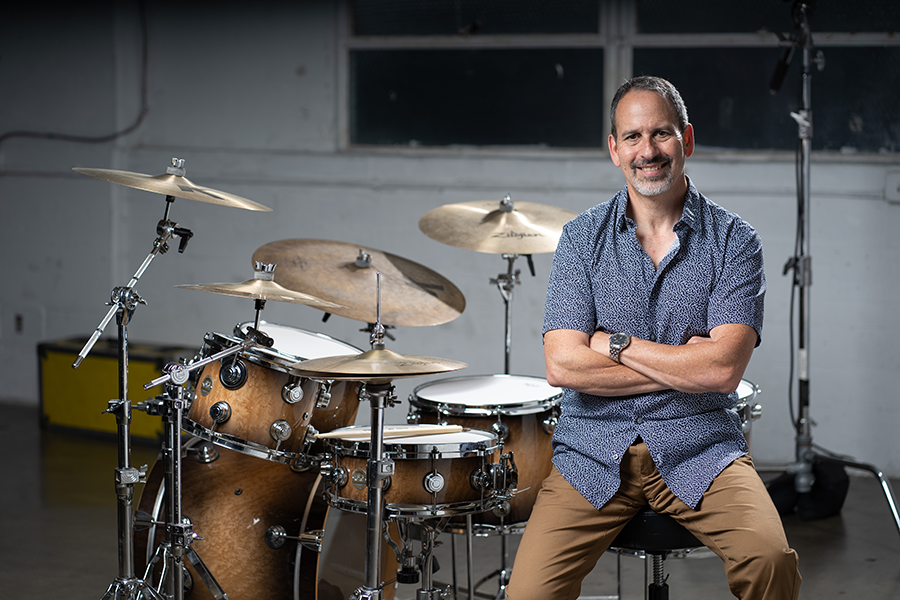
Mike Packer has become known for his teaching and passion surrounding drumset, and specifically bass drum technique. For years he has studied the commonalities between the hands and feet. This has led to multiple educational publications centered around foot technique.
Packer’s career spans more than 35 years of performance, teaching, and program development. His drumming credits include Free Flight, Wilson Phillips, Lorna Luft, Diane Reeves, and the Los Angeles Philharmonic. He has spent over three decades teaching private lessons, classroom instruction, and clinics across the U.S., Europe, and Asia. Mike holds a Bachelor of Arts in Percussion Performance degree from the University of Northern Colorado and a master’s in Education, Leadership, and Policy from Boston University. He is also a published author and inventor. His books include Feet Don’t Fail Me Now (Hal Leonard), The Bass Drum Owner’s Manual (Modern Drummer Publications), and The Drum Channel Method E-Books (Hudson Music), along with editorial and production work on Ralph Humphrey and Joe Porcaro’s Playing Techniques series (Hudson Music). He also invented the Heel Less bass drum pedal, a design licensed to DW Drums and produced as the DW5000 ADH. Mike is the Founder and President of Inspire EDU, where he leads curriculum design, workforce development, and professional development initiatives for the arts and entertainment sector.
Colleen Clark: Introduce Percussive Notes readers to your professional career
Mike Packer: I’ve been playing drums and percussion since I was 11, over 40 years. I came up in public schools in Denver and the suburbs of Chicago. I went to University of Northern Colorado for my undergrad in classical percussion, but we also had a great jazz program. I was involved in all the big bands, combos, vocal jazz — everything that I could do. I was playing in about 10 ensembles per semester. I was trying to soak it up as much as possible, always knowing that I was going to move to L.A. and pursue a career as a player and an educator.
When I moved out, I realized quickly that I needed to continue studying drumset specifically. I’d had a lot of experience with ensemble playing and reading and all of that stuff, but I needed to brush up on some technique and some flow and vocabulary and stuff. I studied primarily with Ralph Humphrey, and also studied with Jeff Hamilton for a while and a guy named Carl Tassy who was an alum of Freddy Guber’s method. In doing so, we worked a lot on hands. But I was able to take what we were doing with hands and apply it to the feet. I was studying a lot of Moeller technique, and in looking at those motions and how everything worked together, I applied it to the bass drum. So I was able to improve my rhythmic accuracy, my sound quality, and it gave me the tools to play whatever I needed to play. I play in a lot of different situations stylistically.
Clark: Have you checked out this modified Moeller that Ed Soph teaches?
Packer: Yes. I took one lesson with Ed. I totally relate to that because what I do with my hands I call a modified Moeller, too. It’s more straight up and down and more wrist than elbow. To be able to take that to the feet was super cool. In doing that I kind of stumbled on the fact that the key to bass drum technique is all about how you distribute the weight between your thigh and your toes. That determines whether or not you play into the head, play out of the head, whether you play leg strokes, ankle strokes, prep motions. It is 100% applicable to what we do with the hands. It really opened my eyes to it and it made it a lot easier to see.
Clark: Talk a little bit about your plans for your PASIC clinic.
Packer: I’m planning to do a lot of demonstrations, a lot of modeling, and kind of start at the beginning super quick. You have to set the table in looking at the setup. Then I want to talk about the four primary strokes and how they work together. I’m going to really try to have people understand that I’m in no way preaching one specific thing. I’m giving them the tools so that they can put it together in a way that works for them. I do it the way I do it because that’s what works for me, but it might not work for you that way. So that’s totally cool as long as you’re getting the sound quality you need, the rhythmic accuracy you need, and you’re not hurting yourself.
Clark: What are some takeaways that you’d like for audience members to learn?
Packer: First of all, a proper understanding of setup and the motions themselves — understanding what sound qualities you can get by manipulating weight distribution. I think the biggest takeaway I’d like attendees to have is understanding weight distribution and how they can use that to gain rhythmic accuracy and sound control perfection. I look at videos all the time of great players who have a lot of things going on, but they’re still leaving some meat on the bone as far as clarity. For example, if you’re preparing to do a stroke and you get a ghost note before or after the stroke you want to play, how do you control that? It’s the weight distribution. With all of us growing up, it was all about hand technique. It wasn’t about feet. So once there’s that general awareness of these things, then I think light bulbs go off for other people, too, because it’s not rocket science. It’s just I don’t think that the pedagogy is widely known. I think it’s a lot about awareness.