
Mallet Collective: Creating and Capturing Views from Dutch Trains
Mallet Collective: Creating and Capturing Views from Dutch Trains
Expanding the marimba duo repertoire: collaboration, new works, and Dutch minimalism
by Ramon Lormans and Georgi Tsenov
Percussive Notes
Volume 64
No. 5
October
2026
The Mallet Collective’s project “Views from Dutch Trains” began in 2024, focusing on a trilogy of works by the Sporck family—father Jo and his sons Antal and Misha. It expanded into a full album featuring seven contemporary Dutch composers, centered on new- and post-minimalist music for two marimbas. The thematic core draws from Jacob ter Veldhuis’s 1992 piece “Views from a Dutch train,” evoking the sensory experience of traveling through the Dutch landscape by rail. The album explores themes of rhythm, travel, transit, and sustainability. The recording, done in the acoustically rich Kunstkerk in Dordrecht, was self-produced by the duo to capture the marimbas’ warmth and clarity. The project aims to inspire percussionists to engage with contemporary music and to view ensemble playing as a deep, communicative dialogue.
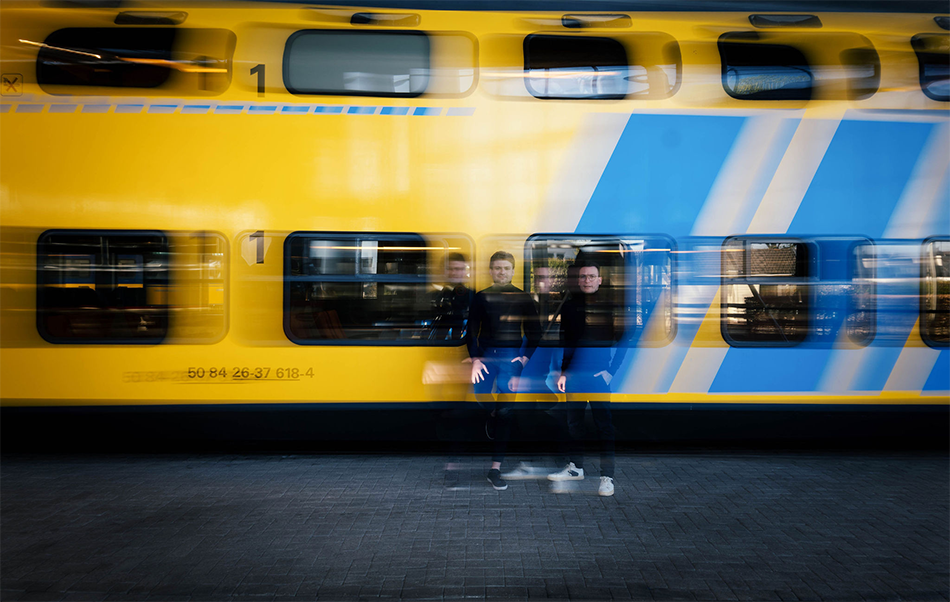
The origin of Views from Dutch Trains began in early 2024 with a clear compositional focus: bringing together three works written by members of a single musical family: father Jo Sporck and his two sons, Antal and Misha. While Jo’s “Dubbelspel” (2015/2023) and Misha’s “DeSoLaTion” (2015) were already part of our chamber music repertoire, the trilogy remained incomplete until we collaborated with Antal Sporck in 2024 to write his brand-new work, “KeepGoing” (2023).
Working with Antal on “KeepGoing” provided an exciting musical spark. His driving momentum and interlocking rhythmic cells seamlessly complemented the contrapuntal craftsmanship of his father Jo and the introspective colors of his brother Misha. Experiencing these two distinct generations of Dutch compositional voices side-by-side inspired a broader vision: what if we built a full album project centered around Dutch new- and post-minimalist music for two marimbas?
The logical centerpiece for this concept was Jacob ter Veldhuis’s (JacobTV) iconic 1992 work, “ViewsfromaDutchtrain,”which appeared on our iTunes playlist during a listening session. Originally composed for two accordions and later adapted for two pianos, we set out to create a fresh arrangement for two marimbas that emphasized the work’s ambient richness, rhythmic groove, and acoustic depth.
From there, the concept grew naturally. We expanded the project by commissioning brand-new pieces from Jannum Kruidhof, “Opdeuitkijk”(“On the lookout”), Anastas Paev, “Koploper,” and our own arrangement of Anthony Fiumara’s “JaggedNoir.” What started as a focused collaboration with the Sporck family evolved into a comprehensive, one-hour recording project featuring seven living Dutch composers with new music for marimba duo.
THEMATIC FRAMEWORK: RHYTHMS, TRAVELING, TRANSIT, AND SUSTAINABILITY
The thematic spine of Views from Dutch Trains originated from “ViewsfromaDutchtrain” by Jacob ter Veldhuis. Traveling across the Netherlands by railways offers an evocative sensory journey: continuous flat horizons, sudden geometric cuts of urban architecture, shifting cloudscapes, and the persistent, hypnotic rhythm of steel wheels gliding over tracks.
For Mallet Collective (Ramon Lormans and Georgi Tsenov), train travel is not merely a visual metaphor; it reflects our commitment to sustainability and environmental consciousness. The album transforms the physical experience of transit into a musical voyage, exploring themes of ecological awareness, unexpected human encounters, and the steady forward pulse of modern life.
To build a full-length, one-hour recital program around this concept, we commissioned and curated seven distinct works by two generations of living Dutch composers:
1. Antal Sporck, “KeepGoing” (2023): “Keep Going” for two bass marimbas was written for the Mallet Collective Duo. This virtuoso tour-de-force is primarily a cheerful toccata in which both players make circular movements around a repeating central E. The quieter B section is reminiscent of minimal music. Gamelan provides the inspiration for a dance-like pas-de-deux that culminates in a climax with four layers of music stacked on top of each other. In the coda, the repeating E from the toccata is replaced by a repeating B. The ending is somewhat disturbing in character. The title is taken from text in Luciano Berio’s “Sinfonia”; Berio, in turn, borrowed these words from Samuel Beckett’s novel The Unnamable.
2. Jacob ter Veldhuis, “Views from a Dutch train” (1992/2025): When traveling by train through the Netherlands, this small and densely populated country, you discover that every square meter is in use: rectangular pieces of land divided by straight ditches, canals, and dikes, long rows of trees and narrow strips of greenery, interspersed with concrete residential areas and industrial estates, cities, and villages. Repetition and variation pass by like the Dutch landscape from the train. The duo describes the panorama of the streamlined Dutch landscape on either side of the train. Jacob gave the Mallet Collective permission to release this version on their album and to play it during their concerts. This work has been arranged for two marimbas by Mallet Collective with the composer’s approval.
3. Jannum Kruidhof, “Opdeuitkijk” (2025): According to the composer, “During a train journey, you absorb all kinds of impressions. You gaze outside at the passing world or observe the subtle moments happening inside the carriage. At other times, it becomes a space for quiet introspection and daydreaming.”
4. Jo Sporck, “Dubbelspel” (2015/2023): According to the composer: “I am a real train traveler and find a strong connection between the motoric movement of this means of transport and the rhythmic patterns it creates and the character of the marimba. Although it is an instrument that is called idiophone, it is still primarily a percussion instrument that is based on movement and progress.”
5. Anastas Paev, “Koploper” (2025): Inspired by the iconic Dutch intercity train and Bach’s “Chaconne,” “Koploper” weaves virtuosity, rhythmic momentum, and architectural layering into a powerful musical portrait. The piece connects the motor skills and speed of the train with Bach’s monumental structure and art of variation, creating a flow of energy that is technically challenging and compelling.
6. Anthony Fiumara, “JaggedNoir” (2017/2025): Anthony Fiumara says he was particularly inspired by the simultaneity in Terry Riley’s “Rainbow in Curved Air.” There is no clear melody with accompaniment; on the contrary, the various voices sound more like they are playing alongside each other, alternating in various constellations. In ‘Jagged Noir,’ Fiumara immediately introduces a melodic pattern, which is gradually expanded throughout the piece, becoming increasingly colorful and creating a contemplative effect through endless repetition. It is an intense and overwhelming piece, for which Anthony gave permission to play and record Mallet Collective’s arrangement.
7. Misha Sporck, “DeSoLaTion” (2015): As you listen, you discover that the ascending second “So La Ti” plays an important role in this work. This piece explores the profound emotions and melancholy associated with being alone when you take the last train of the day. With an introspective and contemplative tone, “Desolation” captures the loneliness and abandonment that can arise during long journeys through silent landscapes. The music reflects the inner journey of the traveler, transforming the silence and rhythm of the train into a musical story that radiates both fragility and strength.
THE RECORDING EXPERIENCE: CAPTURING ACOUSTIC WARMTH
Recording two marimbas was a deeply rewarding creative milestone for us. To capture the full warmth, resonance, and rhythmic punch of Views from Dutch Trains, we chose the Kunstkerk in Dordrecht — a breathtaking, intimate space with a rich acoustic decay that allowed our wooden bars to bloom naturally without losing clarity in fast passages.
What made this recording experience truly special was its hands-on, self-produced nature. Georgi and I handled the entire recording and editing process ourselves, taking full artistic and technical control of the production from behind the microphones. Working alongside mixing and mastering engineer Emil van Steenwijk (Studio Charlatan), we transformed the Kunstkerk into our personal acoustic laboratory.
Capturing these new Dutch works in such a renewed but historical, resonant space completely in-house brought an incredible sense of intimacy and ownership to the final album, which is available on all streaming platforms.
PREVIEWING AT PASIC
Bringing Views from Dutch Trains to PASIC 2026 marks an exciting chapter for Mallet Collective. Our presentation will be the performance of the full album for marimba duo.
Our ultimate goal is to inspire fellow percussionists, students, and educators to actively engage with contemporary composers, expand the marimba duo canon, and view ensemble playing not just as a technical exercise, but as a deep, non-verbal dialogue that connects music to the world around us.
Mallet Collective is an innovative mallet percussion collective seeking to connect with contemporary societal and cultural themes. The collective stands for communication, fluid interplay, and sincerity, which have become an integral part of their performances, but also of who they are as individuals. The group believes in the purity of the collective that exchanges and inspires. Strongly believing in these ideas, they share the essence and energy of making music together with the audience — a collective experience. Georgi Tsenov is Professor in Music Theory at Codarts Conservatory Rotterdam. Ramon Lormans is Professor of Percussion at Codarts Conservatory of Rotterdam.