
Becoming a Well-Rounded Musician Can Lead to More Opportunities
Becoming a Well-Rounded Musician Can Lead to More Opportunities
A conversation with Jim Riley
by Colleen Clark
Percussive Notes
Volume 64
No. 5
October
2026
Jim Riley, drummer and musical director for Rascal Flatts, reflects on his 26-year career with the band and his deep connection to PAS and PASIC. Starting as a music education student and drum line member at the University of North Texas, Jim joined PAS in college and attended his first PASIC in 1987. After moving to Nashville in 1997, he quickly landed major gigs and joined Rascal Flatts in 2000, becoming their musical director in 2001. Beyond performing, Jim is passionate about education, running his own drum studio and teaching at Belmont University. He emphasizes the importance of being a well-rounded musician, understanding leadership, and applying music theory like the Nashville Number System. His upcoming PASIC clinic will focus on arranging, groove construction, tone selection, recording techniques, and creating effective drum parts, sharing both practical tips and insights from his extensive experience.
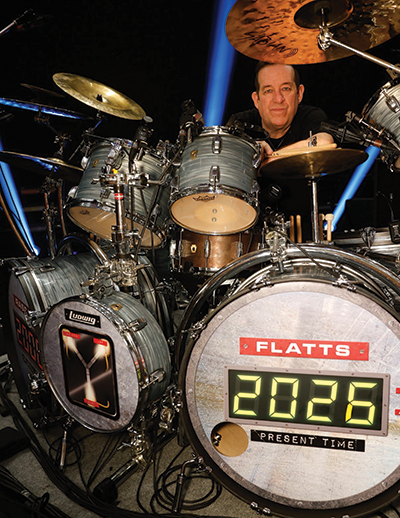
Drummer and musical director Jim Riley chatted with Percussive Notes from a Rascal Flatts tour bus. In his 26th year with the band, Riley works as the drummer and the musical director. He chatted about his PASIC clinic, why he loves PAS, and about what skills were most important in his early working life in Nashville.
Colleen Clark: What is your background as a drummer and with PAS?
Jim Riley: I first joined PAS when I was a student at North Texas State [now the University of North Texas], where I was a member of the drum line and I was a music education major. The first PASIC I went to was in 1987 in St. Louis and it was a great experience. I got my degree in music education and ended up teaching for a year, and I started pursuing my career as a performer.
I moved to Nashville in 1997. I was fortunate to land some pretty big jobs early on. I started playing with Rascal Flatts in 2000, and I’ve been their musical director since 2001. One of the really great things about being in this position and being a successful player is it’s afforded me the opportunity to get back to my educational endeavors. I believe this will be my fourth time presenting at PASIC. If you like drum clinics, if you like seeing all the latest gear, PASIC has become the best drum festival in North America, along with this opportunity to learn more about percussion. You’ll see the most amazing drum clinics, but there’s probably 50 great events you could be going to over the weekend — everything from someone talking about playing cymbals to a percussion ensemble from Japan to the greatest drumset players in the world. The best thing about it is getting to see some of your fellow friends, drummers, musicians, educators. I don’t go to my college reunion; I just go to PASIC and see all my friends in the percussion business.
I have my own percussion studio, that I call the drum dojo. I’ve done a variety of things from teaching sixth grade beginner classes to doing private lessons. I record songs there, which we’ll get into when we start talking about my presentation at PASIC. Most recently I’ve gotten into doing continuing education drum dojo weekend classes. Players from all over the world spend the weekend with me. There’ll be six players, and everyone will be behind a drumset all weekend. Since 2020 I’ve been teaching at Belmont University. I do a variety of things there from teaching drumset to teaching career professional development classes. It’s been a real blast to talk to young people about trying to make a living with the skill set you’ve been working on in college. You think, “I’ve learned how to do all this stuff; how do I monetize this?” If we want to have a career in music, we’ve got to learn how to monetize it. We have to realize how to properly value all of these talents and resources that we’ve built up so that we can do this for a living.
Clark: What is a skill that you had to learn or sharpen during your professional career?
Riley: I’ve had to learn a certain style of leadership. Being from the Northeast, I can be a little bit aggressive and abrasive. That’s just how we talk. But, you talk to people from the south and they’re like, “Whoa, dude. Settle down.” One of the biggest things for me was learning to properly value other people’s input and opinions and to consider the fact that I might not always be right or have the best solution. I have to give opportunities for other people’s ideas to come to pass. Even if it’s a bad idea, give it a chance and let them see that it’s not the best idea, and then we can all go forward. For me, that was really valuable. But there’s a lot to being a musical director — so much more than the drumming part. Since we’re talking specifically to drummers and percussionists, the more well-rounded of a musician you are, the better you’re going to be able to contribute to the conversations musically.
One of the things that you and I have in common going to North Texas is having taken two years of music theory and sight-singing. I think a lot of times when people are in those classes, they’re going, “I’m never going to use any of this stuff.” The truth is, I’ve used music theory so much in my career. There’s a system that we use in Nashville called the Nashville Number System, and it’s very much based on the concepts of Roman Numeral analysis and figured bass. If you understand that, it’s a very small leap to go to the Nashville Number System. I think the educational circles would do themselves a great favor to say, “If you learn how to harmonically analyze Mendelssohn, I’ll show you how you can use this to make really great and effective charts for your band.” But they don’t.
We played a gig on Friday, and two guys who were in one of my classes were playing with the opening act. It was super cool because they were loving being on a gig on the same level that I was. And then for me to see those guys doing their thing and applying some of the concepts we talked about at school was really great.
Clark: What should we expect to see at your PASIC clinic?
Riley: What I’m going to do in 50 minutes is, I’m going to go from listening to the song, to charting it out using the Nashville Number System, which I will explain. So I’m going to chart out the song in front of everybody. Then I’m going to talk about the ideas of orchestration. What do I mean by that? Where my right hand is going to be — on the hi-hat or the ride cymbal or the open hi-hat? Or am I going to be putting it on a floor tom?
I’m going to talk about groove construction, which is a fancy way of saying what are the rhythms I should be playing to match up to this song? Then I’ll talk about some fill formula ideas I have, which I think is a pretty unique approach to it, but basically keeping things where you’ve got simple, solid fills. Don’t be afraid to play simple, solid ideas. People don’t expect you to reinvent the wheel every time you’re playing a fill. In some cases, it’s very utilitarian. You are the pilot. They just want you to land the darn plane. They don’t want you to do any loop-de-loops when you’re landing it. I’m going to go through some of those concepts.
I’m going to go through the idea of tones I’m using. Quickly choosing a snare from a couple of different snares. Whether I want to have a really aggressive sounding snare or a real low ballad-y snare. Too many people think their snare sound is their identity, and it’s not. It’s one of many different sounds you could get. You essentially bring your sound to whatever instrument you’re playing. It’s not like that’s the snare sound I use. Whether you’re playing the cheapest entry level drumset or the most expensive drumset, you bring your sound with you.
At that point, people are going to watch me record this song. I’ll probably do something I don’t like or make a mistake, and I’m going to point that out, and I’m going to say, “Okay, this is what you do when this happens.” For example, if I’m going into the chorus, I have to play the same thing before I punch in. So if I hit my left crash, I have to hit my left crash before I’m going in, so when you fade those two sections together, they line up. So whatever mistakes or inconsistency I make will be a teaching moment.
Then I’ll talk a little bit about the EQs that I’m doing, and then I’m going to wrap it up. It should be a really interesting presentation. When I was a kid, they would say, “Take an old tape recorder and record yourself and listen back.” I’ll be doing it with 16 tracks, but you could probably do it with two tracks. For learning about your tone quality on the drums, your consistency, your balance on the drums, you can learn a lot from just one microphone. To be able to record is just another skill set you can have. If you can record, that’s another skill set you can use to make a living playing drums.
A lot of people understand how to play the drums. They understand how to listen to someone else’s performance and copy them. Emulation is a really good way to learn. But in my experience as an educator, a lot of people do not understand how to create a part. That’s what I’m going to be talking about in addition to the recording process. It’s going to be about looking at the song from an eagle’s-eye point of view where you can look at the whole thing and say, “What am I doing in the intro? What am I doing in the verse? What am I doing in the chorus?” One of the things that’s been extremely interesting for me teaching at Belmont is that it’s forced me to answer the question “why?” Not just what I do, but why I do it. So that’s some of what I’ll be sharing at my clinic, and I’m very excited to do that.